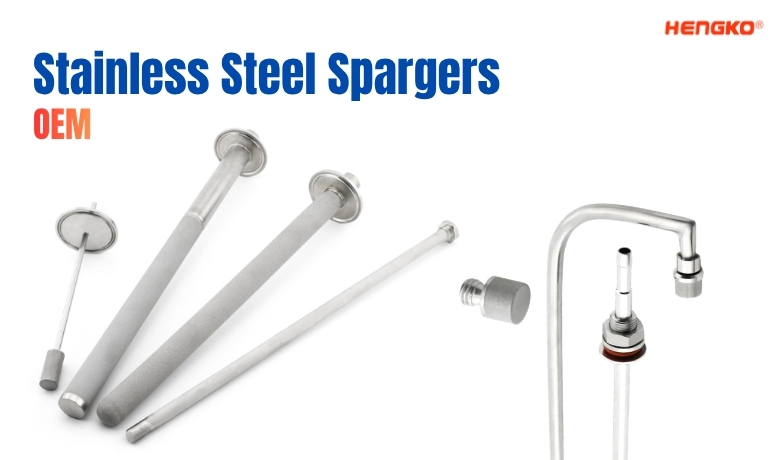
Stainless Steel Spargers for Efficient Gas Dispersion and Process Aeration
A stainless steel sparger is a porous metal gas diffuser used to distribute gases such as air, oxygen, nitrogen, carbon dioxide, or steam
into liquids or process media in a controlled and uniform manner. By generating fine and consistent bubbles, stainless steel spargers help
improve gas-liquid contact, oxygen transfer efficiency, mixing performance, and overall process stability.
HENGKO supplies high-performance 316L stainless steel spargers for applications in bioreactors, fermenters, cell culture vessels,
laboratory reactors, pilot systems, pharmaceutical processing, food & beverage production, and chemical mixing systems.
Our porous metal spargers are engineered for clean gas diffusion, excellent mechanical strength, corrosion resistance, and
repeatable performance under demanding operating conditions.
We offer a wide range of sparger configurations, including:
*Bioreactor sparger tubes
*Porous metal sparger tips
*L-shaped and bent sparger assemblies
*Sintered diffuser discs and plates
*Custom OEM stainless steel spargers
All spargers can be customized based on your required pore size, outer diameter, insertion length, fitting type,
and application environment.
Talk to our OEM team for custom stainless steel sparger solutions.

-
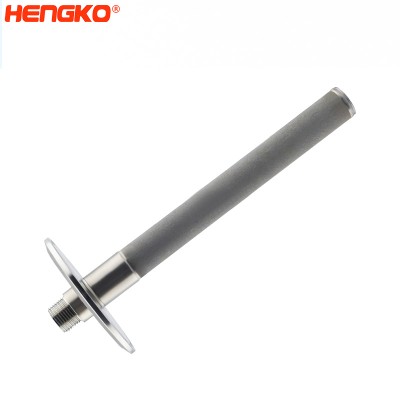
Sanitary 316L Stainless Home Brew 1.5″ Tri-Clamp Air Sparger 2µm Carbonation Diffusion ...
HENGKO sintered spargers introduce gases into liquids through thousands of tiny pores, creating bubbles far smaller and more numerous than with drilled pipe ...
View Detail -
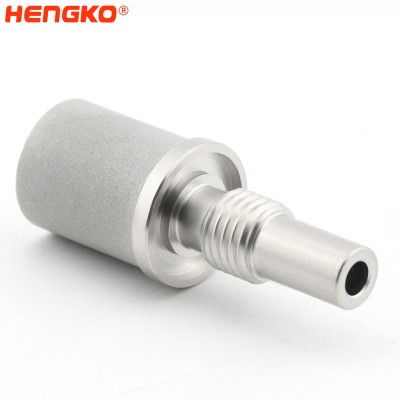
big batches hydrogen permeation micro bubble ozone sparger diffuser for diy home brewin...
1. Better Than Shaking a Keg! 2. Are you tired of carbonating your beer the unpredictable way? You crank up the PSI in the keg, shake, and wait with ...
View Detail -
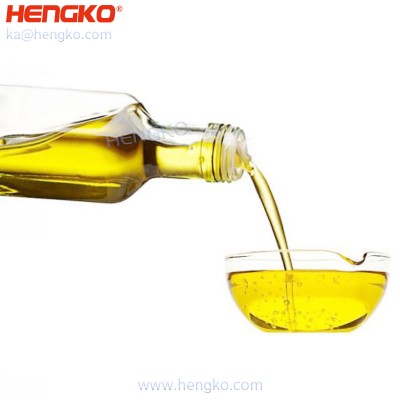
Porous metal process filters, micro spargers for hydrogenated oil manufacturing
Product Description Sintered air stone diffusers are often used for porous gas injecting. They have different pore sizes(0.5um to 100um) allowing small bub...
View Detail
What Is a Stainless Steel Sparger?
A stainless steel sparger is a gas dispersion component used to introduce gas into liquids in the form of fine, uniform bubbles. It is commonly installed inside bioreactors, fermenters, process vessels, and mixing tanks to improve gas-liquid contact, oxygen transfer, mixing efficiency, and process consistency.
Most stainless steel spargers are made from 316L porous sintered stainless steel, allowing gas to pass through a controlled pore structure while maintaining excellent mechanical strength, corrosion resistance, temperature resistance, and cleanability.
Compared with conventional drilled tubes or plastic diffusers, a porous metal sparger can provide:
-More uniform gas distribution
-Better oxygen or gas transfer efficiency
-Longer service life in demanding environments
-Stronger compatibility with sterilization and CIP/SIP processes
Because of these advantages, stainless steel spargers are widely used in biopharma, fermentation, laboratory research, food processing, chemical mixing, and gas-liquid reaction systems.
6-Types of Stainless Steel Spargers
Stainless steel spargers can be designed in different forms depending on the tank structure, gas flow pattern, cleaning requirements, and process goals.
1. Sparger Tube
A sparger tube is one of the most common designs. It is usually installed vertically or horizontally in a vessel to deliver gas evenly into the liquid phase.
Best for:
*Bioreactors
*Fermentation tanks
*Laboratory vessels
*Pilot systems
2. L-Shaped Sparger
This design features a bent tube structure, making it easier to install through vessel ports or adapt to compact equipment layouts.
Best for:
*Small fermenters
*Lab bioreactors
*Custom vessel designs
*Systems with limited insertion space
3. Porous Sparger Tip
A porous sintered metal tip is attached to the end of a tube, concentrating gas diffusion at a specific point inside the vessel.
Best for:
*Localized gas injection
*Laboratory systems
*Compact reactor designs
*Retrofit applications
4. Disc Sparger / Diffuser Plate
This type uses a flat porous metal disc or plate to create broad and even gas distribution across the bottom of a vessel.
Best for:
*Shallow tanks
*Cell culture systems
*Aeration systems
*Gas-liquid mixing vessels
5. Multi-Arm Sparger Assembly
A multi-arm sparger is designed for larger tanks or applications requiring broader gas coverage and more uniform aeration.
Best for:
*Large bioreactors
*Industrial fermenters
*Scale-up production systems
*High-volume gas transfer applications
6. Custom OEM Sparger
Many industrial and bioprocess applications require custom spargers designed to match vessel geometry, flow rate, pressure, gas type, and sterility requirements.
Customizable features include:
*Tube length
*Outer diameter
*Pore size
*Connection type
*Number of gas outlets
*Diffusion area
*Surface finish
*Material grade
8-Applications of Stainless Steel Spargers You Should Know
Stainless steel spargers are used wherever gas needs to be introduced into liquid efficiently and reliably.
Common Applications Include:
1.Bioreactors
Used for oxygen or air delivery in microbial fermentation and cell culture systems.
2.Fermenters
Provides aeration for yeast, bacteria, fungi, and other biological processes.
3.Cell Culture Systems
Helps maintain dissolved oxygen and gas balance in sensitive upstream bioprocessing.
4.Pharmaceutical Production
Suitable for clean, sterile, and corrosion-resistant gas dispersion requirements.
5.Food & Beverage Processing
Used in carbonation, oxygenation, degassing, and process aeration systems.
6.Chemical Processing
Supports gas-liquid reactions, oxidation, stripping, and mixing operations.
7.Water and Wastewater Treatment
Can be used for aeration and gas diffusion in treatment processes.
8.Laboratory and Pilot Systems
Ideal for R&D, scale-up studies, and controlled process development.
Why Use Porous Metal Spargers Instead of Plastic or Ceramic?
Choosing the right sparger material can directly affect bubble quality, process stability, durability, and maintenance cost. Compared with plastic or ceramic spargers, porous metal spargers offer significant performance advantages in demanding industrial and bioprocess applications.
1. Higher Mechanical Strength
Porous stainless steel spargers are much stronger than ceramic or plastic alternatives. They are less likely to crack, deform, or fail under pressure, vibration, or repeated handling.
Why it matters: This is especially important in bioreactors, fermentation tanks, pressurized systems, and industrial process lines.
2. Better Corrosion and Temperature Resistance
316L stainless steel performs well in a wide range of chemical and cleaning environments, and it can withstand higher temperatures than most plastics.
Why it matters: This makes stainless steel spargers more suitable for:
*CIP cleaning
*SIP sterilization
*Steam exposure
*Solvent contact
*Harsh process media
3. Longer Service Life
Plastic spargers may age, deform, or become chemically incompatible over time. Ceramic spargers can become fragile or crack during installation or thermal cycling. Porous metal spargers generally offer longer operational life and better reliability.
Why it matters: Longer life means:
*Less replacement frequency
*Lower downtime
*Lower maintenance cost
4. More Stable Bubble Distribution
A well-manufactured sintered stainless steel sparger can provide a more controlled pore structure, leading to consistent gas diffusion and more predictable process performance.
Why it matters: Stable bubbles help improve:
*Oxygen transfer
*Gas utilization
*Mixing uniformity
*Fermentation reproducibility
5. Easier Integration into OEM Equipment
Stainless steel spargers are easier to machine, weld, thread, assemble, and customize than ceramic components.
Why it matters: This makes them better suited for:
*Custom reactor systems
*Sanitary assemblies
*OEM process equipment
*Industrial retrofits
Customization Options
At HENGKO, stainless steel spargers can be customized to match your process system, installation method, and gas dispersion requirements.
Available Customization Options Include:
1. Material
*316L stainless steel
*304 stainless steel
*Special alloys for corrosive environments (on request)
2. Pore Size
Common pore sizes include:
- *0.5 μm
*1 μm
*2 μm
*5 μm
*10 μm
*20 μm
*50 μm
*100 μm
3. Tube Length and Diameter
Custom tube length and OD can be designed based on vessel depth and port configuration.
4. Sparger Head Shape
*Cylindrical tip
*Disc type
*Tube type
*L-type assembly
*Multi-point diffuser design
5. Connection Type
*Threaded connection
*Compression fitting
*Tri-clamp
*Welded assembly
*Customized sanitary fittings
6. Surface Finish
Surface treatment and finish can be adapted for cleaner process requirements or sanitary applications.
7. OEM Structure Design
We support custom development based on:
*Tank drawing
*Bioreactor port size
*Gas type
*Flow rate
*Operating pressure
*Sterilization method
*Target bubble performance
Need a custom stainless steel sparger for your system? Contact our OEM team for engineering support.
FAQ About Stainless Steel Spargers
1. What is a stainless steel sparger used for?
A stainless steel sparger is used to introduce gas into a liquid in the form of fine bubbles. Its main purpose is to improve gas-liquid contact so the gas can dissolve, react, or distribute more efficiently in the process.
Typical uses include:
*Aeration in fermentation tanks
*Oxygen supply in bioreactors
*CO₂ diffusion in liquid systems
*Gas stripping or degassing
*Chemical gas-liquid reactions
In simple terms, a sparger helps transfer gas into liquid more effectively and uniformly.
2. What does a sparger do in a bioreactor?
In a bioreactor, a sparger is responsible for delivering gas—usually air or oxygen—into the culture medium. This is essential because microorganisms or cells need dissolved oxygen or controlled gas conditions to grow properly.
A sparger in a bioreactor helps:
*Maintain dissolved oxygen levels
*Improve oxygen transfer efficiency
*Distribute gas evenly in the vessel
*Support healthy cell or microbial growth
*Improve fermentation consistency
Without an effective sparger, oxygen transfer may become insufficient, which can reduce productivity and affect process stability.
3. Why use stainless steel sparger instead of ceramic sparger?
A stainless steel sparger is often preferred over a ceramic sparger because it is generally stronger, more durable, easier to integrate, and better suited for industrial cleaning and sterilization.
Stainless steel sparger advantages over ceramic:
*Better mechanical strength
*Less fragile during handling or installation
*Better resistance to pressure and vibration
*Easier to weld or connect into equipment
*More suitable for CIP/SIP and repeated industrial use
Ceramic spargers can work well in some applications, but in industrial and bioprocess systems, stainless steel is usually the more robust and long-term solution.
4. What pore size is best for a sparger?
The best pore size for a sparger depends on your gas type, liquid properties, flow rate, pressure, and process objective.
General guideline:
*Smaller pore sizes → smaller bubbles, better gas transfer, but higher back pressure
*Larger pore sizes → lower pressure drop, larger bubbles, easier gas flow
Common recommendations:
*0.5–2 μm: very fine diffusion, sterile or high-efficiency applications
*5–10 μm: common for bioreactor and fermentation gas diffusion
*20–100 μm: larger bubble aeration or lower-pressure systems
In many bioprocess and fermentation applications, 5 μm to 20 μm is often a practical starting range.
The ideal pore size should always be selected based on your actual process conditions.
5. How do you clean a stainless steel sparger?
A stainless steel sparger can typically be cleaned using backflushing, solvent cleaning, ultrasonic cleaning, or CIP/SIP procedures, depending on the contamination type and application.
Common cleaning methods include:
*Flushing with clean water or solvent
*Reverse-flow cleaning (backflush)
*Ultrasonic bath cleaning
*Chemical cleaning for organic or salt buildup
*Steam sterilization if compatible with the process
Important note:
Cleaning method should match the fouling type:
*Protein or biological residue
*Salt or mineral deposits
*Oil or organic contamination
*Process particulates
Regular cleaning helps maintain pore openness, bubble consistency, and long-term sparger performance.
6. Can stainless steel spargers be customized?
Yes. Stainless steel spargers are commonly customized to fit different vessel designs, gas flow requirements, and process environments.
Common customization items include:
*Tube length
*Outer diameter
*Pore size
*Connection fitting
*Head shape
*Number of diffusion points
*Surface finish
*Material grade
For OEM and industrial systems, custom spargers are often necessary to ensure proper fit, cleanability, and gas transfer performance.
7. What gas can be used with a porous metal sparger?
A porous metal sparger can be used with many different gases, depending on the application and material compatibility.
Common gases include:
*Air
*Oxygen (O₂)
*Nitrogen (N₂)
*Carbon dioxide (CO₂)
*Hydrogen (H₂)
*Steam
*Inert gases
*Process specialty gases
The correct sparger design should be selected based on gas purity, pressure, safety, and chemical compatibility.
8. What is the difference between a sparger and a diffuser?
A sparger and a diffuser are closely related, and in many industrial cases the terms are used interchangeably. However, there is a slight practical difference.
Generally:
- *A sparger usually refers to a component specifically designed to inject gas into liquid
- *A diffuser is a broader term for any component that spreads or disperses gas or fluid
In process systems:
- *A sparger is often part of a reactor, fermenter, or vessel
- *A diffuser may also be used in aeration, gas treatment, or general dispersion systems
So, most spargers are diffusers, but not all diffusers are necessarily spargers.
9. What is the purpose of a sparger?
The main purpose of a sparger is to disperse gas into a liquid as efficiently and uniformly as possible.
This helps improve:
*Gas dissolution
*Oxygen transfer
*Reaction efficiency
*Mixing uniformity
*Process control
In many systems, the sparger plays a direct role in overall process performance. A well-designed sparger can help improve product consistency, biological growth conditions, and gas utilization efficiency.
The purpose of a sparger is to maximize gas-liquid contact and improve process performance.
Looking for a custom stainless steel sparger for your bioreactor, fermenter, or gas diffusion system?
HENGKO offers OEM porous metal sparger solutions tailored by pore size, structure, and connection type.
Contact our team today for technical support and quotation.
Send your message to us:


