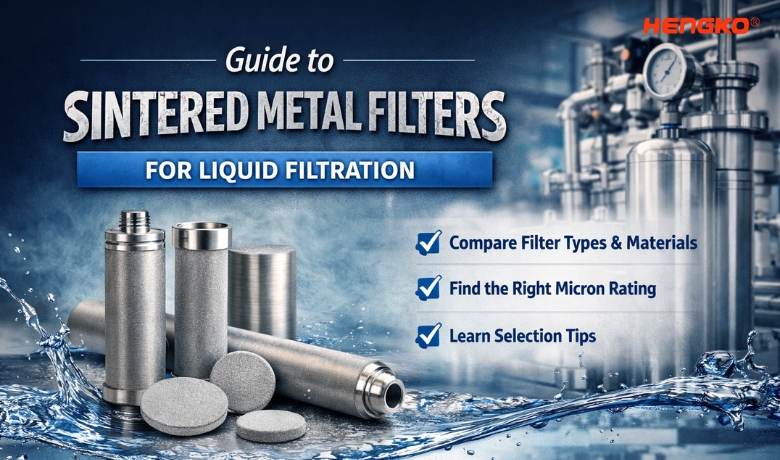
Introduction: Why Sintered Metal Filters
Are Critical in Liquid Filtration
Liquid filtration is one of the most demanding tasks in industrial separation. Compared with air or gas,
liquids typically carry higher particle loads, variable viscosities, aggressive chemicals, and
stricter cleanliness requirements. In this context, the sintered metal filter has become a preferred
solution across many high-reliability industries.
What Is a Sintered Metal Filter?
A sintered metal filter is produced by compacting and sintering metal powders—such as stainless steel
or titanium—into a rigid, porous structure. The controlled sintering process creates uniform, interconnected pores
that deliver consistent filtration performance while maintaining high mechanical strength.
This design allows sintered metal filters to withstand high pressure, elevated temperatures, and aggressive liquids,
while remaining cleanable and reusable over long service cycles.
Why Liquid Filtration Is More Demanding Than Gas Filtration
Compared with gases, liquids generate higher differential pressure, require more precise particle retention,
and pose greater risks of chemical corrosion. Disposable or polymer filters often struggle in these conditions,
whereas a sintered metal filter for liquid filtration maintains pore stability, structural integrity, and long-term reliability.
Industries Using Sintered Metal Filters for Liquid Filtration
Sintered metal filters are widely used in:
-Chemical processing for corrosive and high-temperature liquids
-Pharmaceuticals for high-purity and cleanable filtration systems
-Food & beverage applications requiring hygienic filtration
-Water treatment and industrial process water
-Oil & gas for fuels, lubricants, and production fluids
-Semiconductor wet processes demanding ultra-clean liquid filtration
Because of their durability, reusability, and stable performance, sintered metal filters play a critical role in ensuring safe,
efficient, and cost-effective liquid filtration across these industries.
What Makes a “Top-Rated” Sintered Metal Filter?
Actually, Not all sintered metal filters deliver the same performance.
A top-rated sintered metal filter stands out because it combines reliable filtration, material compatibility,
mechanical durability, and consistent manufacturing quality. The criteria below explain why certain products
perform better in demanding liquid filtration applications.
2.1 Filtration Performance
*Absolute vs. nominal micron rating:
Absolute-rated filters provide predictable particle retention, critical for precision liquid systems.
*Particle retention efficiency:
High-quality filters maintain stable efficiency over time without pore collapse or bypass.
*Flow rate vs. pressure drop:
Optimized pore structure balances sufficient flow with acceptable pressure loss—especially important for viscous liquids.
2.2 Material Options & Corrosion Resistance
*316L stainless steel:
The most common choice, offering excellent corrosion resistance and mechanical strength for industrial liquids.
*Titanium:
Preferred for highly corrosive media and high-purity applications due to superior chemical stability.
*Inconel / Hastelloy (specialty alloys):
Used in extreme environments with high temperature or aggressive chemicals.
*Chemical compatibility:
A top-rated filter must match the liquid’s pH, temperature, and chemical composition to avoid degradation or contamination.
2.3 Mechanical Strength & Service Lifetime
*High differential pressure resistance:
Essential for liquid filtration where pressure loads are significantly higher than gas systems.
*Cleanability:
Effective backwashing, chemical cleaning, or ultrasonic cleaning extends service life.
*Reusability:
Unlike disposable filters, sintered metal filters are designed for repeated use, lowering total cost of ownership.
2.4 Manufacturing Quality
*Metal powder quality:
Consistent particle size and purity are the foundation of reliable filtration performance.
*Sintering process control:
Precise temperature and time control ensure strong particle bonding without pore blockage.
*Pore structure uniformity:
Uniform, interconnected pores deliver stable filtration efficiency and repeatable results.
By evaluating sintered metal filters against these criteria, buyers can identify top-rated products that offer
dependable performance, long service life, and superior value in liquid filtration systems—rather than relying on brand names alone.
5- Top-Rated Sintered Metal Filter Products for Liquid Filtration
Different liquid filtration applications require different sintered metal filter designs. Below are the most widely used and top-rated sintered metal filter product types, selected based on performance, reliability, and application suitability—rather than brand names.
3.1 Sintered Stainless Steel Filter Cartridges (Most Popular)
Best for: General industrial liquid filtration
Key features
*Micron range: 0.5–100 μm
*Good chemical and temperature resistance
Typical applications
*Chemical liquids
*Hydraulic oils
*Process water
*Industrial solvents
Why top-rated
*Long service life
*Washable and reusable
*Stable filtration efficiency
3.2 Sintered Metal Disc Filters (High Precision Filtration)
Best for: Inline and compact systems
Key features
*Flat disc structure
*Uniform pore distribution
*Low internal volume
Typical applications
*HPLC sample filtration
*Fine chemical dosing
*Precision liquid control
Why top-rated
*Consistent particle retention
*Easy integration into small housings
3.3 Sintered Metal Tube Filters (High Flow & High Pressure)
Best for: High-flow liquid systems
Key features
*Tubular design
*High dirt-holding capacity
*Strong mechanical structure
Typical applications
*Water treatment
*Petrochemical liquids
*Slurry filtration
Why top-rated
*Handles high differential pressure
*Suitable for continuous operation
3.4 Sintered Titanium Filters (Corrosive & High-Purity Liquids)
Best for: Harsh and high-purity environments
Key features
*Excellent corrosion resistance
*Biocompatible material
*Long operating life
Typical applications
*Pharmaceutical liquids
*Strong acids and alkalis
*Seawater filtration
Why top-rated
*Superior chemical stability
*No metal ion contamination
3.5 Custom OEM Sintered Metal Filters (Specialized Systems)
Best for: Equipment manufacturers (OEM)
Key features
*Custom pore size and shape
*Integrated into valves, pumps, or housings
*Designed for specific operating conditions
Typical applications
*OEM filtration modules
*Proprietary liquid handling systems
Why top-rated
*Optimized filtration performance
*Reduced system size and complexity
Comparison Table:
Top Sintered Metal Filter Types for Liquid Filtration
To help engineers and buyers quickly compare options, to find your right filter, here we make a table below summarizes
the most common sintered metal filter types for liquid filtration, based on material, filtration range,
pressure capability, and typical use cases.
| Filter Type | Material | Micron Range | Pressure Resistance | Best Application |
|---|---|---|---|---|
| Cartridge | 316L Stainless Steel | 0.5–100 μm | High | General industrial liquids |
| Disc | Stainless Steel / Titanium | 0.5–50 μm | Medium | Precision and compact systems |
| Tube | Stainless Steel / Titanium | 1–100 μm | Very High | High-flow liquid filtration |
| Titanium Filter | Titanium | 0.5–50 μm | High | Corrosive and high-purity liquids |
| OEM Custom | Multiple materials | Custom | Custom | Equipment and system integration |
This comparison makes it easier to match a sintered metal filter to specific liquid filtration requirements, balancing filtration accuracy,
operating pressure, and system design constraints.
3-Stepes Choosing the Right Sintered Metal Filter for Liquid Filtration
Selecting the right sintered metal filter for liquid filtration requires more than choosing a micron rating. Understanding your process conditions and maintenance strategy is essential to achieve stable performance and long service life.
Step-1) Define Your Liquid Properties
Start by analyzing the characteristics of the liquid being filtered:
*Viscosity:
Higher-viscosity liquids increase pressure drop and may require larger filter surface area or coarser pore sizes.
*Corrosiveness:
Acids, alkalis, or solvents may require titanium or specialty alloys instead of standard stainless steel.
*Operating temperature:
Elevated temperatures demand materials and sintered structures that maintain strength and pore stability.
Step-2) Determine Filtration Requirements
Next, define the technical filtration targets:
*Target particle size:
Choose an absolute or nominal micron rating based on contamination limits and downstream equipment sensitivity.
*Flow rate:
Ensure the filter can handle required throughput without excessive pressure loss.
*Pressure drop limits:
Balance filtration precision with acceptable differential pressure to avoid energy loss or system stress.
Actually these 3 requirement is the key point for the product choosing.
Step-3) Plan the Cleaning & Maintenance Strategy
One key advantage of sintered metal filters is reusability, but cleaning methods must match the application:
*Backflushing:
Effective for removing trapped particles in many industrial liquid systems.
*Chemical cleaning:
Used to dissolve oils, scale, or chemical residues without damaging the filter material.
*Ultrasonic cleaning:
Ideal for fine-pore filters where deep particle removal is required.
By carefully matching liquid properties, filtration targets, and maintenance methods, users can select a
sintered metal filter that delivers reliable liquid filtration performance with a low total cost of ownership.
4-Common Mistakes When Selecting Sintered Metal Filters for Liquids
Even experienced buyers can encounter performance issues if key factors are overlooked. Avoiding the mistakes below can
significantly improve the reliability and efficiency of a sintered metal filter for liquid filtration.
Mistake 1 : Choosing a Pore Size That Is Too Small
Selecting an overly fine micron rating often leads to excessive pressure drop, reduced flow rate, and higher energy consumption. In liquid filtration, it is critical to balance particle retention with system pressure limits rather than choosing the smallest pore size available.
Mistake 2 : Ignoring Chemical Compatibility
Not all sintered metal materials perform equally in aggressive liquids. Failing to match the filter material to the liquid’s pH, temperature, and chemical composition can cause corrosion, contamination, or premature filter failure.
Mistake 3 : Overlooking Cleaning Method Compatibility
Sintered metal filters are reusable, but only when the cleaning method matches the application. Incompatible chemical cleaners or improper backflushing can damage the pore structure or reduce filtration efficiency over time.
Mistake 4 : Using Gas-Designed Filters for Liquid Systems
Filters designed for gas service may not withstand the higher differential pressure and viscosity of liquids. Using a gas-oriented sintered metal filter in liquid filtration can result in poor performance or structural damage.
Avoiding these common mistakes helps ensure that a sintered metal filter delivers stable performance, long service life, and lower total operating costs in liquid filtration applications.
7. FAQs About Sintered Metal Filters for Liquid Filtration
What is the best micron rating for liquid filtration?
There is no single “best” micron rating. The ideal pore size depends on the target particle size, liquid viscosity,
and acceptable pressure drop. Common sintered metal filters for liquid filtration range from 0.5 to 100 μm,
with finer ratings used for precision or high-purity systems.
Are sintered metal filters reusable?
Yes. One of the main advantages of a sintered metal filter is reusability. These filters can be cleaned through
backflushing, chemical cleaning, or ultrasonic cleaning, allowing multiple service cycles and reducing
long-term operating costs.
How long do sintered metal filters last?
Service life depends on operating conditions, cleaning methods, and material selection.
In many industrial liquid filtration applications, sintered metal filters can last several years,
significantly longer than disposable filters.
Can sintered metal filters replace polymer filters?
In many cases, yes. Sintered metal filters offer higher temperature resistance, better chemical compatibility,
and longer service life than polymer filters. They are especially suitable for harsh or high-pressure liquid environments
where polymers may fail.
Are sintered metal filters food-grade?
Sintered metal filters made from 316L stainless steel or titanium can be food-grade when properly manufactured and cleaned.
They are commonly used in food and beverage processing where hygiene, cleanability, and material safety are required.
Conclusion:
Why Top-Rated Sintered Metal Filters Deliver Long-Term Value
Top-rated sintered metal filters are engineered to perform reliably in demanding liquid filtration environments where consistency,
durability, and process safety are critical. Their stable pore structures and high mechanical strength help ensure
long-term filtration efficiency, even under high pressure, high temperature, or corrosive conditions.
Compared with disposable filters, sintered metal filters deliver a lower total cost of ownership through extended service life and
repeatable cleaning. They also improve system reliability by reducing unplanned downtime and protecting downstream equipment.
As a reusable and sustainable filtration solution, they are well suited for modern industrial liquid filtration applications.
For specialized liquid filtration requirements, OEM sintered metal filter solutions can be tailored to your exact process conditions.
Contact HENGKO at ka@hengko.com
to discuss your application and technical requirements.
Post time: Jan-05-2026


