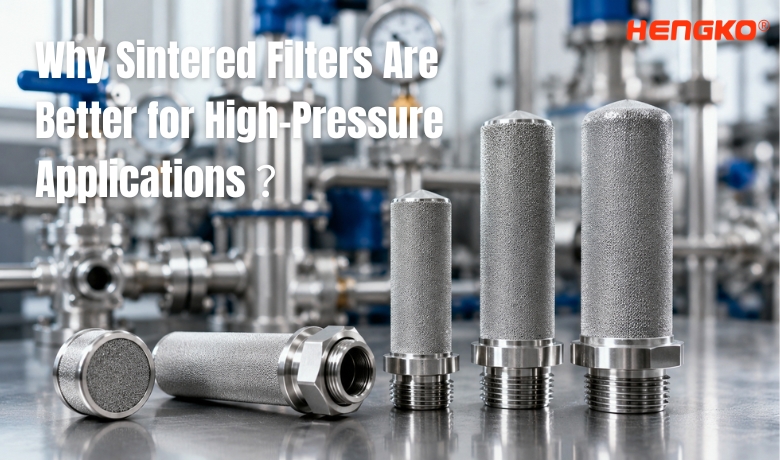
Sintered filters are better for high-pressure applications because they combine high mechanical strength, stable pore structure, precise filtration accuracy, and excellent resistance to temperature, corrosion, and pressure shock.
Unlike fiber, mesh, or polymer filter media that may deform, collapse, or release particles under high differential pressure, sintered metal filters are made from bonded metal particles, forming a rigid porous structure that can maintain reliable filtration performance even in demanding gas or liquid systems.
In short, sintered filters perform better under high pressure because they offer:
| Key Advantage | Why It Matters in High-Pressure Systems |
|---|---|
| High structural strength | Helps prevent media collapse or deformation under pressure |
| Stable pore size | Maintains consistent filtration accuracy during operation |
| Low particle shedding | Reduces contamination risk in critical systems |
| High temperature resistance | Suitable for steam, hot gas, and high-temperature process fluids |
| Corrosion resistance | Works well in aggressive gas, liquid, or chemical environments |
| Cleanable & reusable design |
Supports backflushing, ultrasonic cleaning, and longer service life |
For industries such as semiconductor manufacturing, petrochemical processing, hydrogen energy, pharmaceutical production, and high-pressure gas filtration, filter failure is not just a maintenance issue
— it can cause contamination, pressure drop instability, equipment damage, or production downtime.
That is why sintered porous metal filters are widely used where filtration reliability, mechanical durability, and long-term system stability are critical.
Summary: So, as our experience, If the application involves high pressure, high temperature, corrosive media, or strict contamination control, sintered metal filters are usually a more reliable choice than conventional filter media.
What Are Sintered Filters?
Sintered filters are porous filtration components manufactured by compressing and heat-bonding metal powders into a rigid, interconnected structure.
Unlike woven mesh or fiber-based filters, sintered filters form a fully bonded porous matrix with controlled and uniform pore distribution.
The result is a filter media that combines:
- High mechanical strength
- Precise micron filtration
- Stable airflow or liquid flow
- Excellent pressure resistance
- Long operational life
How Sintered Metal Filters Are Made
The manufacturing process typically includes:
Metal Powder Selection
Common materials include:
- 316L stainless steel
- Bronze
- Titanium
- Hastelloy
- Inconel
- Nickel alloys
1.Mold Pressing
Metal powders are compressed into a desired shape under controlled pressure.
2.High-Temperature Sintering
The pressed material is heated below its melting point, allowing metal particles to bond together metallurgically.
3.Post-Processing & Finishing
Including:
- CNC machining
- Welding
- Thread connections
- Surface treatment
- Cleaning & passivation
What Makes the Structure Different?
Unlike ordinary filters that rely mainly on surface capture, sintered filters use a three-dimensional porous network for both surface and depth filtration.
Key Structural Characteristics
| Structure Feature | Benefit |
|---|---|
| Uniform pore distribution | Stable filtration accuracy |
| Interconnected porosity | Smooth gas and liquid flow |
| Fully metallic structure | High pressure & temperature resistance |
| Rigid porous matrix | Reduced deformation under pressure |
| Controlled micron rating | Reliable particle retention |
Because the pore structure is formed during the sintering process itself, the filter media remains stable even under demanding operating conditions.
Typical Filtration Ratings
Sintered metal filters are commonly available in:
- 0.1 μm to 100+ μm filtration ratings
- High – flow porous structures
- Customized permeability designs
This makes them suitable for:
- Gas filtration
- Liquid filtration
- Sparging & diffusion
- Flow restriction
- Venting & breathers
- High – purity filtration systems
Why Material Selection Matters
Different industrial environments require different porous metal materials.
| Material | Typical Application |
|---|---|
| 316L Stainless Steel | General industrial & corrosive environments |
| Titanium | Strong acid or seawater applications |
| Hastelloy | Highly aggressive chemical processing |
| Bronze | Pneumatic silencers & lower-cost systems |
| Nickel Alloys | High-temperature or special gas systems |
For most high-pressure industrial filtration systems, 316L stainless steel sintered filters are the most widely used due to their balance of:
- Corrosion resistance
- Mechanical strength
- Weldability
- Cleanability
- Cost – effectiveness
Engineering Perspective
One of the biggest advantages of sintered porous metal technology is that the pore structure itself becomes part of the mechanical structure.
This means the filter media is not simply “held inside” a housing
— the porous material itself acts as a durable structural filtration element capable of withstanding
demanding industrial operating conditions.
Why High-Pressure Applications Require Specialized Filters
High-pressure filtration systems operate under conditions where ordinary filter media may fail mechanically, lose filtration accuracy, or create contamination risks.
In these environments, the filter is not only responsible for particle removal
— it must also withstand continuous pressure load, flow impact, thermal cycling, and aggressive
media exposure without structural failure.
Common Problems With Conventional Filters Under High Pressure
Traditional mesh, fiber, or polymer-based filters often experience performance issues when differential pressure increases.
Typical Failure Modes
| Problem | Result |
|---|---|
| Filter media deformation | Unstable filtration accuracy |
| Fiber rupture or shedding | Downstream contamination |
| Mesh collapse | Sudden pressure drop or system failure |
| Seal leakage | Loss of filtration integrity |
| Pore structure instability | Reduced filtration consistency |
| Frequent replacement | Higher maintenance costs |
In critical systems, these failures can lead to:
- Equipment damage
- Process contamination
- Product quality issues
- Production downtime
- Increased operational risk
Why Pressure Resistance Matters
As operating pressure increases, the filtration media experiences significantly higher mechanical stress.
High-pressure systems commonly involve:
- Rapid pressure fluctuations
- Pulsating flow
- High differential pressure
- Elevated temperatures
- Corrosive gases or liquids
Under these conditions, weak filter structures may:
- Crack
- Compress
- Warp
- Tear
- Release trapped particles
This is especially critical in:
- Semiconductor gas delivery systems
- Hydrogen processing systems
- Pharmaceutical manufacturing
- Petrochemical plants
- High – pressure instrumentation
Key Requirements for High-Pressure Filtration
A reliable high-pressure filter must provide more than just fine filtration.
Essential Performance Requirements
| Requirement | Why It Is Important |
|---|---|
| High mechanical strength | Prevents collapse under pressure |
| Stable pore structure | Maintains consistent filtration efficiency |
| Corrosion resistance | Handles aggressive process media |
| Thermal stability | Supports high-temperature operation |
| Low particle shedding | Protects sensitive downstream equipment |
| Pressure shock resistance | Improves long-term reliability |
| Cleanability | Extends service life and reduces downtime |
Why Sintered Metal Filters Perform Better
Sintered porous metal filters are specifically suited for these demanding conditions because their porous structure is formed through metallurgical bonding between metal particles.
This creates:
- A rigid and self – supporting filtration structure
- High compressive strength
- Stable micron – rated pores
- Excellent resistance to pressure deformation
Unlike disposable or soft filter media, sintered metal filters are designed to maintain structural integrity and filtration performance during continuous high-pressure operation.
Engineering Insight
In many industrial systems, the real challenge is not achieving filtration efficiency under ideal conditions
— it is maintaining stable filtration performance after thousands of hours of pressure exposure,
thermal cycling, and process fluctuations.
This is where sintered porous metal filters offer a major long-term reliability advantage over conventional filtration media.
Key Advantages of Sintered Filters in High-Pressure Applications
The main reason sintered filters are widely used in high-pressure industrial systems is that they combine filtration performance and structural durability in a single porous metal component.
Unlike conventional filters that primarily focus on particle capture, sintered metal filters are engineered to maintain stable performance under continuous mechanical and thermal stress.
Below are the key advantages that make sintered filters better suited for high-pressure applications.
1. Exceptional Mechanical Strength
One of the biggest advantages of sintered metal filters is their rigid metallurgical structure.
During the sintering process, metal particles bond together at high temperature to form a strong, self-supporting porous matrix. This allows the filter to withstand:
- High differential pressure
- Pressure fluctuations
- Flow shock
- Mechanical vibration
- Continuous industrial operation
Compared With Conventional Filters
| Filter Type | Structural Stability Under Pressure |
|---|---|
| Fiber Filter | Poor |
| Polymer Filter | Moderate |
| Wire Mesh Filter | Moderate |
| Sintered Metal Filter | Excellent |
Because the porous structure itself acts as a load-bearing component, sintered filters are far less likely to:
- Collapse
- Warp
- Crack
- Compress under pressure
This is especially important in:
- High – pressure gas filtration
- Hydraulic systems
- Semiconductor gas delivery
- Steam filtration systems
- Chemical processing equipment
2. Stable Filtration Accuracy Under Pressure
Many conventional filters lose filtration precision when pressure changes deform the filter media.
Sintered filters maintain a more stable micron rating because the pore structure is permanently formed during manufacturing.
Benefits of Stable Pore Structure
- More consistent particle retention
- Reduced bypass risk
- Stable flow characteristics
- Reliable filtration efficiency
- Better process control
Typical Characteristics
| Feature | Sintered Filter Advantage |
|---|---|
| Uniform pore distribution | More accurate filtration |
| Rigid porous network | Reduced pore deformation |
| Controlled permeability | Stable pressure drop |
| Depth filtration structure | Higher dirt holding capacity |
This makes sintered filters highly suitable for :
- Precision gas filtration
- Fine particle removal
- High – purity applications
- Instrument protection systems
3. Excellent Temperature & Corrosion Resistance
High-pressure systems are often combined with:
- High temperatures
- Steam exposure
- Corrosive chemicals
- Aggressive gases
Sintered metal filters perform well in these environments because they are commonly manufactured from corrosion-resistant alloys such as:
- 316L stainless steel
- Hastelloy
- Titanium
- Inconel
- Nickel alloys
Advantages in Harsh Environments
| Operating Condition | Sintered Metal Performance |
|---|---|
| High temperature | Excellent |
| Corrosive gas | Excellent |
| Steam sterilization | Excellent |
| Thermal cycling | Excellent |
Unlike polymer-based filters, metal porous structures do not easily soften, degrade, or chemically break down under demanding operating conditions.
4. Low Risk of Media Shedding & Contamination
In critical industries, filtration media shedding can become a serious contamination risk.
This is particularly important in:
- Semiconductor manufacturing
- Pharmaceutical production
- Analytical instrumentation
- High – purity gas systems
Because sintered filters use a fully bonded metallic porous structure, they generate:
- Lower fiber release
- Lower particle shedding
- Better downstream cleanliness
This helps protect:
- Valves
- Mass flow controllers
- Sensors
- Pumps
- Analytical instruments
5. Cleanable & Reusable Structure
Unlike disposable filter cartridges, many sintered metal filters can be regenerated and reused multiple times.
Common Cleaning Methods
- Backflushing
- Ultrasonic cleaning
- Solvent cleaning
- Thermal cleaning
- Steam sterilization
Long-Term Benefits
| Benefit | Operational Impact |
|---|---|
| Reusable structure | Lower replacement cost |
| Long service life | Reduced downtime |
| Stable filtration performance | Better process reliability |
| Cleanability | Lower maintenance frequency |
For industrial systems operating continuously under high pressure, this can significantly reduce total operating cost over time.
Summary
The key advantage of sintered porous metal filters is not only their filtration capability, but their ability to maintain stable performance under demanding industrial conditions.
By combining:
- Mechanical strength
- Stable pore structure
- Corrosion resistance
- Low contamination risk
- Long service life
sintered filters become a more reliable solution for high-pressure filtration systems where operational stability and equipment protection are critical.
Typical High-Pressure Applications of Sintered Filters
Because of their high mechanical strength, stable pore structure, and resistance to heat and corrosion, sintered metal filters are widely used in demanding industrial environments where conventional filter media may fail.
Their ability to maintain reliable filtration performance under continuous pressure makes them suitable for both gas and liquid filtration systems across multiple industries.
1. Semiconductor & High-Purity Gas Systems
Semiconductor manufacturing requires extremely clean and stable gas delivery systems.
Even microscopic particles can damage wafers, reduce yield, or contaminate sensitive process equipment.
Sintered metal filters are commonly used in:
- Bulk gas filtration
- Point – of-use (POU) filtration
- Ultra – high purity (UHP) gas systems
- Mass flow controller protection
- Gas cabinet filtration
Why Sintered Filters Work Well
| Requirement | Benefit of Sintered Filters |
|---|---|
| Low particle shedding | Reduces contamination risk |
| High pressure resistance | Handles gas delivery pressure |
| Stable micron rating | Protects sensitive components |
| High cleanliness | Suitable for critical gas systems |
Typical gases include:
Nitrogen
Hydrogen
Argon
Helium
Specialty process gases
2. Hydrogen & Energy Applications
Hydrogen systems often involve:
- High operating pressure
- Moisture sensitivity
- Safety – critical operation
- Corrosive or reactive environments
Sintered filters are widely used in:
- Hydrogen production systems
- Fuel cells
- Electrolyzers
- Gas purification systems
- Compressor protection
- High pressure durability
- Corrosion resistance
- Stable gas flow control
- Reliable long – term operation
Key Advantages
As hydrogen energy infrastructure continues to grow, porous metal filtration is becoming increasingly important for system safety and reliability.
3. Petrochemical & Chemical Processing
Chemical processing environments can expose filters to:
- Corrosive chemicals
- High temperatures
- Pressure cycling
- Abrasive particles
Sintered metal filters are commonly used for:
- Catalyst recovery
- Steam filtration
- Process gas filtration
- Chemical liquid filtration
- Reactor protection
Why Metal Porous Filters Are Preferred
| Challenge | Sintered Filter Advantage |
|---|---|
| Corrosive media | Excellent material compatibility |
| High temperature | Strong thermal resistance |
| Continuous operation | Long service life |
| Pressure fluctuation | Stable mechanical structure |
316L stainless steel and Hastelloy are especially common in aggressive chemical environments.
4. Pharmaceutical & Biotechnology Systems
Pharmaceutical manufacturing requires strict contamination control and reliable sterilization capability.
Sintered filters are widely used in:
- Sterile gas filtration
- Fermentation systems
- Steam filtration
- Sparging systems
- Process venting
- Steam sterilizable
- Low contamination risk
- Cleanable & reusable
- Resistant to repeated CIP/SIP cycles
Important Benefits
This helps maintain:
- Product purity
- Process stability
- Regulatory compliance
5. High-Pressure Liquid Filtration Systems
Many industrial liquid systems operate under high pressure and require stable fine filtration to protect downstream equipment.
Typical applications include:
- Hydraulic systems
- Chemical injection systems
- Lubrication systems
- Cooling systems
- Precision fluid handling
Sintered Filter Advantages in Liquid Systems
| Performance Requirement | Benefit |
|---|---|
| Fine particle retention | Protects pumps & valves |
| Pressure resistance | Prevents media collapse |
| Long service life | Reduces maintenance |
| Cleanability | Improves operating efficiency |
Their rigid porous structure allows them to maintain filtration efficiency even under continuous liquid pressure loading.
6. Industrial Gas & Steam Filtration
High-temperature industrial gas systems often require filtration solutions capable of handling:
- Hot gas
- Steam
- Condensation
- Thermal shock
Sintered metal filters are frequently used in:
- Compressed air systems
- Steam pipelines
- Drying equipment
- Industrial furnaces
- Process exhaust systems
- Excellent thermal stability
- Resistance to thermal cycling
- Durable metallic structure
- Stable flow performance at elevated temperatures
Why They Are Suitable
Engineering Perspective
In many high-pressure industrial systems, the filter is not simply a consumable component — it is a critical reliability element that directly affects:
- Equipment protection
- Process stability
- Product quality
- Maintenance frequency
- Operational safety
This is why sintered porous metal filters are increasingly preferred in industries where filtration reliability under pressure is essential.
Sintered Filters vs Other Filter Types for High-Pressure Applications
Not all filtration technologies are designed to handle high-pressure operating conditions. While mesh, fiber, polymer, and ceramic filters each have their own advantages, many conventional filter media struggle to maintain long-term stability under continuous pressure, temperature fluctuation, and aggressive process conditions.
Sintered metal filters are different because the porous structure itself becomes a strong, load-bearing filtration component.
Comparison of Common Filter Types
| Feature | Sintered Metal Filter | Wire Mesh Filter | Fiber Filter | Polymer Filter | Ceramic Filter |
|---|---|---|---|---|---|
| Pressure Resistance | Excellent | Moderate | Poor | Moderate | Good |
| Mechanical Strength | Excellent | Moderate | Poor | Moderate | Brittle |
| Temperature Resistance | Excellent | Good | Poor | Poor | Excellent |
| Corrosion Resistance | Excellent | Moderate | Moderate | Chemical dependent | Excellent |
| Filtration Stability | Excellent | Moderate | Poor | Moderate | Good |
| Particle Shedding Risk | Very Low | Moderate | High | Moderate | Low |
| Cleanability | Excellent | Limited | Poor | Limited | Moderate |
| Reusability | Excellent | Moderate | Low | Low | Moderate |
| Service Life | Long | Medium | Short | Medium | Medium |
| Shock/Vibration Resistance | Excellent | Moderate | Poor | Moderate | Poor |
Why Conventional Filters Often Fail Under High Pressure
Many traditional filters are designed primarily for low-cost particle removal rather than long-term structural durability.
Common Weaknesses of Conventional Filters
| Filter Type | Typical Limitation |
|---|---|
| Fiber filters | Media rupture and particle shedding |
| Mesh filters | Deformation under pressure |
| Polymer filters | Thermal and chemical limitations |
| Ceramic filters | Brittle structure and cracking risk |
Under high differential pressure, these issues can cause:
- Reduced filtration accuracy
- Flow instability
- Seal leakage
- Media collapse
- Increased maintenance frequency
Why Sintered Metal Filters Perform Better
The biggest advantage of sintered metal technology is that the porous structure is permanently bonded through metallurgy rather than mechanically assembled.
This provides several important benefits:
Structural Advantages
- Rigid self – supporting structure
- Uniform interconnected pores
- High compressive strength
- Better pressure shock resistance
- Stable filtration under continuous load
- Lower contamination risk
- Longer service intervals
- Better cleanability
- Stable pressure drop characteristics
- Improved long – term reliability
Operational Advantages
Comparison in Real Industrial Conditions
High-Pressure Gas Systems
| Challenge | Conventional Filters | Sintered Metal Filters |
|---|---|---|
| Pressure fluctuation | Media deformation risk | Stable structure |
| Particle shedding | Possible | Very low |
| Continuous operation | Shorter lifespan | Long-term durability |
| High purity requirement | Limited | Excellent |
High-Temperature Applications
| Condition | Conventional Media | Sintered Metal |
|---|---|---|
| Steam exposure | May degrade | Excellent |
| Thermal cycling | Can weaken structure | Highly stable |
| Hot gas filtration | Limited | Excellent |
Corrosive Chemical Environments
| Challenge | Conventional Filters | Sintered Filters |
|---|---|---|
| Aggressive chemicals | Material degradation | Alloy selectable |
| Solvent cleaning | Limited compatibility | Excellent |
| Long-term stability | Moderate | Excellent |
Cost vs Long-Term Reliability
At first glance, sintered metal filters may have a higher initial cost than disposable filter media.
However, in high-pressure industrial systems, the total lifecycle cost is often lower due to:
- Longer service life
- Reusable structure
- Reduced downtime
- Lower replacement frequency
- Improved equipment protection
Lifecycle Perspective
| Factor | Disposable Filters | Sintered Metal Filters |
|---|---|---|
| Initial Cost | Lower | Higher |
| Replacement Frequency | High | Low |
| Maintenance Cost | Higher over time | Lower over time |
| System Reliability | Moderate | High |
Engineering Perspective
In critical industrial filtration systems, the most important factor is often not the initial filter price, but the ability to maintain stable and predictable performance over long operating periods.
This is where sintered porous metal filters provide a major advantage
— combining filtration efficiency, structural durability, and operational reliability into a single engineered component.
How to Select the Right Sintered Filter for High-Pressure Systems
Selecting the right sintered filter is critical for maintaining stable filtration performance, pressure resistance, and long service life in demanding industrial environments.
The ideal filter depends on several key operating conditions.
Key Factors to Consider
1. Operating Pressure
Evaluate:
- Working pressure
- Differential pressure
- Pressure fluctuations
Higher pressure systems require stronger porous structures and stable mechanical integrity.
2. Filtration Rating
| Application | Typical Micron Rating |
|---|---|
| Coarse filtration | 20–100 μm |
| General industrial filtration | 5–20 μm |
| Fine filtration | 1–5 μm |
| High-purity filtration | <1 μm |
Smaller pore sizes improve filtration efficiency but may increase pressure drop.
3. Material Compatibility
| Material | Typical Use |
|---|---|
| 316L Stainless Steel | General industrial applications |
| Hastelloy | Corrosive chemical environments |
| Titanium | Seawater & aggressive media |
| Inconel | High-temperature systems |
Material selection directly affects corrosion resistance, durability, and system reliability.
4. Flow Rate & Filter Design
Consider:
- Gas or liquid flow rate
- Pressure drop allowance
- Filter surface area
- Connection type
Common configurations include:
- Disc filters
- Tubular filters
- Cartridge filters
- Inline high – pressure filters
5. Cleanability & Service Life
Reusable sintered metal filters support:
- Backflushing
- Ultrasonic cleaning
- Steam sterilization
- Solvent cleaning
This helps reduce:
- Maintenance frequency
- Downtime
- Long – term operating cost
Why OEM Customization Matters
Many high-pressure applications require customized solutions such as:
- Special pore sizes
- High – pressure housings
- Fittings
- Compact inline designs
- Multi – layer porous structures
This is especially common in:
- Semiconductor systems
- Hydrogen energy
- Pharmaceutical processing
- Analytical instrumentation
Need Help Selecting the Right High-Pressure Sintered Filter?
At HENGKO, we provide customized sintered porous metal filtration solutions for demanding industrial applications.
Our engineering team can help with:
- Filter material selection
- Micron rating optimization
- High – pressure design
- OEM customization
- Rapid prototyping
Contact HENGKO today to discuss your high-pressure filtration application.
Conclusion
Sintered metal filters are an ideal solution for high-pressure applications because they provide:
- High mechanical strength
- Stable filtration accuracy
- Excellent pressure & temperature resistance
- Low particle shedding
- Long service life
- Reusable and cleanable performance
Compared with conventional filter media, sintered porous metal filters offer better reliability and durability in demanding industrial environments such as semiconductor, hydrogen, pharmaceutical, and chemical processing systems.
Need a High-Pressure Filtration Solution?
HENGKO provides OEM sintered porous metal filters for high-pressure gas and liquid filtration applications.
We support:
- Custom micron ratings
- 316L stainless steel filters
- High – pressure OEM designs
- Technical engineering support
Contact HENGKO today for customized sintered filter solutions.
Post time: May-18-2026


