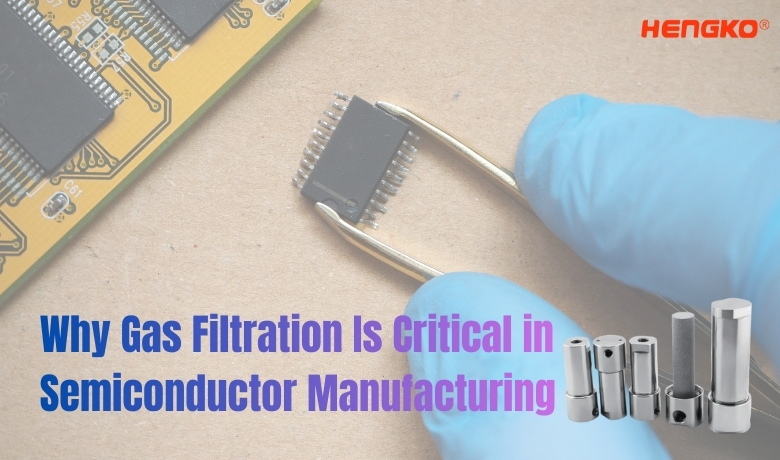
In semiconductor manufacturing, even the smallest gas-borne contaminant can lead to wafer defects,
yield loss, and unplanned tool downtime. Gas filtration is therefore not just a supporting component
—it is a critical safeguard that protects process stability, product quality, and long-term manufacturing efficiency.
As following, we will explains why gas filtration is essential in semiconductor fabs,
what risks it helps eliminate, and how engineers, OEMs, and procurement teams can make informed
decisions when selecting the right gas filtration solutions for their processes.
The Hidden Role of Gas Purity in Semiconductor Manufacturing
A common assumption during early-stage procurement is that ultra-high-purity (UHP) gases
supplied by certified vendors are “clean enough” and do not require additional filtration.
In reality, gas purity at the point of delivery is only the starting point—not the final condition
experienced inside semiconductor tools.
Modern semiconductor manufacturing relies on a wide range of critical process gases, including
nitrogen, hydrogen, argon, and specialty gases used in etching, deposition, and doping processes.
While these gases may meet UHP specifications when leaving the supplier, contamination can be
introduced as soon as the gas enters the fab infrastructure—through pipelines, valves, fittings,
pressure regulators, and repeated tool connections.
Even trace levels of particles, moisture, or chemical residues can negatively impact process stability.
Poor gas purity leads to increased defect rates, reduced wafer yield, and unpredictable tool behavior,
ultimately driving up cost of ownership. This is why effective gas filtration is a core element of
contamination control in semiconductor manufacturing, bridging the gap between gas supply
specifications and real-world fab conditions.
What Types of Contaminants Threaten Semiconductor Processes?
When discussing gas filtration, many procurement teams initially focus only on particle size.
However, semiconductor processes are sensitive to multiple forms of contamination, and overlooking
non-particulate impurities can lead to hidden process risks and long-term yield loss.
1. Particles: The Most Visible Risk
Sub-micron particles are one of the most direct causes of wafer defects.
Once introduced into process gases, these particles can deposit on wafer surfaces, interfere with
thin-film formation, or create localized defects during lithography and etching steps.
The difference between 0.1 µm and 0.01 µm filtration is not incremental—it is often decisive.
While 0.1 µm filters may capture larger debris, smaller particles can still penetrate advanced
process nodes, where feature sizes continue to shrink. In such environments, even a single escaped
particle can translate into measurable yield loss or downstream reliability issues.
2. Moisture, Oil & Chemical Impurities
Not all contamination is visible. Trace moisture can significantly affect ALD, CVD, and etching
processes by altering reaction kinetics, film uniformity, and repeatability. In moisture-sensitive steps,
even parts-per-billion levels may be enough to cause process drift.
Oil mist and organic residues typically originate from compressors, valves, seals,
and upstream gas handling components. These contaminants may not trigger immediate alarms,
but over time they can poison catalysts, contaminate chambers, and increase
maintenance frequency—often without a clear root cause.
3. Key Procurement Insight
? “What exactly are we filtering—and is smaller always better?”
Effective gas filtration is not about choosing the smallest micron rating available.
It is about understanding the full contamination profile—particles, moisture, and chemical impurities
—and selecting a filtration strategy that protects yield and tool stability without introducing excessive
pressure drop or system complexity.
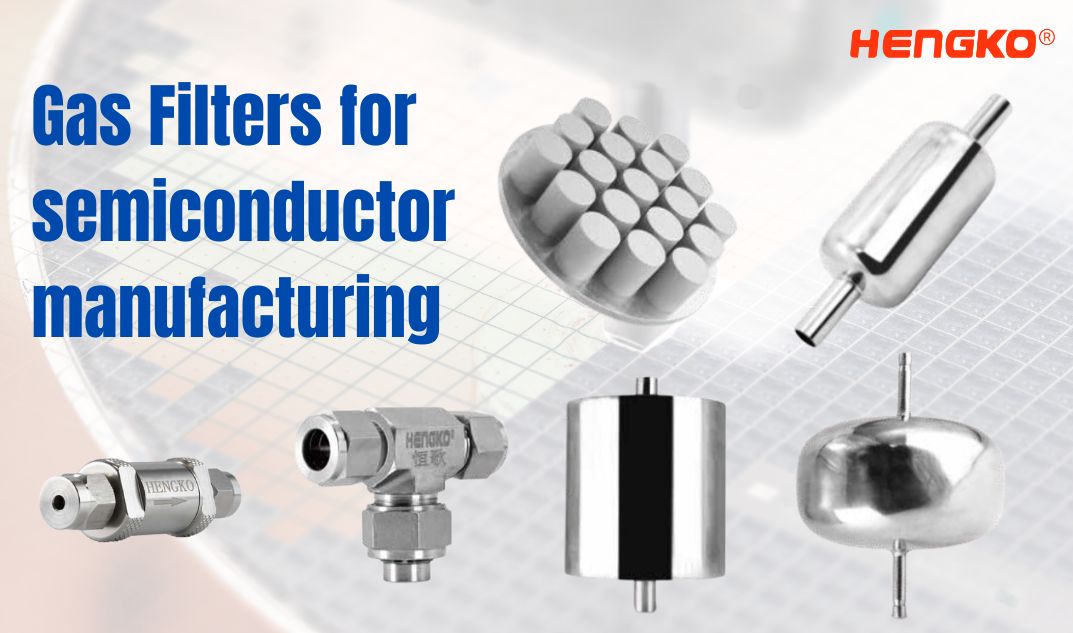
How Gas Contamination Impacts Yield, Cost & Tool Reliability
Gas contamination is often viewed as a technical concern, but in semiconductor manufacturing it quickly
escalates into a business-critical issue.
Even a single contamination event can trigger a chain reaction of losses that extend far beyond
the cost of the gas filter itself.
A contamination incident may result in wafer scrap, where entire batches must be discarded due to
particle-induced defects or process instability. In parallel, affected tools often require unplanned downtime
for inspection, chamber cleaning, and qualification, disrupting production schedules and
reducing fab throughput. In less obvious cases, contamination leads to rework and gradual yield loss,
where defects increase slowly and root causes are difficult to trace.
When viewed in this context, the economics become clear. The cost of gas filtration is minimal
compared to the potential losses associated with scrapped wafers, lost tool time, and compromised
product quality. A relatively small investment in proper gas filtration acts as a safeguard against
disproportionately large operational and financial risks.
Procurement Perspective
“Gas filters are not consumable expenses—they are risk control components.”
For procurement and sourcing teams, effective gas filtration should be evaluated not by unit price alone,
but by its ability to protect yield, stabilize tools, and reduce the total cost of ownership
across the manufacturing lifecycle.
Where Gas Filtration Is Critical Inside a Semiconductor Fab
Understanding where gas filtration is applied inside a semiconductor fab is just as important as
understanding what is being filtered. Contamination risks vary across the gas delivery system,
and effective filtration requires a layered approach rather than a single filtration point.
Bulk Gas Lines
Bulk gas lines form the backbone of the fab’s central gas distribution system. Although these lines are
designed for high purity, contamination can still be introduced through long pipe runs, pressure regulators,
valves, and maintenance activities. Particles generated upstream may travel long distances and
accumulate over time, making bulk filtration a necessary first barrier to reduce the overall contamination
load entering the fab.
Point-of-Use (POU) Filtration
Point-of-use filtration is often the most critical line of defense. Installed just before the gas enters
the process tool, POU filters protect against contaminants generated downstream of the bulk system,
including particles released from fittings, seals, and last-meter connections.
From a process control perspective, POU filters provide the highest level of risk mitigation,
as they ensure gas purity exactly where it matters most—at the tool inlet. This is why advanced
semiconductor processes typically specify finer micron ratings at the POU level.
Process Tools & Equipment Interfaces
At the interface between the gas delivery system and process equipment, compatibility with OEM tool
requirements becomes essential. Filters must match specified connections, flow rates, pressure limits,
and cleanliness standards to avoid introducing turbulence, pressure drop, or installation risks.
For equipment manufacturers and fabs alike, filtration at these interfaces is not only about purity,
but also about integration, reliability, and repeatable performance across tools and production lines.
Common Procurement Question
? “Where in the system should we install filters, and what specifications are required at each point?”
The answer depends on contamination risk, process sensitivity, and system design. A well-designed
gas filtration strategy balances bulk protection, point-of-use precision, and equipment compatibility
to deliver consistent gas purity throughout the fab.
3 Key Questions You Should Ask Before Selecting a Gas Filter
Selecting a semiconductor gas filter is not a simple specification exercise—it requires a clear understanding
of process risk, application requirements, and long-term operational impact. Asking the right questions early
helps procurement teams avoid over-engineering, under-protection, and supplier mismatches.
1. Product Understanding: What Do We Really Need?
One of the first questions buyers ask is how fine the filtration should be. The required micron rating
depends on process sensitivity, node size, and tool requirements. Advanced processes often demand
sub-micron or even ultra-fine filtration, while upstream stages may tolerate coarser levels.
Not all semiconductor processes carry the same contamination risk. Different tools and applications
may require different filtration grades, making a single “one-size-fits-all” solution inefficient or risky.
Another common point of confusion is whether gas filters and gas purifiers are interchangeable.
Filters are designed to remove particles and certain physical contaminants, while purifiers target
molecular-level impurities. In many critical applications, they are complementary rather than mutually exclusive.
2. Selection Criteria: How Do We Choose the Right Specification?
Choosing a finer micron rating than necessary may appear safer, but over-filtration can introduce
unwanted pressure drop, affecting gas flow stability and tool performance.
The optimal filter balances contamination control with system efficiency.
Material selection also plays a critical role. Sintered stainless steel and porous metal filters differ in
mechanical strength, cleanability, and service life. The right material choice directly impacts filter longevity,
maintenance cycles, and total cost of ownership.
Flow rate and pressure drop must always be evaluated in the context of the specific gas system.
A filter that performs well on paper may still disrupt process stability if these parameters
are not properly matched.
3. Application Fit: Will It Work in Our System?
Beyond specifications, buyers must confirm application compatibility.
Filters should be suitable for the specific gases used—such as nitrogen, hydrogen, argon, or specialty gases
—without compromising safety or performance.
Equally important is integration with OEM tools and gas delivery systems.
The ability to customize connections, dimensions, and flow characteristics ensures seamless installation
and reduces integration risk. For semiconductor fabs and equipment manufacturers, this level of fit is
often a decisive factor in supplier selection.
Common Mistakes in Semiconductor Gas Filter Procurement
During semiconductor gas filter procurement, many risks stem not from cost, but from incomplete
evaluation and incorrect assumptions. The table below highlights common purchasing mistakes,
their hidden risks, and the correct decision-making approach to help buyers avoid costly errors.
| Common Mistake | Why It Seems Acceptable | Hidden Risk | Better Purchasing Approach |
|---|---|---|---|
| Focusing only on micron rating | Easy to compare and specify | Inconsistent filtration performance and particle breakthrough | Evaluate pore structure, filtration efficiency, and batch consistency |
| Over-selecting ultra-fine micron levels | Assumed higher safety margin | Excessive pressure drop affecting gas flow stability | Select micron rating based on process sensitivity, not assumption |
| Ignoring cleanliness control | Product appears clean | Filter itself becomes a contamination source | Verify cleaning process, cleanliness standards, and packaging |
| Not assessing production consistency | Sample testing passes | Performance variation in mass production | Confirm quality control and manufacturing repeatability |
| Comparing unit price only | Lower upfront cost | Higher long-term maintenance and yield loss | Evaluate total cost of ownership (TCO) |
| Choosing suppliers without fab knowledge | Specifications look sufficient | Poor application guidance and integration risk | Select suppliers with semiconductor application expertise |
3-Shortlist to Evaluate a Semiconductor Gas Filter Suppliers
Selecting a semiconductor gas filter supplier is a risk-management decision, not just a pricing exercise.
Beyond specifications, buyers should focus on technical understanding, manufacturing discipline,
and long-term OEM support.
What to Look For in a Supplier
1. Technical Capability
A qualified supplier understands semiconductor applications and can provide test data, validation support,
and application-level recommendations, not just product datasheets.
2. Manufacturing & Quality Control
Consistency matters. Buyers should evaluate material stability, cleaning and cleanliness processes,
and batch-to-batch repeatability, all of which directly impact gas purity and tool reliability.
3. Customization & OEM Support
Most semiconductor systems require more than standard parts. The ability to customize interfaces,
dimensions, flow rates, and housings, and to support equipment integration, is critical—especially for tool OEMs.
Supplier Example: HENGKO
HENGKO is a manufacturer of high-purity semiconductor gas filters with a strong focus on OEM and custom solutions.
The company specializes in sintered stainless steel and porous metal filtration products designed for UHP gas applications.
Key advantages include:
-
Application-driven filtration design for semiconductor gas systems
-
Controlled manufacturing and cleaning processes for high consistency
-
Strong OEM customization capability, including interfaces, pore size, and flow characteristics
For fabs and equipment manufacturers, suppliers like HENGKO represent not just a component source,
but a long-term filtration partner supporting stable, scalable semiconductor manufacturing.
Why Reliable Gas Filtration Is a Long-Term Investment, Not a Cost
In semiconductor manufacturing, the value of gas filtration should be measured by risk reduction and process stability,
not by unit price. Reliable gas filtration helps lower defect rates by preventing particles and impurities from reaching
critical process steps, directly protecting wafer yield.
At the same time, proper filtration improves tool uptime by reducing contamination-related failures, unplanned maintenance,
and frequent chamber cleaning. Stable gas quality also supports long-term process consistency, allowing fabs to maintain
tight control over critical parameters as production scales and process nodes shrink.
From a procurement perspective, investing in reliable gas filtration simplifies internal justification: it is a proactive measure
that reduces hidden losses and protects the overall cost of ownership across the manufacturing lifecycle.
Conclusion: Building a Safer, Cleaner Semiconductor Gas System
Gas filtration is not optional — it is foundational to yield, reliability, and scalable semiconductor manufacturing.
By understanding contamination risks, selecting the right filtration strategy, and partnering with capable suppliers,
semiconductor manufacturers can build gas systems that support both technical excellence and long-term business success.
So Are You Looking to reduce contamination risk and improve process stability in your semiconductor gas systems?
* Talk to a semiconductor gas filtration specialist to discuss your application and challenges
* Request an application-based gas filter recommendation tailored to your process requirements
* Discuss custom gas filtration solutions designed for your fab or equipment integration
A well-designed gas filtration strategy starts with the right conversation. contact with our gas filter expert today
by email ka@hengko.com
Send your message to us:
Post time: Dec-27-2025


