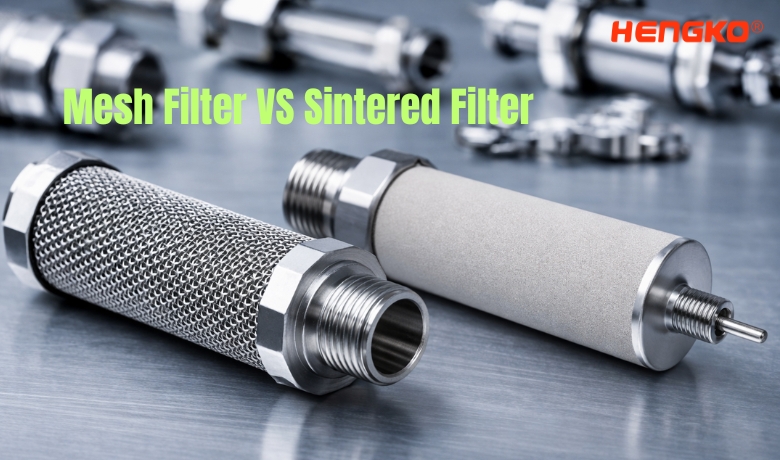
In industrial filtration system, choosing the right filter type directly affects system performance, product quality, and maintenance cost.
However, mesh filters and sintered filters are often confused due to their similar appearance and function.
Based on our experience in applications such as semiconductor processing, analytical instruments, and high-purity gas systems, the key difference is clear:
Filtration Precision—Especially at Micron and Sub-Micron Levels.
Mesh filters use surface filtration with defined openings, making them suitable for coarse particle removal.
In contrast, sintered filters feature a controlled porous structure that enables depth filtration, delivering higher precision, stability, and reliability.
Understanding this difference is essential when filtration performance is critical to your process.
What Is a Mesh Filter?
A mesh filter is a type of surface filtration device made from woven or welded metal wires, typically stainless steel such as 304 or 316.
It removes particles by physically blocking them at the surface through uniform openings in the mesh.
In most industrial applications, mesh filters are used for coarse filtration, with typical filtration ratings ranging from 25 to 500 microns.
They are valued for their simple structure, high flow rate, and ease of cleaning.
However, due to their fixed opening size and surface-only filtration mechanism, mesh filters have limitations in fine filtration.
Their performance becomes less reliable when dealing with particles below 10 microns or in applications requiring high precision and stability.
From our practical experience, mesh filters are commonly used as pre-filters to remove larger particles before finer filtration stages.
What Is a Sintered Filter?
A sintered filter is a high-precision filtration component manufactured through a powder metallurgy process, where metal particles are bonded together at high temperatures to form a rigid, porous structure. Unlike mesh filters, its pore size and distribution can be precisely controlled during production.
This unique structure enables depth filtration, allowing particles to be captured not only on the surface but throughout the internal pore network. As a result, sintered filters provide significantly higher filtration efficiency and consistency.
Depending on the material and design, sintered metal filters can achieve filtration ratings from 50 microns down to 0.1 micron or even finer, making them suitable for demanding applications requiring stable and reliable performance.
In our experience working with high-purity gas systems and analytical equipment, sintered filters are widely used in critical filtration stages, where even sub-micron particles can impact system performance or product quality.
In addition to precision, sintered filters also offer excellent mechanical strength, high pressure resistance, and temperature stability, making them ideal for harsh industrial environments.
Key Differences Between Mesh Filter and Sintered Filter
While both mesh filters and sintered filters are used for particle removal, their performance differs significantly in terms of structure, filtration mechanism, and precision.
The table below highlights the key differences:
| Feature | Mesh Filter | Sintered Filter |
|---|---|---|
| Filtration Type | Surface filtration | Depth filtration |
| Filtration Precision | 25–500 μm | 50 μm → 0.1 μm (or finer) |
| Structure | Woven wire mesh | Porous metal structure |
| Particle Retention | Surface blocking | Multi-layer interception |
| Pressure Resistance | Low to moderate | High |
| Durability | Moderate | Long service life |
| Application Stage | Pre-filtration | Precision / critical filtration |
In practical applications, these differences directly impact system performance. Mesh filters are typically used as pre-filters to remove larger particles, while sintered filters are applied in critical filtration stages where precision, stability, and reliability are essential.
From our experience, in industries such as semiconductor processing, pharmaceutical manufacturing, and analytical instrumentation, sintered metal filters are preferred when filtration performance directly affects product quality or system integrity.
Real Industrial Applications
The choice between mesh filters and sintered filters depends largely on filtration precision and application criticality.
1. Where Mesh Filters Are Typically Used
Mesh filters are mainly applied in pre-filtration stages, where removing larger particles is sufficient.
Typical applications include:
- Water treatment systems
- Air intake filtration
- General industrial processes
- Equipment protection from coarse contaminants
In these scenarios, the focus is on flow rate and basic protection, rather than fine filtration accuracy.
2. Where Sintered Filters Are Required
Sintered filters are designed for high-precision and critical filtration environments, where performance directly impacts system reliability.
They are widely used in:
- Semiconductor gas filtration systems
- Pharmaceutical production processes
- Analytical instruments (HPLC, GC, etc.)
- High – purity gas and fluid control systems
3. Why the Difference Matters
In high-end applications, even micron or sub-micron particles can cause:
- Contamination of sensitive products
- Measurement errors in analytical systems
- Damage to valves, sensors, or instruments
- Reduced system stability and lifespan
4. Expert Insight
Based on our experience in high-purity gas and laboratory systems, sintered metal filters are typically installed at critical control points to:
- Ensure stable and consistent filtration performance
- Protect sensitive downstream components
- Maintain overall system integrity
Expert Insight: Why Precision Matters
In modern industrial systems, filtration is no longer just about removing visible particles—it is about controlling micron and sub-micron contamination that can directly impact performance and reliability.
1. The Hidden Risk of Fine Particles
Particles that are invisible to the naked eye can still cause serious issues, such as:
- Blockage in precision components
- Wear or damage to valves and sensors
- Instability in flow and pressure
- Inaccurate results in analytical systems
2. Why Mesh Filters Fall Short
While mesh filters perform well in coarse filtration, their limitations become clear in high-precision environments:
- Filtration is limited by fixed opening size
- Particles smaller than the mesh can pass through
- No internal structure to capture finer contaminants
3. Why Sintered Filters Perform Better
Sintered filters are specifically designed to address these challenges:
- Controlled pore structure for consistent filtration accuracy
- Depth filtration captures particles throughout the media
- Stable performance even under high pressure and temperature
4. Practical Engineering Perspective
From our experience, in applications such as high-purity gas systems and analytical instrumentation, filtration precision is not optional—it is critical.
Even a small number of sub-micron particles can lead to:
- Product quality issues
- System downtime
- Increased maintenance costs
This is why sintered metal filters are commonly selected for final or critical filtration stages, where reliability and precision must be guaranteed.
How to Choose Between Mesh Filter and Sintered Filter
Selecting the right filter depends on your filtration requirements, operating conditions, and system sensitivity.
1.Choose a Mesh Filter If:
Mesh filters are a practical option when filtration requirements are relatively low and cost efficiency is a priority:
- Particle size is larger than 50 microns
- The system operates under low to moderate pressure
- Filtration is used for pre – treatment or basic protection
- High flow rate is more important than precision
2.Choose a Sintered Filter If:
Sintered filters are the better choice for applications where precision and reliability are critical:
Filtration requirement is below 10 microns or sub-micron level
The system involves high pressure or high temperature conditions
The application requires stable and consistent filtration performance
Used in critical processes (e.g., semiconductor, pharma, analytical systems)
3.Quick Selection Tip
If filtration performance directly affects your product quality, measurement accuracy, or system reliability, a sintered filter is typically the safer and more effective long-term solution.
Need Help Choosing the Right Filter?
If you're unsure which option fits your application, our engineering team can help you select
the optimal filtration solution based on your specific requirements.
FAQ: Mesh Filter vs Sintered Filter
What is the micron rating of a mesh filter?
Mesh filters typically range from 25 to 500 microns, depending on the wire size and mesh count. They are mainly used for coarse filtration.
Can mesh filters be used for fine filtration?
Not effectively. Mesh filters rely on surface openings, so particles smaller than the mesh size can pass through. They are not suitable for sub-10 micron filtration.
What is the micron rating of a sintered filter?
Sintered filters can achieve filtration ratings from 50 microns down to 0.1 micron or even finer, depending on the material and manufacturing process.
Are sintered filters reusable?
Yes. Most sintered metal filters can be cleaned, backwashed, and reused multiple times, making them cost-effective over the long term.
Which filter is better for gas filtration?
For high-purity or critical gas systems, sintered filters are preferred due to their higher precision and structural stability.
What is the difference between surface and depth filtration?
- Surface filtration (mesh filter) – particles are trapped on the surface
- Depth filtration (sintered filter) – particles are captured throughout the internal pore structure
Are sintered filters more expensive?
Yes, the initial cost is higher. However, due to their long lifespan and stable performance, they often provide better value over time.
About Us & Technical Support
As a manufacturer specializing in sintered metal filtration solutions, we support a wide range of industries including:
- Semiconductor
- Pharmaceutical
- Analytical instrumentation
With extensive experience in high-purity gas and precision filtration applications, we provide:
- Custom sintered metal filters with controlled pore size
- Solutions for high – pressure and high-temperature environments
- OEM support for system integration and specialized designs
- Technical guidance based on real application requirements
Talk to Our Engineering Team
Choosing the right filter is not just about specifications—it’s about ensuring long-term system performance and reliability.
If you are working on a filtration project or evaluating alternatives, our team can help you:
- Select the appropriate filtration solution
- Optimize performance based on your application
- Provide customized design and manufacturing support
Send your message to us:
Post time: Apr-15-2026


