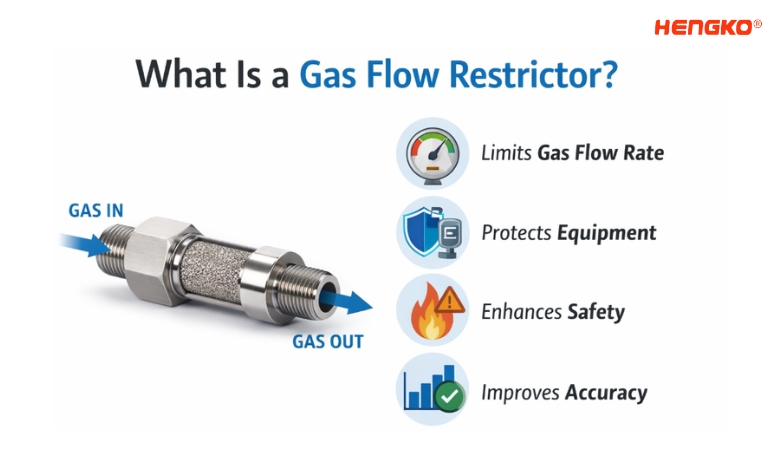
Quick answer: A gas flow restrictor is a passive component that limits and stabilizes gas flow by creating a controlled pressure drop. It protects downstream equipment, improves safety, and provides predictable flow without electrical power or moving parts.
Why Gas Flow Restrictors Matter in Industrial Systems
In industrial gas systems, controlling flow rate is critical for safety and performance. Unstable or excessive gas flow can cause pressure surges, equipment damage, inaccurate measurements, and serious safety risks—especially when handling high-pressure or flammable gases.
Uncontrolled gas flow increases danger. Excessive flow can overload sensors and instruments, create leaks, and in extreme cases contribute to fire or explosion. Reliable flow limitation is therefore a basic requirement in many industrial applications.
Precision flow control is also essential in high-technology industries:
•Semiconductor manufacturing: stable gas flow helps maintain consistent process quality.
•Hydrogen systems: controlled flow improves operational safety.
•Laboratories: accurate flow supports repeatable test results.
•Compressors and pneumatic systems: restriction protects downstream components and can extend service life.
This is why gas flow restrictors are widely used as a simple and dependable solution for managing gas flow.
What Is a Gas Flow Restrictor?
1. Simple Definition
A gas flow restrictor is a device designed to limit and stabilize gas flow rate in a system. In simple terms, it acts like a “speed limiter” for gas, protecting downstream equipment and keeping flow within safe operating limits.
2. Technical Definition in Industrial Systems
Technically, a gas flow restrictor is a passive flow-control component that controls volumetric or mass flow under defined pressure conditions by creating a pressure drop through an orifice, capillary, or porous structure.
Unlike an active device such as a mass flow controller, it operates without power or sensors:
•Passive control—flow restrictor: provides fixed or calibrated flow limitation.
•Active control—mass flow controller: electronically measures and adjusts flow.
This passive operating principle makes flow restrictors simple, reliable, and suitable for harsh industrial environments.
3. Flow Restrictor vs. Other Flow-Control Devices
| Device Compared | Main Function | Control Method | Key Difference |
|---|---|---|---|
| Restrictor vs. Regulator | A regulator controls pressure; a restrictor controls flow rate. | The regulator adjusts outlet pressure; the restrictor limits flow through a fixed or porous path. | Pressure management versus flow limitation. |
| Restrictor vs. Needle Valve | A needle valve provides adjustable flow; a restrictor provides fixed flow. | The needle valve is manually adjusted; the restrictor is passive and normally non-adjustable. | The restrictor offers stable, tamper-resistant flow without manual tuning. |
| Restrictor vs. Mass Flow Controller | An MFC measures and actively controls flow; a restrictor passively limits flow. | The MFC uses sensors and electronics; the restrictor relies on physical geometry. | The restrictor is simpler, lower-maintenance, and typically more economical. |
Selection takeaway: Gas flow restrictors are generally preferred when the application requires simple, stable, maintenance-free flow limitation rather than continuously adjustable electronic control.
How Does a Gas Flow Restrictor Work?
1. Basic Working Principle
A gas flow restrictor works by creating a controlled pressure drop (ΔP) across a fixed internal structure. As gas passes through a narrow path—such as an orifice, capillary, or porous element—the flow rate is limited and stabilized.
•Pressure drop: reduces excessive flow caused by high inlet pressure.
•Fixed or porous structure: defines the maximum allowable flow.
•Flow stabilization: keeps gas delivery consistent and predictable.
2. Common Flow-Restriction Mechanisms
A small, fixed opening limits flow according to its diameter. It is simple, but a very small single opening can be sensitive to contamination.
A long, narrow tube controls flow through wall friction and its length-to-diameter ratio.
Gas passes through a network of interconnected micro-pores, creating distributed and stable resistance.
3. Why Porous Metal Flow Restrictors Are Widely Used
Porous sintered-metal flow restrictors are preferred in many demanding systems because they can provide:
•Uniform pore structure for repeatable flow control.
•Stable long-term performance with minimal drift when the gas remains clean.
•High temperature and pressure resistance when an appropriate metal and design are selected.
•Distributed flow paths that can be less vulnerable than a single very small orifice.
These characteristics make porous metal restrictors suitable for applications such as semiconductor processing, hydrogen systems, analytical instruments, and industrial gas equipment.
6 Key Functions of a Gas Flow Restrictor
1.Limit maximum gas flow rate: keeps gas delivery within designed operating limits.
2.Protect downstream instruments: shields sensors, analyzers, and valves from overload or damage.
3.Reduce pressure-related flow fluctuation: moderates sudden changes and supports more stable operation.
4.Improve system safety: reduces the consequences of uncontrolled gas release.
5.Improve measurement consistency: provides steadier flow conditions for repeatable readings.
6.Reduce surge or shock: limits flow spikes during start-up or sudden pressure changes.
5 Typical Industrial Applications of Gas Flow Restrictors
Process-gas control and carrier-gas stabilization.
Hydrogen flow limitation and fuel-cell gas management.
Gas chromatographs, gas analyzers, and calibration-gas lines.
Controlled oxygen or breathing-gas flow in appropriately engineered devices.
Air compressors, pneumatic equipment, actuators, and instrument-air lines.
3 Common Materials Used in Gas Flow Restrictors
1. Stainless Steel 316L or 304
Stainless steel is widely selected for its corrosion resistance, mechanical strength, pressure capability, and suitability for precision manufacturing.
2. Porous Sintered-Metal Materials
Common options include stainless-steel powder, bronze, nickel, and nickel-based alloys. The best material depends on gas compatibility, temperature, pressure, purity, and corrosion conditions.
3. Polymer Flow Restrictors
PTFE, PEEK, and other engineering polymers may be used in lower-pressure or chemically demanding applications where their temperature, pressure, and gas-permeation limits are acceptable.

What Determines the Flow Rate of a Gas Flow Restrictor?
The flow rate is not determined by one factor alone. It depends on both the restrictor design and the actual operating conditions.
•Pore size or orifice diameter: smaller openings create greater resistance and lower flow; larger openings allow more gas to pass.
•Length and thickness: a longer or thicker flow path increases resistance and usually reduces flow.
•Gas type: air, nitrogen, hydrogen, oxygen, and other gases have different density and viscosity.
•Inlet and outlet pressure: the pressure ratio and pressure drop directly affect gas flow and may determine whether the flow becomes choked.
•Temperature: temperature changes gas density and viscosity, influencing actual flow.
•Cleanliness and clogging: contamination can partially block the flow path, reduce flow, and cause drift over time.
Important: A flow value should always be specified together with the gas type, inlet pressure, outlet pressure, temperature, and reference condition. A statement such as “1 SLPM” is incomplete unless the test conditions are defined.
Advantages of Using a Gas Flow Restrictor
•Simple structure: easy to integrate, with no complicated mechanism.
•No power required: suitable for remote locations and harsh environments.
•High reliability: passive operation reduces the number of possible failure points.
•Low maintenance: fewer moving or electronic components can reduce downtime.
•Cost-effective: often more economical than active flow-control equipment when fixed flow is sufficient.
•Long service life: sintered-metal versions can perform well under high temperature, pressure, and corrosive conditions when correctly specified.
When Do You Need a Gas Flow Restrictor?
A gas flow restrictor is a strong choice when your system needs simple, stable, and reliable flow limitation without complex control equipment.
•Your system requires a fixed or calibrated flow: a predefined flow is sufficient and continuous adjustment is unnecessary.
•You need to protect sensitive instruments: a restrictor can reduce overload risk for analyzers, detectors, sensors, and valves.
•You need passive risk control: limiting maximum gas release can support a broader safety design.
•You operate in a harsh environment: stainless-steel or sintered-metal designs can be suitable where electronics are undesirable.
How to Choose the Right Gas Flow Restrictor
Selecting the right restrictor requires matching its design to the actual operating conditions. Prepare the following information before requesting a quotation or technical recommendation:
1.Required flow rate: specify the target value or acceptable flow range.
2.Working pressure: provide both inlet and outlet pressure, including maximum conditions.
3.Gas type: identify the gas and any purity or moisture requirements.
4.Temperature: provide normal and maximum operating temperatures.
5.Material compatibility: consider corrosion, cleanliness, high-purity, and oxygen-service requirements.
6.Connection and dimensions: specify NPT, BSP, metric thread, compression fitting, weld end, or custom interface.
7.Standard or custom design: decide whether an off-the-shelf component can meet the requirement or calibrated customization is needed.
Need help selecting a gas flow restrictor?
Send your gas type, target flow, inlet pressure, outlet pressure, temperature, connection, and quantity. HENGKO can evaluate standard and custom porous-metal flow-restriction solutions for your application.
Conclusion
A gas flow restrictor is a simple passive device that limits and stabilizes gas flow, helping protect equipment, improve measurement consistency, and support system safety.
In semiconductor, hydrogen, laboratory, pneumatic, and industrial gas applications, controlled flow is essential for reliable operation. When fixed or calibrated flow is sufficient, a properly engineered restrictor can provide a compact, dependable, and low-maintenance solution.
For specialized requirements, work with a manufacturer that can evaluate the complete operating conditions and provide a calibrated flow test rather than selecting only by pore size or orifice diameter.
Looking for a Custom Gas Flow Restrictor?
Tell us your application conditions and required flow. Our team will help assess material, structure, dimensions, and test requirements.
Post time: Feb-02-2026


