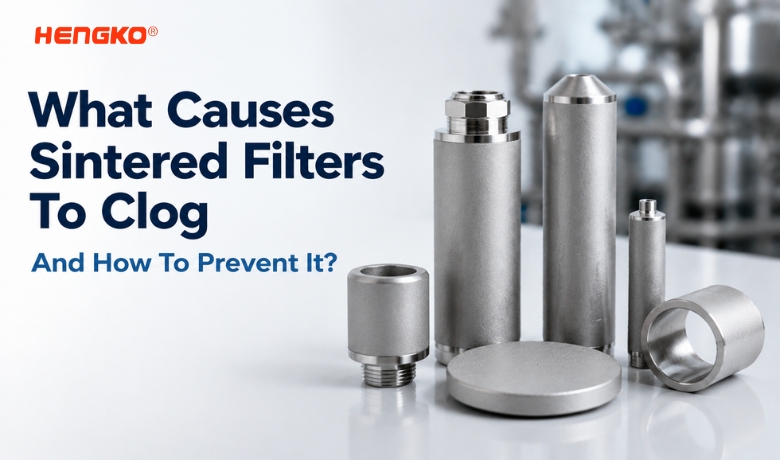
What Causes Sintered Filters to Clog and How to Prevent It ?

What Causes Sintered Filters to Clog and How to Prevent It ?

Sintered filters clog mainly because particles gradually accumulate inside the porous structure and exceed its holding capacity.

Once this happens, the flow path becomes restricted, causing a rapid increase in pressure drop and a reduction in filtration efficiency.

In most industrial systems, clogging is not caused by a single factor, but a combination of:

*Excessive particle load in the upstream fluid or gas
*Incorrect micron rating selection (too fine for the application)
*High-viscosity or sticky media that traps particles easily
*Lack of proper pre-filtration stages
*Insufficient cleaning or maintenance cycles 

In simple terms:
A sintered filter clogs when it is exposed to more contamination than its pore structure is designed to handle—and there is no effective way to release or remove those trapped particles.


How to Prevent Clogging (Practical Engineering Answer)

To prevent sintered filter clogging in industrial applications, engineers typically apply the following strategies:

  • Select the correct pore size (micron rating) based on actual particle load, not just filtration precision
  • Use pre-filtration systems to remove large contaminants before they reach the sintered element
  • Monitor pressure differential (ΔP) to detect early-stage clogging
  • Apply regular cleaning methods, such as backflushing or ultrasonic cleaning
  • Choose corrosion-resistant materials (e.g., 316L stainless steel, Inconel) for harsh environments

The most effective prevention method is system-level design optimization, not just replacing the filter more frequently.


Key Insight (Important for Engineers & Buyers)

Most sintered filter failures are predictable and preventable.

If clogging happens frequently, it usually indicates:

  • The filtration system is undersized
  • The media is not properly pre-treated
  • Or maintenance strategy is missing


What Is a Sintered Filter and Why It Clogs Easily in Industrial Use

A sintered filter is a porous metal filtration element formed by compacting and heating metal powders (such as stainless steel 316L, bronze, or nickel alloys) below their melting point. This process creates a rigid, interconnected pore structure that allows fluids or gases to pass through while trapping solid particles.

Unlike surface filters (such as mesh screens or paper filters), sintered filters are depth filtration media. This means particles are captured not only on the surface but also within the internal pore structure.


Why Sintered Filters Are Widely Used in Industry

Sintered metal filters are commonly used in demanding industrial environments because they offer:

  • High mechanical strength and pressure resistance
  • Excellent temperature stability (high and low extremes)
  • Corrosion resistance (especially 316L stainless steel)
  • Cleanability and reusability (backflush / ultrasonic cleaning)
  • Stable filtration performance over long service life

These advantages make them ideal for:

  • Chemical processing systems
  • Gas filtration and sparging
  • Pharmaceutical and biotech processes
  • Food & beverage production
  • Semiconductor and precision manufacturing


Why They Still Clog Despite Their Advantages

Although sintered filters are durable, their porous depth structure is also the reason they can clog more progressively and sometimes more difficult to detect early.

Clogging happens because:

  • Particles are not only trapped on the surface but also inside the pore network
  • Over time, deeper layers become blocked and cannot be easily cleaned
  • Fine particles can penetrate deeper and form compacted layers
  • In some cases, contaminants chemically bond or stick to pore walls

This makes clogging less visible at the beginning, but more severe once it reaches a critical stage.

Key Engineering Insight

Sintered filters do not usually fail suddenly.
They degrade gradually through progressive pore blockage, which increases pressure drop until system performance becomes unstable.

That is why understanding clogging mechanisms is critical for:

  • Filter sizing
  • System design
  • Maintenance planning


Top 6 Root Causes of Sintered Filter Clogging

Sintered filter clogging is rarely caused by a single issue. In most industrial systems, it is the result of operating conditions, fluid quality, and filter design working against each other over time.

Below are the six most common and critical causes identified in real industrial applications.

3.1 Particle Overload in the Upstream Flow (Most Common Cause)

The most direct reason for clogging is simply too many solid particles entering the filter system.

When the contaminant load exceeds the designed holding capacity of the sintered structure:

  • Particles accumulate rapidly inside the pore network
  • Flow channels become progressively blocked
  • Pressure drop increases sharply over time

This is especially common in:

  • Slurry systems
  • Catalyst recovery processes
  • Compressed air or gas systems without pre-treatment


3.2 Incorrect Micron Rating Selection

Choosing the wrong pore size is one of the most overlooked design mistakes.

If the filter is too fine:

  • It captures too many particles too quickly
  • Service life becomes very short
  • Frequent clogging and maintenance are required

If the filter is too coarse:

  • Contaminants pass through and damage downstream equipment


3.3 High Viscosity or Sticky Media

Fluids with high viscosity or adhesive properties significantly accelerate clogging.

Examples include:

  • Oils and lubricants
  • Polymer solutions
  • Resin, adhesives, or chemical slurries

In these cases:

  • Particles do not flow freely
  • They tend to stick to pore walls
  • Layer-by-layer buildup forms faster than in low-viscosity fluids

3.4 Lack of Pre-Filtration Design

A single-stage filtration system is one of the fastest ways to overload a sintered filter.

Without pre-filtration:

  • Large particles directly enter fine pores
  • Sudden blockage occurs in localized areas
  • Uneven flow distribution develops inside the element


3.5 Chemical Fouling and Surface Reaction

In chemically aggressive environments, clogging is not only physical but also chemical.

Possible mechanisms include:

  • Oxidation of metal surface
  • Chemical deposition inside pores
  • Crystallization of dissolved substances

Over time, these reactions form a thin layer that:

  • Reduces effective pore diameter
  • Increases flow resistance
  • Cannot be removed by simple backflushing

3.6 Poor Cleaning Strategy or Maintenance Neglect

Even a well-designed filter will fail early without proper maintenance.

Common issues include:

  • No scheduled cleaning cycle
  • No backflushing or reverse flow system
  • Overuse beyond designed service life
  • Cleaning too late (after deep clogging has formed)


How Clogging Affects System Performance (Why Engineers Care)

Sintered filter clogging is not just a maintenance issue—it directly impacts system efficiency, operational cost, and process stability.

As clogging develops inside the porous structure, it gradually changes the hydraulic or gas flow behavior of the entire system.

Below are the most critical performance impacts observed in industrial applications.

4.1 Increased Pressure Drop (ΔP Rise)

The first and most measurable effect of clogging is a steady increase in pressure differential across the filter.

As pores become blocked:

  • Flow resistance increases
  • More energy is required to push fluid or gas through
  • Pump or compressor load rises continuously

4.2 Reduced Flow Rate and Process Instability

When pore blockage becomes significant:

  • Effective filtration area decreases
  • Flow rate drops below design specifications
  • Process output becomes inconsistent

This is especially critical in:

  • Chemical dosing systems
  • Gas sparging applications
  • Continuous production lines

4.3 Equipment Overload and Energy Waste

A partially clogged sintered filter forces upstream equipment to work harder:

  • Pumps operate at higher load
  • Compressors consume more power
  • Valves experience abnormal pressure stress

Over time, this leads to:

  • Higher operating costs
  • Increased equipment wear
  • Shorter system lifespan

4.4 Risk of Sudden System Shutdown

In severe cases, clogging can reach a critical threshold where:

  • Flow is almost completely restricted
  • Pressure spikes trigger safety shutdowns
  • Production line must be stopped for maintenance

4.5 Product Quality and Contamination Risks

When filtration becomes unstable:

  • Particles may bypass partially blocked zones
  • Channeling effects can occur inside the filter
  • Downstream contamination risk increases

This is particularly critical in:

  • Pharmaceutical production
  • Food & beverage processing
  • Semiconductor manufacturing


How to Prevent Sintered Filter Clogging (Engineering Solutions)

Preventing sintered filter clogging is not about reacting after failure, but about designing the filtration system correctly from the beginning.

In most industrial applications, clogging can be significantly reduced—or even eliminated—by optimizing system design, operating conditions, and maintenance strategy.

Below are the most effective engineering solutions.

5.1 Select the Correct Pore Size and Filtration Rating

The first and most important step is choosing the right micron rating.

A common mistake is selecting a filter that is too fine for the actual particle load.

To optimize performance:

  • Match pore size to real contamination level, not theoretical purity requirement
  • Avoid over-filtration (which causes rapid clogging)
  • Balance filtration efficiency with dirt-holding capacity

5.2 Implement Multi-Stage Filtration Systems

A single sintered filter should not handle raw contamination directly.

A better approach is a layered filtration system, such as:

  • Stage 1: Coarse pre-filtration (remove large particles)
  • Stage 2: Medium filtration (stabilize flow load)
  • Stage 3: Sintered filter (final precision filtration)

5.3 Use Backflushing or Reverse Flow Cleaning

Backflushing is one of the most effective methods for maintaining sintered filters.

It works by:

  • Reversing flow direction
  • Dislodging trapped particles
  • Restoring partial pore capacity

Common methods include:

  • Compressed air pulse backflush
  • Liquid reverse flow systems
  • Automated periodic cleaning cycles

5.4 Apply Ultrasonic Cleaning for Deep Fouling

For filters with embedded or stubborn contamination, ultrasonic cleaning is highly effective.

It removes:

  • Deeply trapped particles inside pores
  • Organic deposits
  • Fine fouling layers on internal surfaces

However:

  • It is typically used for maintenance/offline cleaning, not real-time operation
  • Effectiveness depends on material and contamination type

5.5 Control Operating Conditions and Pressure Differential

Many clogging issues can be prevented simply by monitoring system conditions.

Key control strategies include:

  • Monitoring pressure differential (ΔP) in real time
  • Replacing or cleaning filters before reaching critical ΔP
  • Stabilizing flow rate to avoid sudden particle surges
  • Avoiding extreme pressure spikes that force particles deeper into pores


Best Practices for Extending Sintered Filter Lifespan

Extending the service life of a sintered filter is not only about cleaning—it is about building a stable and controlled operating environment around the filter system.

In industrial applications, the difference between a short lifespan and a long-lasting filter often comes down to small but consistent operational practices.

6.1 Monitor Pressure Differential (ΔP) Regularly

The most reliable indicator of filter health is pressure drop across the element.

Best practice includes:

  • Installing pressure sensors upstream and downstream
  • Tracking ΔP trend over time, not just absolute value
  • Setting alarm thresholds for early intervention

6.2 Establish a Scheduled Cleaning Cycle

Waiting for full blockage is a common but costly mistake.

Instead, industries should implement:

  • Preventive cleaning schedules based on operating hours or ΔP
  • Backflushing routines in continuous systems
  • Offline ultrasonic cleaning for deep maintenance

6.3 Avoid Overloading the Filter System

One of the main reasons for premature clogging is operating beyond design conditions.

To prevent this:

  • Do not exceed designed flow rate
  • Avoid sudden pressure surges
  • Control upstream contamination levels

6.4 Use Correct Installation and Flow Direction

Improper installation can create uneven flow distribution, leading to localized clogging.

Key considerations:

  • Ensure correct flow direction as specified by the manufacturer
  • Avoid dead zones where particles can accumulate
  • Ensure proper sealing to prevent bypass flow

6.5 Choose High-Quality OEM-Grade Filter Elements

Not all sintered filters are manufactured equally.

Higher quality filters typically offer:

  • More uniform pore distribution
  • Better mechanical strength under pressure cycles
  • Higher resistance to fouling and deformation


When to Replace vs When to Clean (Decision Guide)

In real industrial operations, one of the most important maintenance decisions is determining whether a sintered filter should be cleaned or replaced.

Making the wrong decision can either increase unnecessary cost (over-replacement) or lead to system failure (over-cleaning).

The table below provides a practical engineering guideline.

Condition / Symptom Root Cause Recommended Action Explanation
Gradual increase in pressure drop (ΔP) Normal particle accumulation ✔ Clean (Backflush / Ultrasonic) Pore structure still intact; fouling is reversible
Flow rate slightly reduced but stable Partial surface blockage ✔ Clean Early-stage clogging, easily recoverable
Rapid ΔP spike within short time Heavy particle overload ✔ Clean + check upstream filtration System overload; root cause must be fixed
Persistent low flow after cleaning Deep pore blockage ⚠ Inspect or Replace Particles embedded inside deep pore structure
Visible discoloration or surface fouling Chemical deposition / oxidation ⚠ Ultrasonic clean first, then evaluate Chemical fouling may or may not be reversible
Physical deformation or cracked filter Mechanical damage / fatigue ❌ Replace immediately Structural integrity is compromised
Frequent clogging after short cycles System design issue  

Post time: Jul-04-2026