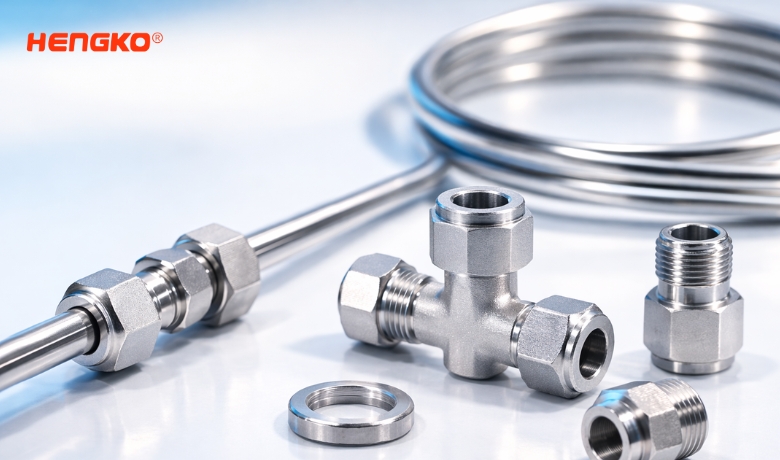
In high-purity gas and fluid systems, selecting the right tube fitting is critical for ensuring leak-tight connections, system reliability, and contamination control. Even a small leak or particle contamination can affect system performance, especially in industries such as semiconductor manufacturing, analytical instrumentation, and pharmaceutical processing.
Two of the most commonly used tube fitting types are VCR fittings and compression fittings. While both are designed to connect tubing and maintain sealed connections, their sealing mechanisms, cleanliness levels, and typical applications are significantly different.
Understanding the differences between VCR vs compression fittings helps engineers choose the most suitable solution for their systems. In this article, we will compare these two fitting types in terms of sealing principle, leak tightness, pressure capability, and typical applications to help you determine which option is best for your system.
What Is a VCR Fitting?
VCR Fitting Definition
A VCR fitting (Vacuum Coupling Radiation fitting) is a type of metal gasket face seal fitting designed to provide ultra-leak-tight connections in high-purity gas and vacuum systems. It is widely used in industries where contamination control and leak prevention are critical, such as semiconductor manufacturing, high-purity gas delivery systems, and analytical instrumentation.
Unlike traditional tube fittings, VCR fittings create a seal using a replaceable metal gasket compressed between two polished sealing faces. When the male and female fittings are tightened together, the gasket is deformed to form a highly reliable metal-to-metal seal.
This sealing design allows VCR fittings to achieve extremely low leak rates and excellent cleanliness, making them a standard choice for ultra-high purity (UHP) gas systems.
How VCR Face Seal Fittings Work
The sealing mechanism of a VCR fitting is based on a face seal design rather than ferrule compression. During installation, a metal gasket—typically made from stainless steel, nickel, or other high-purity alloys—is placed between the sealing surfaces of the two fittings.
When the nut is tightened to the specified torque, the gasket is compressed and slightly plastically deforms, creating a uniform metal-to-metal seal. This design minimizes leakage paths and helps prevent particle generation inside the gas line.
Because the gasket is the primary sealing element, it is normally replaced each time the fitting is reassembled to maintain optimal sealing performance.
Key Advantages of VCR Fittings
VCR fittings are widely used in high-purity applications because they provide several important advantages:
*Ultra-low leak rates, suitable for vacuum and high-purity gas systems
*Metal-to-metal sealing, reducing the risk of contamination
*Excellent compatibility with ultra-high purity gases
*High pressure and temperature resistance
*Reliable sealing performance in semiconductor process gas systems
Due to these advantages, VCR face seal fittings are commonly used in semiconductor gas delivery systems,
UHP gas panels, gas cabinets, and vacuum equipment.
What Is a Compression Fitting?
Compression Fitting Definition
A compression fitting is a widely used tube fitting designed to create a leak-tight connection by mechanically compressing ferrules around a tube. These fittings are commonly used in instrumentation systems, laboratory equipment, and industrial fluid applications.
Unlike face seal fittings, compression fittings seal by deforming metal ferrules around the outer surface of the tubing. This design allows the fitting to grip the tube securely while forming a reliable seal between the tubing and the fitting body.
Because of their simple installation and strong mechanical hold, compression fittings are widely used in many industries including chemical processing, oil and gas, laboratory instrumentation, and general industrial fluid systems.
How Compression Fittings Work
Compression fittings typically use a two-ferrule sealing system, consisting of a front ferrule and a back ferrule.
When the fitting nut is tightened:
*The front ferrule compresses onto the tube surface to create the primary seal.
*The back ferrule grips the tubing and provides mechanical support.
*The tubing is pressed firmly into the fitting body to maintain alignment and sealing integrity.
This design allows compression fittings to provide reliable sealing without requiring welding or brazing, making them a convenient solution for many tubing installations.
Key Advantages of Compression Fittings
Compression fittings offer several practical benefits that make them suitable for a wide range of industrial applications:
*Easy installation without specialized welding equipment
*Reusable connections when properly installed
*Strong mechanical grip on tubing
*Suitable for many fluid and gas systems
*Cost-effective for general industrial applications
Because of these advantages, compression fittings are widely used in instrumentation lines, laboratory systems, hydraulic equipment, and industrial fluid pipelines.
VCR vs Compression Fittings: Key Differences
Although both VCR fittings and compression fittings are designed to connect tubing and create leak-tight seals, they differ significantly in their sealing mechanism, cleanliness level, and typical applications.
VCR fittings are primarily designed for ultra-high purity gas systems and vacuum environments, while compression fittings are commonly used in general industrial fluid and instrumentation systems. Understanding these differences is essential when selecting the right fitting for a specific application.
The following table highlights the key differences between VCR fittings and compression fittings.
VCR vs Compression Fitting Comparison
| Feature | VCR Fitting | Compression Fitting |
|---|---|---|
| Sealing Method | Metal gasket face seal | Ferrule compression seal |
| Sealing Components | Metal gasket between sealing faces | Front ferrule and back ferrule |
| Leak Rate | Extremely low (suitable for UHP systems) | Low but higher than face seal fittings |
| Cleanliness Level | Ultra-high purity compatible | Standard industrial cleanliness |
| Reusability | Gasket replaced after each use | Ferrules can often be reused |
| Installation | Requires torque control | Easier installation |
| Typical Applications | Semiconductor gas systems, UHP gas delivery, vacuum systems | Instrumentation lines, laboratory equipment, industrial fluid systems |
Key Takeaway
The main difference between VCR vs compression fittings lies in their sealing technology.
*VCR fittings use a metal gasket face seal, which provides extremely low leak rates and superior cleanliness for high-purity environments.
*Compression fittings rely on ferrule compression around the tubing, making them easier to install and suitable for many general industrial systems.
Because of these differences, VCR fittings are commonly used in semiconductor and ultra-high purity gas systems, while compression fittings are more widely used in instrumentation and industrial fluid applications.
Typical Applications of VCR and Compression Fittings
Both VCR fittings and compression fittings are widely used in fluid and gas systems, but they are typically applied in different environments depending on the system’s purity requirements, operating pressure, and leakage tolerance.
Understanding the typical applications of each fitting type helps engineers select the most appropriate connection method for their systems.
Applications of VCR Fittings
VCR fittings are primarily designed for ultra-high purity (UHP) gas systems where even microscopic leaks or contamination can affect system performance.
Because of their metal gasket face seal design, VCR fittings provide extremely reliable sealing and excellent cleanliness, making them ideal for sensitive processes.
Typical applications include:
*Semiconductor gas delivery systems
*Ultra-high purity gas distribution lines
*Gas cabinets and gas panels
*Vacuum systems and process equipment
*Pharmaceutical and biotechnology gas systems
In industries such as semiconductor manufacturing, VCR fittings are commonly used to connect process gas lines, regulators, valves, and filters, ensuring stable and contamination-free gas flow.
Applications of Compression Fittings
Compression fittings are commonly used in general industrial and instrumentation systems where reliable sealing is required but ultra-high purity conditions are not necessary.
Their simple installation and mechanical grip make them suitable for a wide range of fluid and gas applications.
Typical applications include:
*Instrumentation tubing systems
*Laboratory equipment and analytical instruments
*Hydraulic and pneumatic systems
*Chemical processing pipelines
*General industrial fluid systems
Compression fittings are especially popular in systems that require frequent maintenance or adjustment, since they can often be disassembled and reassembled more easily than gasket-based fittings.
When Should You Choose a VCR Fitting?
VCR fittings are the preferred choice for systems that require extremely high sealing integrity and ultra-clean gas delivery. Their metal gasket face seal design provides superior leak tightness and minimizes the risk of contamination inside the gas line.
Engineers typically select VCR fittings when system reliability, gas purity, and leak prevention are critical.
You should consider using VCR fittings in the following situations:
*Ultra-high purity gas systems where contamination must be minimized
*Semiconductor manufacturing processes that require stable and clean gas delivery
*Toxic, corrosive, or hazardous gas applications where leak prevention is essential
*Vacuum systems that require extremely low leak rates
*High-pressure or high-temperature environments where metal sealing performs better than compression-based connections
Because the sealing surface is isolated from the tubing itself, VCR fittings also help reduce particle generation and system contamination, which is a critical requirement in semiconductor and high-purity process industries.
For these reasons, VCR face seal fittings are widely used in gas cabinets, gas panels, high-purity gas filters, regulators, and semiconductor process gas lines.
When Is a Compression Fitting a Better Choice?
Compression fittings are often the preferred option in systems where ease of installation, flexibility, and cost efficiency are important considerations. While they may not provide the same ultra-low leak rates as VCR face seal fittings, compression fittings offer reliable sealing performance for many industrial and laboratory applications.
Engineers commonly choose compression fittings when the system does not require ultra-high purity conditions or vacuum-level leak tightness.
Compression fittings are typically a better choice in the following situations:
*General instrumentation tubing systems
*Laboratory and analytical equipment
*Hydraulic and pneumatic systems
*Industrial fluid pipelines where ultra-high purity is not required
*Systems that require frequent disassembly or maintenance
Because compression fittings use ferrules to grip the tubing, they can often be installed quickly and adjusted easily without replacing additional sealing components such as gaskets.
For many industrial fluid and instrumentation applications, compression fittings provide a practical and cost-effective connection solution.
How to Choose the Right Fitting for Your System
Selecting the right tube fitting depends on several key factors, including system purity requirements, leak tightness, maintenance needs, and operating conditions. The following table provides a quick comparison to help engineers determine whether VCR fittings or compression fittings are more suitable for their application.
Selection Guide: VCR vs Compression Fittings
| Selection Factor | VCR Fittings | Compression Fittings |
|---|---|---|
| Gas Purity Requirement | Ideal for ultra-high purity (UHP) gas systems such as semiconductor processes | Suitable for general industrial gas and fluid systems |
| Leak Tightness | Provides extremely low leak rates with metal gasket face seal | Provides reliable sealing but leak rate is higher than VCR |
| Contamination Control | Excellent cleanliness with metal-to-metal sealing | Standard industrial cleanliness |
| System Maintenance | Requires gasket replacement during reassembly | Can often be reassembled without replacing components |
| Installation Complexity | Requires controlled torque during installation | Easier and faster installation |
| Typical Applications | Semiconductor gas delivery, vacuum systems, UHP gas panels | Instrumentation tubing, laboratory equipment, industrial pipelines |
By evaluating these factors, engineers can determine which fitting type best meets the performance, safety, and reliability requirements of their system.
FAQs
1. What is the difference between VCR fittings and compression fittings?
The main difference between VCR fittings and compression fittings is the sealing mechanism.
VCR fittings use a metal gasket face seal that creates an ultra-tight connection suitable for high-purity gas systems. Compression fittings use ferrules that compress around the tubing to create the seal, making them more suitable for general industrial and instrumentation applications.
2. Why are VCR fittings used in semiconductor gas systems?
VCR fittings are commonly used in semiconductor gas systems because they provide extremely low leak rates and excellent cleanliness. The metal gasket face seal minimizes particle generation and contamination, which is critical for ultra-high purity (UHP) gas delivery in semiconductor manufacturing.
3. Are VCR fittings reusable?
VCR fittings themselves can be reused, but the metal gasket must be replaced each time the fitting is reassembled. Replacing the gasket ensures proper sealing performance and maintains the ultra-low leak rate required in high-purity gas systems.
4. Are compression fittings reusable?
Yes, compression fittings are often reusable if the ferrules and tubing are still in good condition. However, repeated disassembly and reinstallation may affect the sealing performance, so proper inspection is recommended before reuse.
5. Can compression fittings replace VCR fittings?
In most ultra-high purity or semiconductor gas systems, compression fittings are not recommended as a replacement for VCR fittings. VCR face seal fittings provide better leak tightness and contamination control, which are essential in these environments.
6. When should I choose a VCR fitting instead of a compression fitting?
You should choose a VCR fitting when the system requires:
*Ultra-high purity gas delivery
*Extremely low leak rates
*Vacuum compatibility
*High reliability in semiconductor or specialty gas systems
For general industrial fluid systems or instrumentation lines, compression fittings are usually sufficient.
Conclusion
Both VCR fittings and compression fittings are widely used for tubing connections, but they serve different purposes. Compression fittings are suitable for general industrial and instrumentation systems, while VCR face seal fittings are designed for applications that require ultra-high purity and extremely low leak rates.
For systems such as semiconductor gas delivery, vacuum equipment, and UHP gas lines, VCR fittings provide a more reliable sealing solution.
If your application requires high-purity and leak-tight gas connections, selecting the right VCR fitting is essential for ensuring system safety and long-term reliability.
Post time: Mar-09-2026


