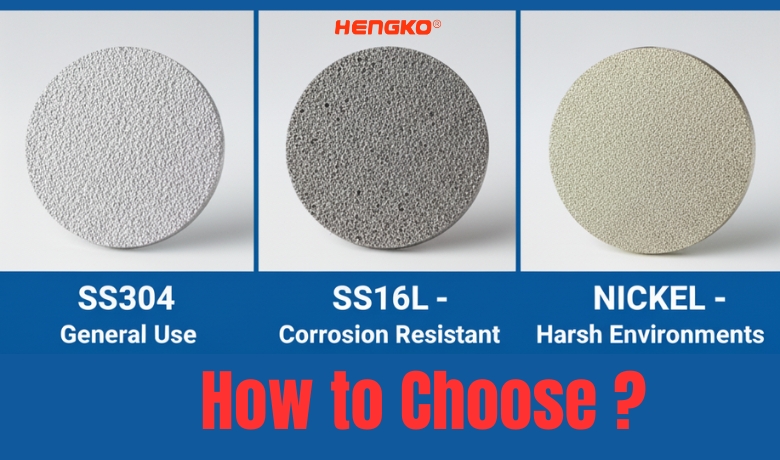
1. Why Porous Metal Filter Material Matters
Porous (sintered) metal filters are formed by bonding fine metal powders into a rigid, uniform porous body.
This structure lets gas or liquid pass while trapping contaminants, so it’s widely used in demanding systems.
The core variable is the material — it decides corrosion resistance, temperature/pressure limits, and service life.
That’s why choosing between SS304, SS316L, nickel alloys, or other metals is not just a cost issue, but a reliability issue.
SS304: general-purpose, economical.
SS316L: better corrosion + high-temp, good for chemical/pharma.
Nickel alloys: for aggressive or high-temperature media.
Copper/others: for special thermal or electrical needs.
In semiconductor, pharmaceutical, chemical, hydrogen, and compressed air systems, the right material keeps the filter stable and safe. If you’re hesitating between 304, 316L, and nickel, the next section will show how to match material to working medium, temperature, and pressure.
So if you are looking for some sepcial and need to customize porous metal filter or elements,
please check products details we made before.
2. What Are Porous Metal Filters Made Of?
Porous metal filters are produced through a process called metal powder sintering
— where fine metal particles are heated below their melting point until they fuse together.
This creates a solid but porous structure without using binders or adhesives, ensuring high purity and mechanical strength.
The fabrication of porous metal filters involves precise control over the form and structure of the filter to achieve the desired pore sizes and performance.
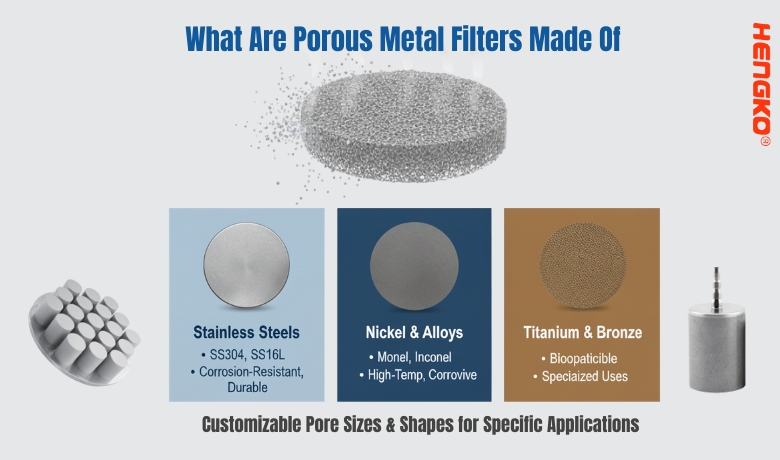
The most common materials used include:
*Stainless Steels (SS304, SS316L, SS310, SS321):
durable, corrosion-resistant, and cost-effective for general industrial use.
*Nickel and Nickel Alloys (Monel, Inconel, Hastelloy):
ideal for high-temperature or corrosive chemical environments.
*Titanium and Bronze:
used in specialized or biocompatible applications, offering unique strength-to-weight and non-magnetic properties.
Porous metals such as stainless steel, nickel alloys, and other metals can be manufactured into
various porous metal components using extremely fine metal powder to create a uniform porous structure.
Each material’s composition and microstructure influence the filter’s pore uniformity, mechanical strength, and resistance to thermal stress, making material selection a key factor in achieving long-term, stable filtration performance.
The manufacture of these filters allows for customization of pore sizes and shapes to meet specific application requirements.
3. Comparison Table: Common Materials and Their Key Properties
Selecting the right porous metal filter material means balancing performance, durability, and cost.
Each metal offers distinct advantages depending on the chemical environment, operating temperature, and mechanical strength required.
The table below summarizes the most commonly used materials
— from economical stainless steels to high-performance nickel alloys and titanium
— helping you quickly compare their key characteristics and ideal applications.
|
Material |
Corrosion Resistance |
Max Temperature |
Strength |
Cost |
Typical Applications |
|---|---|---|---|---|---|
|
SS304 |
Moderate |
~800 °C |
Good |
$$ |
General gas & liquid filtration |
|
SS316L |
Excellent (chlorides, acids) |
~850 °C |
Very Good |
$$$ |
Pharmaceutical, food, and chemical industries |
|
Nickel |
Outstanding |
~1000 °C |
High |
$$$$ |
High-temperature or reducing gas filtration |
|
Monel |
Excellent (seawater, alkalis) |
~900 °C |
High |
$$$$ |
Marine and chemical processing |
|
Hastelloy |
Superior (oxidizing acids) |
~1100 °C |
Very high mechanical strength |
$$$$$ |
Harsh chemical and catalytic processes |
|
Inconel |
Excellent (oxidation, carburization) |
~1100 °C |
Very high mechanical strength |
$$$$$ |
Extreme temperature and corrosive environments |
|
Titanium |
Biocompatible, strong |
~600 °C |
Medium |
$$$$ |
Medical, aerospace, and ultrapure systems |
|
Copper |
Good (non-oxidizing acids) |
~400 °C |
Medium |
$$$$$ |
Specialized applications requiring superior heat conduction |
Other alloys, such as specialty stainless steels or custom blends, are also available for demanding environments and can offer unique properties like enhanced corrosion resistance or very high mechanical strength.
Tip: As temperature and corrosion resistance increase, so does the cost
— understanding your process conditions helps choose the most cost-effective material.
The choice of raw materials directly affects the filter's performance, durability, and cost.
4. How to Choose the Right Porous Metal Filter Material
Choosing the right material for your porous metal filter starts with a clear understanding of your application environment.
The wrong choice can lead to corrosion, clogging, or reduced lifespan — while the right one ensures stable, long-term performance.
Here’s a simple step-by-step guide to help you decide:
1.Identify the fluid or gas
– Know what medium you’re filtering: air, solvent, corrosive gas, or steam (different fluids, including aggressive chemicals
or high-purity gases, may require specific material choices).
2.Define temperature and pressure conditions
– Higher heat or pressure demands stronger, more stable materials like Nickel or Hastelloy.
3.Evaluate chemical compatibility
– Check if acids, alkalis, or chlorides are present; SS316L or Hastelloy performs best in aggressive environments.
4.Consider cleaning and maintenance
– If filters will be backwashed, ultrasonically cleaned, or acid-treated, select materials that resist fatigue and corrosion.
5.Balance cost vs performance
– SS304 offers great value for general use; premium alloys like Nickel or Titanium suit critical systems.
Manufacturers can also provide custom solutions to meet the specific needs of various industries.
Example selections:
•SS316L – Ideal for compressed air dryers, flue gas humidity transmitters, and chemical process gases.
•Nickel – Best for hydrogen filtration or high-temperature oxidation-resistant environments.
•Titanium – Recommended for ultrapure, biomedical, or high-purity analytical systems.
Tip: Always consult your process conditions before ordering — the right alloy means fewer failures and longer filter life.
When it comes to cleaning and maintenance, applying a specialized coating to the filter can enhance its durability and resistance to harsh cleaning processes.
5. Manufacturing and Quality Factors to Consider
The performance of a porous metal filter depends not only on its material but also on how it’s manufactured.
The manufacture of porous metal components involves advanced techniques to ensure consistent quality and performance.
High-quality filters require precise control of pore size, density, and structural integrity during production to ensure consistent flow and durability.
*Uniform Pore Distribution & Mechanical Integrity:
Consistent pore size ensures stable filtration performance, predictable flow rates, and high mechanical strength
— essential for high-pressure or high-temperature systems.
*Controlled Sintering Process:
Strict temperature and pressure control during sintering guarantee strong particle bonding without deformation.
Compliance with ISO and ASTM standards ensures repeatable quality across batches.
*Surface Finishing Options:
Processes like electropolishing, passivation, polishing, or coating improve corrosion resistance, chemical resistance, mechanical strength, cleanliness, and ease of sterilization
— especially important in pharmaceutical and food applications.
*OEM Customization:
Leading manufacturers like HENGKO offer tailored solutions including adjustable pore size (0.2–100 μm), custom geometries, and various connection fittings (threaded, flanged, , etc.) to match different system requirements.
The manufacture of porous metal components often utilizes powder metallurgy techniques such as compaction and sintering
to achieve controlled porosity and enhanced performance for diverse applications.
A well-controlled manufacturing process ensures every filter performs with the same precision, strength, and reliability
— even in the harshest environments.
6. Filter Design and Configuration
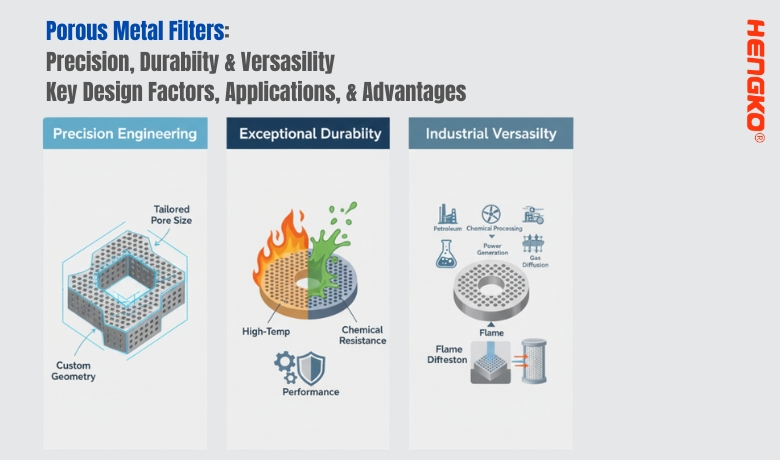
Porous metal filters combine precision engineering with exceptional durability, offering reliable performance in demanding industrial environments.
Through advanced sintering technology, these filters can be tailored in pore size, material, and geometry to meet specific process needs
— from high-pressure chemical systems to precision gas diffusion.
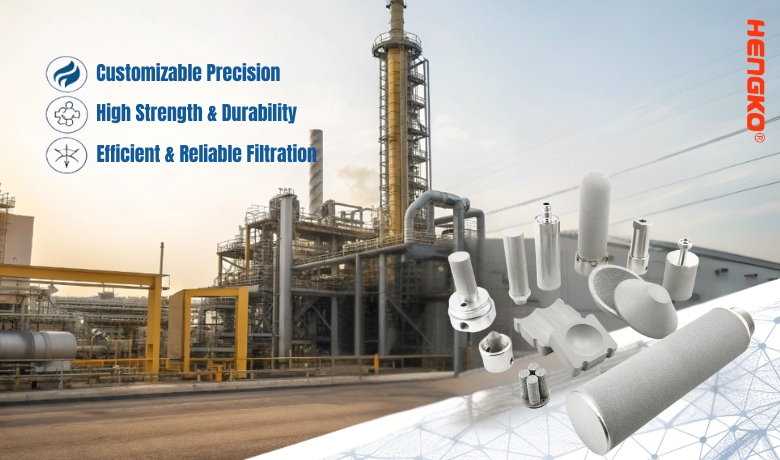
The table below summarizes the key design factors, applications, and advantages that make porous metal filters a trusted choice for critical filtration solutions.
| Aspect | Description | Key Benefits / Examples |
|---|---|---|
| Design Flexibility | Porous metal filters can be produced in both standard and custom configurations due to precise control of pore size, porosity, and geometry. | Enables customized solutions for diverse industrial applications. |
| Manufacturing Process | Sintering allows manufacturers to bond metal particles uniformly, ensuring consistent pore structure and mechanical integrity. | Achieves accurate filtration performance and long service life. |
| Material Selection | Materials are chosen based on chemical compatibility, corrosion resistance, and temperature/pressure requirements. | Common materials: SS304, SS316L, nickel, Hastelloy, titanium. |
| Performance Factors | Critical design factors include pore size, permeability, efficiency, and mechanical strength. | Optimized balance between filtration precision and flow rate. |
| Industrial Applications | Used across chemical processing, petroleum refining, power generation, gas diffusion, and environmental control. | Handles aggressive chemicals, high pressure, and high temperatures. |
| Special Functions | Can serve as flame arrestors, flow equalizers, spargers, or precision filters for high-temperature gases and liquids. | Enhances safety, stability, and contamination control. |
| Customization Options | Filters can be tailored for specific gases, liquids, or separation requirements, with adjustable pore sizes and geometries. | Ensures consistent flow control and compliance with process standards. |
| Operational Advantages | Delivers high durability, corrosion resistance, and reliable separation even in extreme conditions. | Extends service life and reduces maintenance frequency. |
| Regulatory & Efficiency Goals | Designs can meet strict regulatory or performance standards in critical industries. | Supports efficiency maximization and process reliability. |
7. Applications Across Industries
Porous metal filters are trusted across a wide range of industries where precision, purity, and reliability are critical.
Their robust structure and resistance to heat and corrosion make them suitable for both gas and liquid applications.
They are widely used in industrial applications involving the filtration and flow control of various fluids, ensuring dependable performance in demanding environments.
*Compressed Air & Gas Purification:
Remove oil mist, dust, and moisture to ensure clean, dry air in pneumatic and instrumentation systems.
*Catalyst Recovery & Chemical Filtration:
Used in reactors and chemical plants to capture fine catalyst particles and resist corrosive solvents or acids.
*Semiconductor & Hydrogen Systems:
Provide high-purity gas filtration and particle control under extreme temperatures and pressures.
*Pharmaceutical & Food-Grade Processes:
Guarantee hygienic filtration, easy cleaning, and compliance with strict purity standards.
*Environmental Monitoring & Gas Analysis:
Protect sensitive sensors and analyzers from particulates while maintaining fast, accurate gas flow.
Porous metal filters are especially effective in gas applications where blowback cleaning is required to maintain performance.
From compressed air to high-tech semiconductor fabs, porous metal filters play a vital role in keeping processes clean, safe, and efficient.
8. Maintenance and Cleaning of Porous Metal Filters
To ensure porous metal filters continue to deliver optimal performance, regular maintenance and cleaning are essential.
Over time, contaminants and debris can accumulate within the filter’s porous structure, reducing permeability and filtration efficiency.
Routine cleaning—such as backflushing or blowback
—helps dislodge and remove these trapped particles, restoring the filter’s original flow characteristics.
For more demanding applications or when dealing with stubborn contaminants, ultrasonic or chemical cleaning methods may be recommended.
These processes can effectively clean deep within the filter’s pores without compromising the integrity of the metal or its porosity.
It’s important to always follow the manufacturer’s maintenance guidelines to avoid damaging the filter and to maintain its high level of performance.
Many porous metal filters are designed with features like cleaning indicators or integrated flush nozzles, making it easier to monitor filter condition and perform maintenance as needed.
By maintaining the filter’s structure and permeability, industries benefit from longer filter life, reduced downtime, and improved process efficiency.
For specific maintenance procedures or troubleshooting, it’s best to consult the filter manufacturer or a qualified service provider to ensure your porous metal filters continue to meet the highest standards of performance.
9. Why Choose HENGKO as Your Porous Metal Filter Partner
When it comes to high-performance porous metal filters, HENGKO stands out as a trusted source manufacturer
with deep expertise in both design and sintering technology.
Our engineering team focuses on delivering precision, reliability, and customization to meet the most demanding industrial needs.
*In-House Sintering & Design Capability:
Complete control over the powder metallurgy and sintering process, with expertise in the manufacture of high-quality porous metal filters, ensures consistent pore structure, strength, and quality in every filter.
*Wide Material Range:
From SS304 and SS316L to Nickel and Titanium, we supply materials optimized for diverse environments
— from standard air systems to high-corrosion chemical plants.
*Custom OEM Solutions:
We tailor every filter’s pore size, shape, and fitting to your process requirements, offering technical consultation for optimal performance and integration.
*Proven Industry Experience:
HENGKO filters are widely used in semiconductor, hydrogen energy, pharmaceutical, chemical,
and environmental monitoring applications around the world.
We serve various industries and can manufacture custom solutions to meet the specific needs of each client.
Partner with HENGKO to get not just a filter — but a complete, engineered filtration solution built for precision and longevity.
8. FAQ
1. What is the main difference between SS304 and SS316L in filtration applications?
The primary difference between SS304 and SS316L lies in their corrosion resistance and suitability for harsh environments. SS316L contains molybdenum, which significantly improves its resistance to chlorides, acids, and corrosive gases. This makes SS316L the preferred choice for demanding filtration applications such as semiconductor gas systems, chemical processing, and marine environments.
In contrast, SS304 is more cost-effective and performs well in general-purpose filtration, including:
•Air filtration
•Water treatment
•Non-corrosive gas applications
However, in environments with high humidity, salt exposure, or aggressive chemicals, SS304 may degrade faster than SS316L.
For critical filtration systems where longevity and stability are essential, SS316L is typically recommended.
2. Is SS316L always better than SS304 for porous metal filters?
SS316L is not always the better option—it depends on the application conditions.
While SS316L offers superior corrosion resistance and better performance in aggressive environments,
SS304 can be more than sufficient for standard applications and offers a cost advantage.
For example:
•Use SS304 for clean air filtration, general industrial gas, and low – corrosion environments.
•Use SS316L for high – purity gas systems, chemical exposure, or high-humidity environments.
Choosing SS316L unnecessarily can increase costs without delivering additional value.
Therefore, material selection should be based on operating conditions rather than assuming one material is universally better.
3. When should nickel be used instead of stainless steel filters?
Nickel is typically selected when filtration systems operate under extreme conditions that exceed the limits of stainless steel.
This includes:
•High – temperature environments (often above 500°C)
•Strongly corrosive chemical exposure (e.g., acids, alkalis)
•Hydrogen – rich or reducing atmospheres
Compared to stainless steel, nickel offers superior resistance to oxidation and chemical degradation under extreme conditions.
However, it is significantly more expensive and less commonly used for standard filtration applications.
In most industrial cases, SS316L provides sufficient performance.
Nickel is reserved for specialized applications where stainless steel would fail.
4. What material is best for high-temperature porous metal filters?
For high-temperature filtration, the best material depends on the temperature range and chemical exposure:
•Up to ~400°C – SS304 or SS316L is generally sufficient
•400°C – 600°C: SS316L is preferred due to better oxidation resistance
•Above 600°C or in aggressive environments – Nickel or high-performance alloys (e.g., Inconel) are recommended
Nickel-based materials maintain structural integrity and corrosion resistance at elevated temperatures where stainless steel may weaken or oxidize.
Therefore, for extreme high-temperature filtration, nickel or advanced alloys are typically the optimal choice.
5. How does corrosion resistance affect filter performance?
Corrosion resistance directly impacts the lifespan, reliability, and filtration efficiency of porous metal filters.
When a filter material corrodes:
•Pore structure may degrade
•Filtration accuracy can become unstable
•Mechanical strength decreases
•Risk of contamination increases
For example, in chloride-rich environments, SS304 may corrode over time, leading to reduced performance.
SS316L, with enhanced corrosion resistance, maintains stable filtration characteristics under the same conditions.
Selecting the right material ensures consistent performance and reduces maintenance frequency and replacement costs.
6. Which material is more cost-effective: SS304, SS316L, or nickel?
From a cost perspective:
•SS304 → most economical
•SS316L → moderate cost (higher than 304 due to molybdenum content)
•Nickel → significantly more expensive
SS304 is ideal for cost-sensitive applications with mild operating conditions.
SS316L offers a balance between cost and performance, making it the most widely used material in industrial filtration.
Nickel, while offering superior performance in extreme environments, is typically only used when absolutely necessary due to its high cost.
The most cost-effective solution is not the cheapest material, but the one that meets performance requirements without over-specification.
7. What is the best material for high-purity gas filtration systems?
For high-purity gas systems, such as those used in semiconductor manufacturing or analytical instruments,
SS316L is generally the preferred material.
This is due to:
•Excellent corrosion resistance
•Low carbon content (reduces contamination risk)
•Stable pore structure
•Compatibility with ultra – clean environments
In some ultra-high purity (UHP) applications, additional surface treatments such as electropolishing may be applied to SS316L to further improve cleanliness and reduce particle shedding.
Nickel is typically not required unless the system involves extreme temperatures or aggressive chemical exposure.
8. Does pore size stability differ between SS304, SS316L, and nickel?
Yes, pore size stability can vary depending on the material, especially under harsh operating conditions.
While all three materials can be manufactured with precise and uniform pore structures, their long-term stability differs:
•SS304 – May experience degradation in corrosive environments
•SS316L – Offers better structural and chemical stability
•Nickel – Maintains pore integrity even under extreme temperature and chemical stress
For applications requiring long-term filtration accuracy and stability, especially in aggressive environments, SS316L or nickel is preferred over SS304.
9. How do I choose the right material for my filtration application?
Choosing the right material involves evaluating several key factors:
•Operating temperature
•Chemical exposure (corrosive or not)
•Pressure conditions
•Required lifespan
•Budget constraints
A simplified selection guideline:
•Mild conditions → SS304
•Corrosive or high – humidity environments → SS316L
•Extreme temperature or chemical exposure → Nickel or advanced alloys
In many industrial cases, SS316L provides the best balance of performance, durability, and cost.
10. Can stainless steel filters be used in aggressive chemical environments?
Stainless steel filters can be used in aggressive chemical environments, but the choice of grade is critical.
SS304 has limited resistance to strong acids and chlorides and may corrode over time. SS316L, with improved corrosion resistance, performs much better in such conditions and is widely used in chemical processing and pharmaceutical applications.
However, in extremely aggressive environments involving strong acids, alkalis, or high temperatures, even SS316L may not be sufficient. In such cases, nickel or specialized alloys like Hastelloy may be required.
Proper material selection ensures both safety and long-term performance.
8. Conclusion
Choosing the right material for your porous metal filter is crucial to achieving long-term reliability, efficiency, and cost-effectiveness.
Each metal — whether SS304, SS316L, or Nickel alloy — offers unique strengths for different environments and processes.
A careful match between your application conditions and filter material ensures stable performance and fewer maintenance issues.
Before placing an order, it’s always best to consult a filtration expert who understands your system’s fluid type, temperature, and chemical exposure. The right advice can extend your filter’s life and improve overall process safety.
Need help selecting the best porous metal filter material for your filtration system?
Contact our technical team at ka@hengko.com or visit www.hengko.com to discuss your application and receive a tailored filtration solution.
Post time: Nov-01-2025


