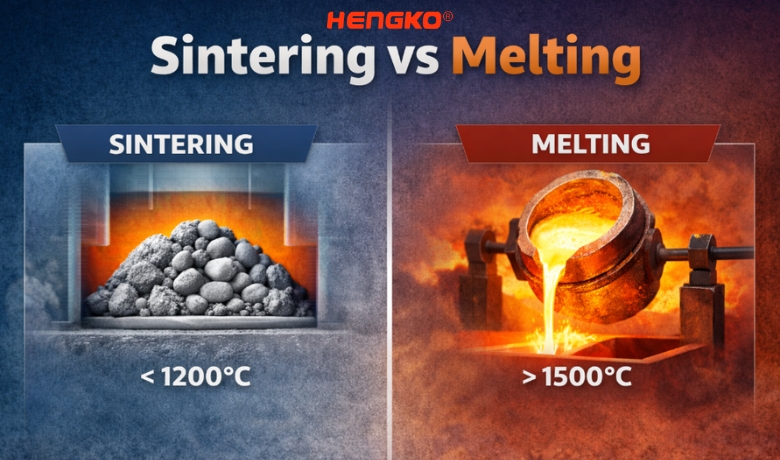
Sintering vs Melting: What’s the Difference?
A Practical Guide for Metal Parts & Sintered Porous Stainless Products
Introduction
In modern metal parts manufacturing, choosing the right production process can directly
impact product performance, cost, and reliability. Two of the most commonly discussed
techniques are sintering and melting, yet many engineers and buyers still confuse these
terms or use them interchangeably. Understanding the real difference between sintering vs melting
is essential for making informed decisions in applications such as filtration, automotive components,
medical devices, and high-precision industrial parts.
In this guide, you will learn:
*What melting and sintering actually mean in metal manufacturing
*How each process works at the material and temperature level
*The key differences in energy use, structure, and final product properties
*Which applications are better suited for sintering and which require melting
By the end of this article, you will have a solid foundation in sintering vs melting,
allowing you to confidently choose the right process for your next metal parts project.
What Is Melting?
2.1 Definition
Melting is a metal manufacturing process in which a solid material is heated to a temperature
above its melting point, causing it to transform from a solid state into a liquid state and then
solidify again after cooling.
In simple terms, melting follows a high-temperature phase change sequence: solid → liquid → solid.
This process is widely used in traditional metalworking methods such as casting and welding,
where metal must be fully liquefied in order to reshape or join components. In the comparison of
sintering vs melting, melting represents a complete phase transition process that relies on full
liquefaction of the metal.
2.2 How Melting Works in Metal Manufacturing
In industrial metal production, melting is the foundation of processes such as foundry casting,
metal forming, and welding.
First, raw metal (ingots, scrap, or alloys) is heated in a furnace until it reaches a temperature
above its melting point. The molten metal is then poured into a mold or applied to a joint area,
where it cools and solidifies into the desired shape.
A key concept in melting-based manufacturing is the formation of a molten pool.
This molten pool allows metal atoms to rearrange freely, creating a continuous and dense
structure after solidification. The final part’s geometry is determined by the mold design or welding path,
making melting suitable for producing solid, fully dense metal components.
2.3 Common Melting Methods
Several industrial techniques are commonly used to achieve metal melting:
*Induction Melting
Uses electromagnetic induction to heat metal rapidly and uniformly. It offers precise temperature
control and is widely used for stainless steel, copper, and alloy melting in foundries.
*Arc Furnace / Crucible Melting
Employs electric arcs or high-temperature crucibles to melt metals at extremely high temperatures.
This method is common in steel production, recycling operations, and heavy industrial manufacturing.
These methods ensure complete liquefaction of metal, which is essential for traditional casting
and joining processes.
2.4 Advantages & Limitations of Melting
Advantages
*Full liquefaction leads to uniform structure
Because the metal becomes fully liquid, the material can solidify into a relatively homogeneous
microstructure when cooled under controlled conditions.
*Ability to form complex shapes using molds
Melting allows manufacturers to create intricate geometries that would be difficult to achieve
through machining alone.
Limitations
*Higher energy consumption and operating cost
Reaching melting temperatures requires significant heat input, making the process more
energy-intensive than solid-state methods such as sintering.
*Larger grain size may reduce mechanical performance
During solidification, grain growth can occur, sometimes resulting in inferior mechanical properties
compared to fine-grained powder metallurgy products.
*Not suitable for porous or controlled-porosity parts
Since melting eliminates all voids and pores, it cannot produce porous structures required for
applications such as filtration, gas diffusion, or fluid control.
3. What Is Sintering?
3.1 Definition
Sintering is a manufacturing process in which metal powder particles are bonded together
through heat without reaching their melting point. Unlike melting, sintering is a solid-state process
that operates at temperatures below the metal’s melting temperature.
During sintering, individual powder particles do not become liquid. Instead, they are joined by
atomic diffusion, forming strong metallurgical bonds while maintaining a controlled porous or
semi-dense structure. This fundamental difference is what separates sintering from melting in the
comparison of sintering vs melting.
Sintering is a core technology in powder metallurgy basics, widely used to manufacture precision
components, porous filters, and functional metal parts.
3.2 How Sintering Works
The sintering process generally involves two main stages:
*Powder Compaction (Pressing)
Metal powders such as stainless steel, bronze, or nickel alloys are first compressed into a specific
shape using a mold or die.
This step creates a “green part” with sufficient mechanical strength for handling before sintering.
*Controlled Heating and Atomic Diffusion
The compacted part is then heated in a furnace under controlled temperature and atmosphere
conditions. As the temperature rises close to—but below—the melting point, atoms diffuse across
particle boundaries. This diffusion forms strong bonds between particles while preserving
a designed level of porosity.
Unlike melting, no molten pool is created. The shape and structure remain stable throughout
the process, enabling precise dimensional control and repeatability.
3.3 Common Sintering Technologies
Several industrial sintering methods are commonly used in metal manufacturing:
*Vacuum Sintering
Performed in a vacuum furnace to prevent oxidation and contamination.
This method is ideal for high-purity stainless steel, titanium, and specialty alloys
used in medical and high-tech applications.
*Hydrogen Atmosphere Sintering
Uses a hydrogen-rich environment to reduce surface oxides and improve bonding between
powder particles. It is widely applied in stainless steel and copper-based powder metallurgy products.
*Continuous Belt Furnaces
Designed for high-volume production with consistent temperature profiles.
These furnaces are commonly used in automotive and industrial component manufacturing
due to their efficiency and stable output.
Each of these technologies supports the precise control required for producing porous
and structural parts through sintering.
3.4 Advantages & Limitations of Sintering
Advantages
*Lower processing temperature and reduced energy consumption
Since sintering occurs below the melting point, it typically requires less energy compared to
melting-based processes.
*High precision porous products
Sintering enables controlled porosity, making it ideal for applications such as filters, diffusers,
silencers, and flow control components.
*Efficient material utilization with minimal waste
Powder metallurgy allows near-net-shape manufacturing, reducing machining and scrap material.
Limitations
*Requires specialized powder metallurgy equipment and expertise
Sintering depends on powder preparation, compaction tools, and controlled atmosphere furnaces,
which may involve higher initial setup costs.
Density control can be challenging
Achieving uniform density and mechanical strength across large or complex parts requires careful
control of powder distribution, pressure, and sintering parameters.
4. Sintering vs Melting — Side-by-Side Comparison
To clearly understand the difference between these two manufacturing processes, the following table compares
sintering vs melting across key technical and practical factors relevant to industrial metal production.
| Feature | Sintering | Melting |
|---|---|---|
| Process Type | Solid-state bonding through atomic diffusion | Liquid-phase forming through full liquefaction |
| Temperature | Below the metal’s melting point | Above the metal’s melting point |
| Energy Use | Lower energy consumption | Higher energy consumption |
| Product Form | Porous or precision-engineered parts | Dense, bulk solid parts |
| Material Waste | Minimal waste (near-net-shape production) | Higher waste due to machining and scrap |
| Typical Industries | Powder metallurgy, filtration, fluid control | Ca |
Key Differences Explained
The most fundamental difference between powder metallurgy vs traditional melting lies in
how metal particles are bonded.
*Sintering relies on diffusion between solid particles, preserving controlled porosity and fine microstructure.
*Melting relies on complete liquefaction, followed by solidification into a dense structure.
From an energy and sustainability perspective, sintering benefits vs melting include lower operating
temperatures and reduced material loss. This makes sintering particularly attractive for manufacturers
seeking cost efficiency and environmentally responsible production.
In terms of product performance, melting is ideal for applications requiring fully dense structural
components, while sintering excels in applications that demand precise porosity,
consistent permeability, and dimensional accuracy, such as metal filters and diffusers.
5. When to Use Sintering vs Melting
Choosing between sintering and melting depends on the functional requirements of the final product.
Each process serves different manufacturing goals, and understanding their strengths helps engineers
and buyers make more informed decisions when comparing sintering vs melting.
Best Cases for Sintering
Sintering is most suitable for applications that require controlled porosity, high
dimensional accuracy, and efficient material usage.
Typical use cases include:
*Porous stainless steel filters
Sintering is ideal for manufacturing filtration media used in gas and liquid systems.
The process allows precise control of pore size and permeability, which is impossible to
achieve through melting-based methods.
*Precision components with tight tolerances
Powder metallurgy produces near-net-shape parts that require minimal machining.
This is especially valuable for small, complex components used in sensors,
medical devices, and fluid control systems.
*Functional metal parts with specific performance requirements
Applications such as diffusers, silencers, and flow restrictors benefit from sintered
structures that combine mechanical strength with engineered porosity.
Best Cases for Melting
Melting-based manufacturing is better suited for products that demand
fully dense structures and high ductility.
Common applications include:
*Large castings and structural parts
Heavy machine frames, pump housings, and industrial components often rely on melting and casting to
achieve their size and strength requirements.
*Bulk metal parts requiring high ductility or toughness
Components that must withstand bending, impact, or large mechanical loads benefit from the continuous
grain structure formed during solidification.
*Welded assemblies and repaired components
Welding relies entirely on melting to join metal parts together, making it essential
for fabrication and construction industries.
Key Decision Factors
When evaluating sintering vs melting, manufacturers and procurement teams
should consider the following factors:
*Cost
Sintering can reduce material waste and post-machining costs, while melting often involves
higher energy consumption and additional finishing operations.
*Performance requirements
Dense structural strength favors melting, whereas permeability and controlled
microstructure favor sintering.
*Porosity needs
If the application requires filtration, diffusion, or fluid flow control, sintering is the only practical choice.
*Geometry and part complexity
Sintering supports near-net-shape production of small, complex parts, while melting is
better for large or thick components.
Ultimately, there is no single “best” process. The right choice depends on balancing cost,
performance, porosity, and geometry to meet the specific demands of each application.
6. Real-World Applications
Understanding the difference between sintering vs melting becomes clearer when examining
real-world industrial applications. Each process supports different product functions and performance
requirements across multiple industries.
Sintered Porous Stainless Steel Parts (B2B Product Examples)
Sintered porous stainless steel components are widely used in industries that require
controlled permeability, corrosion resistance, and long service life.
These parts are manufactured through powder metallurgy rather than melting, allowing
precise control of pore size and flow rate.
Common applications include:
*Sintered metal filters for gas and liquid purification
*Porous diffusers and spargers for aeration and chemical processing
*Flow restrictors and pressure dampers for instrumentation systems
(Internal link opportunity: Sintered Metal Filters, Porous Stainless Steel Diffusers, Sintered Porous Plates)
These products demonstrate the practical advantages of sintering over melting
when porosity and filtration performance are critical.
Automotive Components
Powder metallurgy and sintering are extensively used in the automotive industry to produce
high-volume precision parts such as:
*Bearings and bushings
*Sensor housings
*Valve guides and gears
These components benefit from sintering’s ability to achieve consistent dimensions with
minimal material waste, making it ideal for large-scale manufacturing.
Aerospace Powder Metallurgy Parts
In aerospace engineering, powder metallurgy enables the production of high-strength components
from advanced alloys that are difficult to process using traditional melting techniques.
Typical applications include:
*Turbine engine components
*Heat-resistant structural parts
*Lightweight brackets and connectors
Vacuum sintering is often used to ensure purity and prevent oxidation,
which is essential for aerospace-grade materials.
Industrial Filtration Media
One of the most important real-world uses of sintering is in industrial filtration systems.
Sintered stainless steel media provide:
*Uniform pore size distribution
*High mechanical strength
*Resistance to high pressure and temperature
These properties make sintered filters suitable for chemical processing, pharmaceutical production,
food and beverage industries, and semiconductor gas purification.
By integrating sintered porous products into industrial systems, manufacturers can achieve superior
performance compared to components made through melting-based methods.
These examples clearly illustrate how powder metallurgy vs traditional melting leads to different
solutions depending on the application.
FAQ — Sintering vs Melting
Q1: Is sintering stronger than melting?
Is sintering stronger than melting?
Not necessarily. Strength depends more on the final microstructure and application
requirements than on the process alone.
Melting-based processes typically produce fully dense parts with continuous grain structures,
which can offer higher tensile strength and ductility for structural applications.
However, sintered parts can achieve excellent mechanical strength when properly designed,
especially when high-density sintering or secondary processes such as hot isostatic pressing (HIP) are applied.
In many industrial uses
—such as filters, diffusers, and flow control components
—strength is not the primary goal. Instead, controlled porosity and permeability are critical,
making sintering the superior choice despite slightly lower bulk strength compared to melted metal parts.
Q2: Can sintered parts be fully dense?
Can sintered parts be fully dense like melted metal parts?
Yes, sintered parts can approach or even achieve near-full density under certain conditions.
Advanced powder metallurgy techniques such as:
*High-pressure compaction
*Vacuum sintering
*Hot isostatic pressing (HIP)
can significantly reduce internal porosity.
However, in many applications, full density is not desirable.
Sintered products are often designed with controlled porosity to enable functions such as filtration,
lubrication, or gas diffusion.
This ability to engineer internal structure is one of the main advantages of sintering over melting.
Q3: Does sintering save cost compared to casting?
Does sintering save cost vs traditional casting?
In many cases, yes. Sintering can reduce total manufacturing cost through:
*Near-net-shape production
*Reduced machining and finishing
*Lower material waste
*Lower melting temperature and energy consumption
For high-volume precision components, powder metallurgy is often more economical than
casting or machining from solid blocks. However, for very large parts or low-volume production,
traditional melting and casting may still be more cost-effective.
Cost efficiency depends on part size, complexity, production volume, and material selection.
Q4: How does porosity affect product performance?
How does porosity affect product performance?
Porosity directly influences properties such as:
*Flow rate and permeability
*Filtration efficiency
*Surface area
*Mechanical strength
In filtration and diffusion applications, controlled porosity is essential for achieving consistent performance.
Smaller pore sizes increase filtration accuracy but reduce flow rate, while larger pores allow higher
throughput with less resistance.
This balance between porosity and strength is one of the key design considerations in
sintered metal products and is impossible to achieve through melting-based processes.
Q5: Is sintering more environmentally friendly than melting?
Is sintering more environmentally friendly than melting?
Generally, yes. Sintering is often considered more sustainable because it:
*Requires lower processing temperatures
*Consumes less energy
*Produces minimal scrap and waste
*Uses near-net-shape manufacturing
Traditional melting processes require high heat and frequently involve secondary machining
steps that generate waste material.
Powder metallurgy improves material utilization and can support greener manufacturing goals.
Q6: Can sintering replace melting in all metal applications?
Can sintering replace melting in all applications?
No. Sintering and melting serve different manufacturing needs and are complementary
rather than interchangeable.
Melting is essential for:
*Large structural components
*Welded assemblies
*Applications requiring high ductility
Sintering is ideal for:
*Precision components
*Porous functional parts
High-volume standardized products
Choosing between them depends on geometry, performance requirements, and cost targets.
Q7: Which process offers better dimensional accuracy?
Which process offers better dimensional accuracy: sintering or melting?
Sintering generally offers better dimensional control for small and complex parts due to:
*Precision molds
*Limited deformation during heating
*Near-net-shape manufacturing
Melting and casting can experience shrinkage and distortion during solidification,
often requiring additional machining to achieve tight tolerances.
This makes sintering especially suitable for sensors, medical components, and micro-mechanical parts.
Q8: How do microstructures differ between sintered and melted metals?
How do microstructures differ between sintered and melted metals?
Sintered metals consist of bonded powder particles with controlled inter-particle boundaries
and optional porosity. Their microstructure can be engineered to achieve specific flow,
filtration, or mechanical properties.
Melted metals solidify from a liquid state and typically form larger grains with continuous structures.
While this can provide excellent bulk strength, it lacks the microstructural flexibility of powder metallurgy.
This fundamental difference explains why powder metallurgy vs traditional melting leads to
different material performance and application possibilities.
Conclusion
Understanding the difference between sintering vs melting is the first step toward choosing
the most efficient manufacturing process for your metal parts.
To help you make the right decision faster and with confidence, we invite you to explore
the following resources:
Looking for custom sintered porous stainless steel components such as filters, diffusers,
or precision parts?
Our engineering team can help you select the right material, pore size, and manufacturing
process for your project.
Post time: Jan-24-2026


