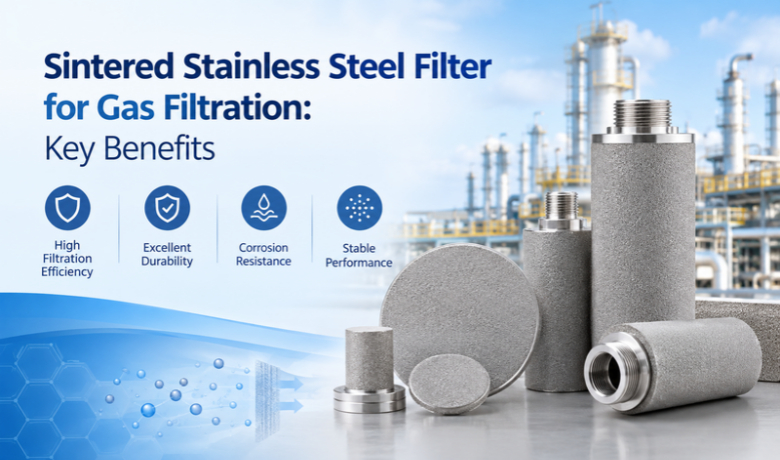
Sintered Stainless Steel Filter for Gas Filtration: Key Benefits, Selection Guide & Engineering Considerations
Gas filtration sounds simple: choose a filter with a sufficiently small micron rating, install it in the gas line, and remove unwanted particles.
In real industrial systems, it is rarely that simple.
A 5 μm filter that works well in one compressed-air line may create unacceptable pressure drop in another. A 1 μm filter may provide finer particle control but clog much faster than expected. A filter element capable of withstanding high temperature may still fail because its gasket, weld, housing, or connection was not designed for the same operating condition.
This is why selecting a sintered stainless steel filter for gas filtration should start with the process—not with the micron rating.
Engineering Starting Point
Before selecting a gas filter, define the gas, contaminant, required particle control, flow rate, operating pressure, allowable differential pressure, temperature, and maintenance strategy.
The answers determine whether sintered stainless steel is appropriate and, if so, what pore structure, filtration area, dimensions, material, and connection should be selected.
This guide explains how sintered stainless steel gas filters work, where they provide advantages, how pore size relates to filtration performance, and what engineers should consider before specifying one.
What Is a Sintered Stainless Steel Gas Filter?
A sintered stainless steel filter is a rigid porous metal component produced by forming stainless steel powder or other porous metal structures and bonding them through a controlled sintering process.
Unlike a perforated plate, the material contains a network of interconnected pores through which gas can travel.
Unfiltered Gas → Interconnected Porous Network → Particle Capture → Filtered Gas
The three-dimensional pore network is important.
Particles are not necessarily captured only at the outer surface. Depending on particle size, pore structure, gas velocity, and filter design, contaminants may also be captured within the depth of the porous material.
This gives sintered metal filters a combination of characteristics that is difficult to obtain from conventional disposable filter media:
Controlled porosity + mechanical strength + temperature resistance + corrosion resistance + cleanability.
316L stainless steel is particularly common where corrosion resistance, cleanliness, mechanical stability, and long service life are important.
However, the material itself is only one part of filter selection. A good gas filter must provide sufficient contaminant removal without creating excessive resistance to gas flow.
That trade-off is central to gas filtration engineering.
Key Benefits of Sintered Stainless Steel for Gas Filtration
1. Stable Pore Structure Under Demanding Conditions
One major advantage of sintered stainless steel is that its filtration structure is formed from a rigid metallic matrix.
This matters in applications involving elevated temperature, pressure fluctuations, vibration, repeated cleaning, high gas velocities, and long operating cycles.
Flexible fibers and some polymeric filter media may deform or change characteristics under demanding conditions. A properly manufactured sintered metal element maintains a comparatively stable physical pore structure.
For an engineer, the benefit is not simply “high strength.” The more important benefit is predictability.
If the porous structure changes significantly during service, pressure drop, flow characteristics, and filtration behavior may also change. A mechanically stable porous structure helps make filter behavior more repeatable.
2. Mechanical Strength for Pressurized Gas Systems
Sintered stainless steel filters are commonly considered for compressed air and process-gas systems because porous metal can combine filtration capability with substantial mechanical strength.
Typical applications may involve compressed air, nitrogen, carbon dioxide, hydrogen, process gases, analyzer gas lines, pneumatic systems, and instrumentation gas.
Important Engineering Distinction
Operating pressure is not the same as differential pressure across the filter.
Suppose a filter operates in a gas line at 20 bar. That does not automatically mean the porous element continuously experiences a 20 bar pressure difference across its wall.
For filtration performance, one of the most important values is:
ΔP = P1 − P2
P1 = upstream pressure | P2 = downstream pressure
If both sides are close to 20 bar, the differential pressure across the porous element may be relatively small. If contamination accumulates and flow becomes restricted, differential pressure can increase.
Therefore, when specifying a filter for a high-pressure gas system, engineers should provide both system operating pressure and expected or maximum differential pressure.
3. Corrosion Resistance with 316L Stainless Steel
316L stainless steel is frequently selected for industrial gas filtration because it provides useful corrosion resistance across many industrial environments.
This can be especially important when the gas contains moisture or when condensate may form inside the system.
However, specifying “316L” should never replace a proper compatibility review. Engineers should also consider moisture content, possible condensates, chlorides, process chemicals, operating temperature, cleaning chemicals, and exposure duration.
Practical engineering rule: evaluate the actual process environment, not only the name of the gas.
4. High-Temperature Gas Filtration Capability
Metal filtration media can operate in environments where many polymer-based filtration materials become unsuitable.
This makes sintered stainless steel attractive for hot process gases, furnace and thermal-process sampling, high-temperature instrumentation, chemical processing, catalyst protection, and heated gas lines.
There is an important qualification, however.
Filter system temperature rating ≠ porous material temperature rating.
A complete filter may contain a porous element, solid metal components, welds, fittings, gaskets, O-rings, and a housing.
The practical temperature rating is determined by the complete assembly and operating environment. For example, the porous 316L element itself may tolerate a temperature that an elastomer seal cannot.
Always evaluate the weakest temperature-sensitive component in the assembly.
5. Cleanable and Reusable
Many disposable gas filters are replaced after contamination reaches a specified level. Sintered stainless steel provides another option: depending on the contaminant and filter design, the element may be cleaned and reused.
Possible cleaning methods include reverse-flow cleaning, ultrasonic cleaning, compatible solvent cleaning, chemical cleaning, clean compressed-gas blowback, or combinations of these methods.
The appropriate method depends strongly on what has entered the pores. Dry, loosely retained particles are generally easier to remove than sticky, oily, chemically deposited, or deeply embedded contamination.
Cleanable does not mean infinitely reusable, and visually clean does not mean performance has been fully restored.
After cleaning, useful indicators include gas flow at a defined pressure differential, differential pressure at a defined flow, permeability, and integrity testing where required.
A filter can look clean externally while contamination remains inside its tortuous pore network. For reusable filters, flow recovery is often more informative than visual inspection alone.
6. Flexible Shapes for OEM Gas Filtration
Sintered stainless steel does not have to be manufactured only as a conventional cartridge.
Depending on manufacturing requirements, porous metal components can be produced or integrated as tubes, discs, cylinders, cups, porous tips, threaded filter elements, welded assemblies, filter cartridges, custom housings, and OEM components.
Connections may include NPT, BSP, flanges, compression-style interfaces, sanitary connections, or custom machined structures.
This is particularly valuable for OEM equipment where space, dead volume, connection geometry, filtration area, and installation method may matter as much as micron rating.
How Does a Sintered Stainless Steel Filter Remove Particles from Gas?
It is tempting to describe gas filtration as a simple sieve:
“A 5 μm pore stops every particle larger than 5 μm and passes every particle smaller than 5 μm.”
Real filtration is more complicated.
Particle capture in porous filtration systems can involve several mechanisms, including physical restriction, interception, inertial effects, diffusion for very small particles, and depth capture within the pore network.
| Mechanism | How It Contributes to Particle Capture |
|---|---|
| Physical restriction | Particles encounter pore passages too restrictive for their geometry. |
| Interception | Particles following the gas stream contact the pore structure. |
| Inertial effects | Particles may not follow changing gas-flow paths perfectly and can impact the solid structure. |
| Diffusion | Very small particles can deviate from streamlines and interact with the pore surface. |
| Depth capture | Particles may be retained within tortuous three-dimensional pore pathways. |
Engineering Insight: Pore size should not automatically be interpreted as an absolute particle-retention cutoff.
Pore Size vs. Filtration Rating: What Should Engineers Actually Specify?
This is one of the most common sources of confusion when purchasing porous metal filters.
Consider a specification that simply says:
“316L filter, 5 μm.”
What exactly does 5 μm mean?
Is it nominal pore size, maximum pore size, nominal particle retention, absolute retention rating, a value derived from a bubble-point test, or a manufacturer-specific grade?
Without a defined test method, the number can be ambiguous.
ASTM E128 provides a useful reference for rigid porous filters made from materials including sintered metal. The method addresses both maximum pore diameter and permeability. Maximum pore diameter is determined using a wetted filter and the pressure at which the first bubble passes through it, while permeability is evaluated from airflow under differential pressure. [1]
| Parameter | What It Helps Describe | What It Does Not Establish by Itself |
|---|---|---|
| Nominal pore size | General pore structure or manufacturer grade | Absolute particle cutoff |
| Maximum pore diameter | Largest detected flow-related pore | Overall filtration efficiency |
| Bubble-point-related value | Information related to large open pore pathways | Complete particle-retention behavior |
| Gas permeability | Ease with which gas passes through the material | Particle-removal efficiency |
| Filtration efficiency | Fraction of specified particles removed | Pressure drop or service life by itself |
A Better Specification Question
What filtration performance is required, under what flow and differential-pressure conditions, and how is that performance verified?
The Most Important Trade-Off: Filtration Efficiency vs. Pressure Drop
Suppose an application currently uses a 10 μm filter and the engineer wants cleaner downstream gas.
A natural response is:
“Let's change it to 1 μm.”
That may improve fine-particle control—but it may also create a new problem.
Finer porous structures generally create greater resistance to gas flow when other design variables remain similar.
Pressure drop can be affected by pore structure, porosity, filter thickness, filtration area, gas flow rate, gas properties, temperature, pressure, and contamination loading.
Before Increasing the Micron Rating to Reduce ΔP, Consider:
• Increasing the effective filtration area
• Optimizing porous wall thickness
• Using a longer or larger-diameter element
• Optimizing element geometry
• Adding staged prefiltration for high contaminant loading
“The best gas filter is not the filter with the smallest pore size. It is the filter that achieves the required gas cleanliness at an acceptable pressure drop and service life.”
A Practical 7-Parameter Method for Selecting a Sintered Stainless Steel Gas Filter
At HENGKO, we recommend treating filter selection as an engineering problem rather than choosing a product from a micron-size list.
1. Gas
What gas will pass through the filter? Examples include compressed air, nitrogen, CO₂, hydrogen, or other process gases. Material compatibility and system design can change substantially between applications.
2. Contaminant
What are you actually trying to remove—rust, pipe scale, catalyst fines, metal debris, process powder, compressor-generated particles, or atmospheric dust?
3. Required Particle Control
What particles must be removed, and what downstream cleanliness is required? Where possible, define a target particle-size distribution or removal performance rather than an arbitrary micron value.
4. Gas Flow
Specify required gas flow together with meaningful operating conditions and units. A filter that performs well at low flow may create unacceptable pressure loss when flow increases substantially.
5. Pressure
Provide inlet/system pressure, normal differential pressure, and maximum allowable differential pressure. These are not interchangeable specifications.
6. Temperature
Provide both normal operating temperature and maximum expected temperature. Short-term temperature excursions may also matter.
7. Operating Environment
Consider moisture, corrosion, cleaning method, sterilization requirements, vibration, installation space, required connection, and acceptable maintenance interval.
Once these seven parameters are known, filter selection becomes much more meaningful than simply choosing “1 μm,” “5 μm,” or “10 μm.”
How Should Sintered Stainless Steel Gas Filters Be Tested?
Testing should correspond to the property the engineer actually needs to verify.
Maximum Pore Diameter / Bubble-Point-Type Testing
ASTM E128 covers determination of maximum pore diameter and permeability for rigid porous filters, including sintered metal filters. [1]
For maximum pore diameter testing, the porous filter is wetted with a suitable liquid and pressure is applied until the defined first-bubble condition occurs.
This can be valuable for production consistency, pore-related quality control, detecting unusually large flow paths, and comparing filters before and after service.
It should not, however, be casually converted into an unsupported claim of absolute particle-removal efficiency.
Gas Permeability and Flow Testing
ASTM E128 also addresses permeability by measuring airflow through a rigid porous filter under differential pressure. [1]
Useful engineering specifications include:
Gas flow @ defined ΔP or ΔP @ defined gas flow, under defined test conditions.
This information is often more useful for real system design than a micron number alone.
What About ISO 8573 and Compressed-Air Filtration?
For compressed-air applications, ISO 8573 is an important reference family.
ISO 8573-1:2010 specifies compressed-air purity classes with respect to particles, water, and oil and also identifies gaseous and microbiological contaminants. [2]
This distinction matters because no single particulate filter automatically solves every compressed-air contamination problem.
Required Compressed-Air Purity
↓
ISO 8573
↓
Particulate Filter Performance Testing
↓
ISO 12500-3
↓
Rigid Porous Material Characterization
↓ ASTM E128
ISO 12500-3 provides guidance and procedures for determining solid-particle removal efficiency by particle size for compressed-air filters. [3]
Important: ISO 8573, ISO 12500-3, and ASTM E128 address different engineering questions. They should not be presented as interchangeable “certifications.”
Common Applications for Sintered Stainless Steel Gas Filters
Compressed Air
Compressed-air piping can contain solid contamination originating from the environment, corrosion, installation debris, or upstream equipment.
Sintered stainless steel elements may be used where robust particulate filtration, mechanical strength, or reusable construction is required.
However, ISO 8573-1 makes an important broader point: compressed-air contamination is not limited to particles; water and oil are also separately classified. [2]
Instrumentation and Gas Analyzers
Small particles can cause problems in sensors, sampling lines, pressure regulators, flow restrictors, valves, and analyzers.
In these systems, filter selection may involve another consideration beyond filtration efficiency: internal volume.
A very large filter may provide excellent filtration area and low pressure drop but introduce unnecessary internal volume into a gas sampling system.
For analyzer applications, response time, dead volume, and contamination retention therefore need to be balanced against filtration area.
Chemical and Petrochemical Process Gas
Process gas filtration can involve combinations of pressure, elevated temperature, corrosive conditions, particulate contamination, and continuous operation.
This is where the mechanical and thermal properties of sintered stainless steel can be particularly useful.
Material compatibility should nevertheless be evaluated against the complete process stream rather than assuming stainless steel is compatible with every chemical environment.
Nitrogen, CO₂ and Other Process Gases
Industrial gases are often used for blanketing, purging, processing, pneumatic control, or manufacturing.
Particulate contamination may originate not only from the supplied gas but also from piping, fittings, regulators, storage systems, installation debris, and downstream process equipment.
Point-of-use filtration can therefore be useful even when the original gas supply is relatively clean.
High-Temperature Gas and Sampling Systems
Sintered metal is particularly attractive where conventional polymer filtration media cannot tolerate the process temperature.
Typical uses can include heated sampling lines, thermal processes, furnace-related systems, and hot process gas.
Again, the complete filter assembly—not merely the porous metal—must be rated for the required temperature.
When Should You NOT Use a Sintered Stainless Steel Filter?
A good filter material is not the best filter material for every application.
Sintered stainless steel may not be the most economical or technically appropriate solution when:
• The filter is intended to be extremely low-cost and disposable.
• Contamination is predominantly sticky material that is difficult to remove from depth pores.
• The main requirement is removal of water vapor.
• Molecular gas purification is required.
• Oil vapor is the principal contaminant.
• The process chemical is incompatible with the selected stainless-steel grade.
• Validated sterile retention is required but the proposed filter has not been validated for that purpose.
A particulate filter should not be expected to perform the job of a dryer, coalescing stage, adsorber, or specialized gas purifier unless it has specifically been designed and validated for that function.
A Common Engineering Mistake: Selecting a Gas Filter by Micron Rating Alone
Consider a typical request:
“We need a 1 μm 316L stainless steel gas filter.”
That sounds like a complete specification. It isn't.
Before manufacturing the filter, we would want to know the gas, contamination, required flow rate, operating pressure, allowable differential pressure, operating temperature, available dimensions, connections, and whether the filter will be cleaned or replaced.
HENGKO Engineering Insight
Micron rating is only one design variable.
For example, when a customer requests finer filtration but reports that pressure drop is already a concern, immediately changing from 10 μm to 5 μm or 1 μm may make the problem worse.
Instead, we first look at the complete geometry:
Could filtration area be increased?
Could a longer porous tube be used?
Is the wall unnecessarily thick?
Could coarse contamination be removed upstream?
Could the housing accommodate a larger-diameter element?
This approach frequently produces a better solution than changing pore size alone.
How to Extend the Service Life of a Sintered Metal Gas Filter
Use Staged Filtration for Heavy Particle Loading
A fine porous element should not necessarily be asked to capture the entire contamination load.
Coarse Prefiltration → Finer Sintered Filter → Protected Downstream Equipment
Where gas contains substantial coarse particles, the coarse stage reduces the amount of material reaching the finer porous structure. This can extend service intervals and reduce the rate at which differential pressure increases.
Monitor Differential Pressure Instead of Relying Only on Time
A maintenance rule such as “clean the filter every three months” is convenient but may have little relationship to actual filter loading.
A more useful approach is to establish:
Clean-filter ΔP → Normal operating ΔP → Maintenance threshold ΔP
at a known operating flow.
Do Not Judge Cleaning Only by Appearance
Particles can penetrate into the three-dimensional pore structure. The outside may appear perfectly clean while internal contamination continues to restrict gas flow.
After cleaning, compare the filter against its clean baseline using:
Flow at a fixed ΔP or ΔP at a fixed flow.
If the original flow characteristics cannot be sufficiently recovered after repeated cleaning, replacement may be more appropriate.
Sintered Stainless Steel vs. Other Gas Filter Media
There is no universally “best” gas-filter medium. The correct material depends on the process.
| Filter Medium | Temperature | Mechanical Strength | Cleanable | Custom Shapes | Typical Strength |
|---|---|---|---|---|---|
| Sintered stainless steel | High | High | Often yes | Excellent | Industrial/process gas |
| Polymer membrane | Material-dependent | Lower | Often limited | Limited | Fine filtration |
| Fibrous media | Material-dependent | Moderate | Usually disposable | Moderate | Fine air/gas filtration |
| Porous ceramic | Very high | High but brittle | Often yes | Moderate | Hot/corrosive gas |
| Wire mesh | High | High | Yes | Excellent | Coarse filtration |
The right question is not “Is sintered stainless steel better?” but “Which medium best satisfies the required cleanliness, pressure drop, temperature, chemical compatibility, service life, maintenance strategy, and cost?”
What Information Should You Provide When Ordering a Custom Gas Filter?
A useful RFQ should include as much of the following information as possible:
Gas: Air / N₂ / CO₂ / H₂ / Other
Contaminant: __________
Required particle control: __________ μm or specified efficiency
Required gas flow: __________
Operating pressure: __________ bar
Maximum allowable ΔP: __________
Normal / maximum temperature: __________ °C
Material: 316L / Other
Filter dimensions: __________
Connection: NPT / BSP / Flange / Tri-Clamp / Custom
Cleaning method: __________
Quantity: __________
If some parameters are unknown, application information is often more useful than guessing.
For example, “We need to protect a downstream pressure regulator from pipe rust in a 10-bar nitrogen line” provides much more engineering context than “Please quote a 5 μm filter.”
Frequently Asked Questions About Gas Filtration
Can gases be filtered?
Yes. Gas streams can be filtered to remove suspended solid particles and, with appropriate separation technologies, other contaminants. Sintered stainless steel filters are particularly useful for solid particulate filtration in demanding industrial gas applications. Water, oil aerosol, oil vapor, and molecular contaminants may require different or additional treatment technologies.
How do gas filters work?
A gas filter allows gas to pass through a porous medium while contaminants are captured. In porous filters, particle capture may involve physical restriction, interception, inertial effects, diffusion, and depth capture within the pore network.
What are the different types of gas filters?
Industrial gas filtration can use sintered metal filters, fibrous particulate filters, coalescing filters, membrane filters, activated-carbon or adsorbent filters, and ceramic filters. These technologies solve different contamination problems and are not interchangeable.
Are gas filters necessary?
A gas filter becomes important when contamination could damage downstream equipment, block small passages, interfere with valves or regulators, contaminate a process, affect sensors or analyzers, or reduce product quality. The required filtration level should be determined by downstream process requirements.
What is a gas filtering system?
A gas filtering system is an arrangement of one or more filtration or separation stages used to remove specified contaminants from a gas stream. Depending on the application, the system may include prefiltration, particulate filtration, coalescing, drying, adsorption, and final point-of-use filtration.
How often should a gas filter be changed or cleaned?
There is no universal replacement interval. Service life depends on contamination loading, filtration area, pore structure, flow rate, allowable pressure drop, and operating conditions. For reusable sintered metal filters, monitoring differential pressure at a known flow condition is generally more useful than relying only on a fixed calendar interval.
What micron rating is best for gas filtration?
There is no single best micron rating. The correct value depends on the contaminant, required downstream cleanliness, flow rate, allowable pressure drop, and required service life. Choosing an unnecessarily fine filter can increase pressure drop and shorten the maintenance interval.
What is the difference between pore size and filtration rating?
Pore size describes characteristics of the porous structure, while filtration rating describes particle-removal performance. They should not automatically be treated as equivalent. For critical applications, ask how the manufacturer's micron value was determined and what test method supports the claimed filtration performance.
Does a smaller pore size always mean better gas filtration?
Not necessarily. A smaller pore structure may improve fine-particle capture but can also increase flow resistance and load more rapidly. Engineers should balance particle control with filtration area, geometry, pressure drop, and service life.
Can sintered stainless steel gas filters be cleaned and reused?
Often, yes. Depending on the contaminant and element construction, cleaning methods can include reverse flow, ultrasonic cleaning, compatible solvents, or chemical cleaning. Cleaning effectiveness should ideally be verified by comparing post-cleaning flow or pressure-drop performance with the clean-filter baseline.
Final Engineering Perspective
The main advantage of a sintered stainless steel gas filter is not simply that stainless steel is strong or that the filter can withstand high temperatures.
Its real value is the combination of controlled porous structure, mechanical stability, corrosion resistance, temperature capability, reusable construction, and design flexibility.
But these benefits only become useful when the filter is correctly matched to the process.
In practical gas-filtration projects, one of the most common mistakes is to begin with a micron number:
“We need 1 μm.”
A better engineering process begins with a different question:
What must be removed from the gas, and what does the downstream process actually require?
From there, engineers can determine the required particle control, flow rate, allowable pressure drop, filtration area, material, geometry, and maintenance strategy.
That approach avoids both under-filtration and unnecessary over-filtration.
For OEM equipment and demanding industrial applications, the filter can then be engineered around the process rather than forcing the process to work around an off-the-shelf filter.
Need Help Selecting a Sintered Stainless Steel Gas Filter?
Send HENGKO your gas type, contaminant, filtration requirement, flow rate, operating pressure, allowable ΔP, temperature, dimensions, connection, and quantity.
Our engineering team can help evaluate an appropriate porous metal structure and custom filter configuration for your application.
References & Technical Sources
[1] ASTM E128 — Standard Test Method for Maximum Pore Diameter and Permeability of Rigid Porous Filters for Laboratory Use
ASTM International. Relevant to rigid porous filters including sintered metal and covers maximum pore diameter and permeability testing.
ASTM E128 Official Standard Page
[2] ISO 8573-1:2010 — Compressed air — Part 1: Contaminants and purity classes
International Organization for Standardization. Defines compressed-air purity classes with respect to particles, water, and oil and identifies additional contaminants.
ISO 8573-1 Official Standard Page
[3] ISO 12500-3:2009 — Filters for compressed air — Test methods — Part 3: Particulates
International Organization for Standardization. Provides test guidance and procedures for determining solid-particle removal efficiency by particle size for compressed-air filters.
ISO 12500-3 Official Standard Page
[4] ISO 8573 Series — Compressed Air
International Organization for Standardization. The ISO 8573 family addresses contaminants, measurement methods, and compressed-air purity assessment.
ISO Compressed Air Standards Catalogue
Post time: Sep-18-2026


