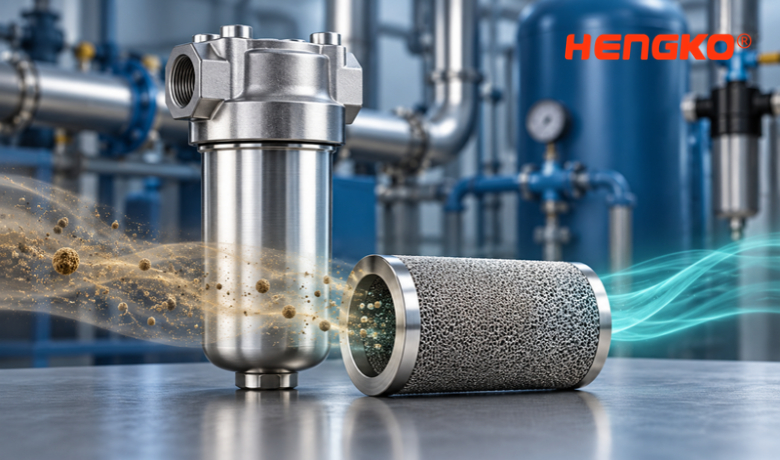
Sintered filters in compressed air systems provide a rigid porous medium for particle protection when their retention and flow performance match the application. When evaluating HENGKO sintered metal filter elements, start with the contaminant, required flow, and acceptable pressure loss. Particle filtration, aerosol coalescence, drying, and vapor adsorption serve different functions; the CAGI Compressed Air Purity Guide separates these treatment roles.
Consider a branch supplying a pneumatic valve or an instrument. The selection problem is more specific than finding a durable filter: which contaminant needs to be controlled, how much air must pass, and what evidence shows that the complete assembly will do the job? Answering those questions turns a generic component inquiry into an engineering specification.
Key takeaways
- Define the particle-protection requirement before choosing a pore designation.
- Evaluate retention and pressure loss together, under matching operating conditions.
- Confirm the assembly's limits and its role within the wider air-treatment system.
In this engineering guide
- Where sintered metal fits in compressed air treatment
- Different contaminants need different treatment functions
- Five engineering decisions behind a suitable filter
- Translate ISO 8573-1 into an air-quality requirement
- Turn the application into a useful engineering inquiry
- References and Technical Sources
Where sintered metal fits in compressed air treatment
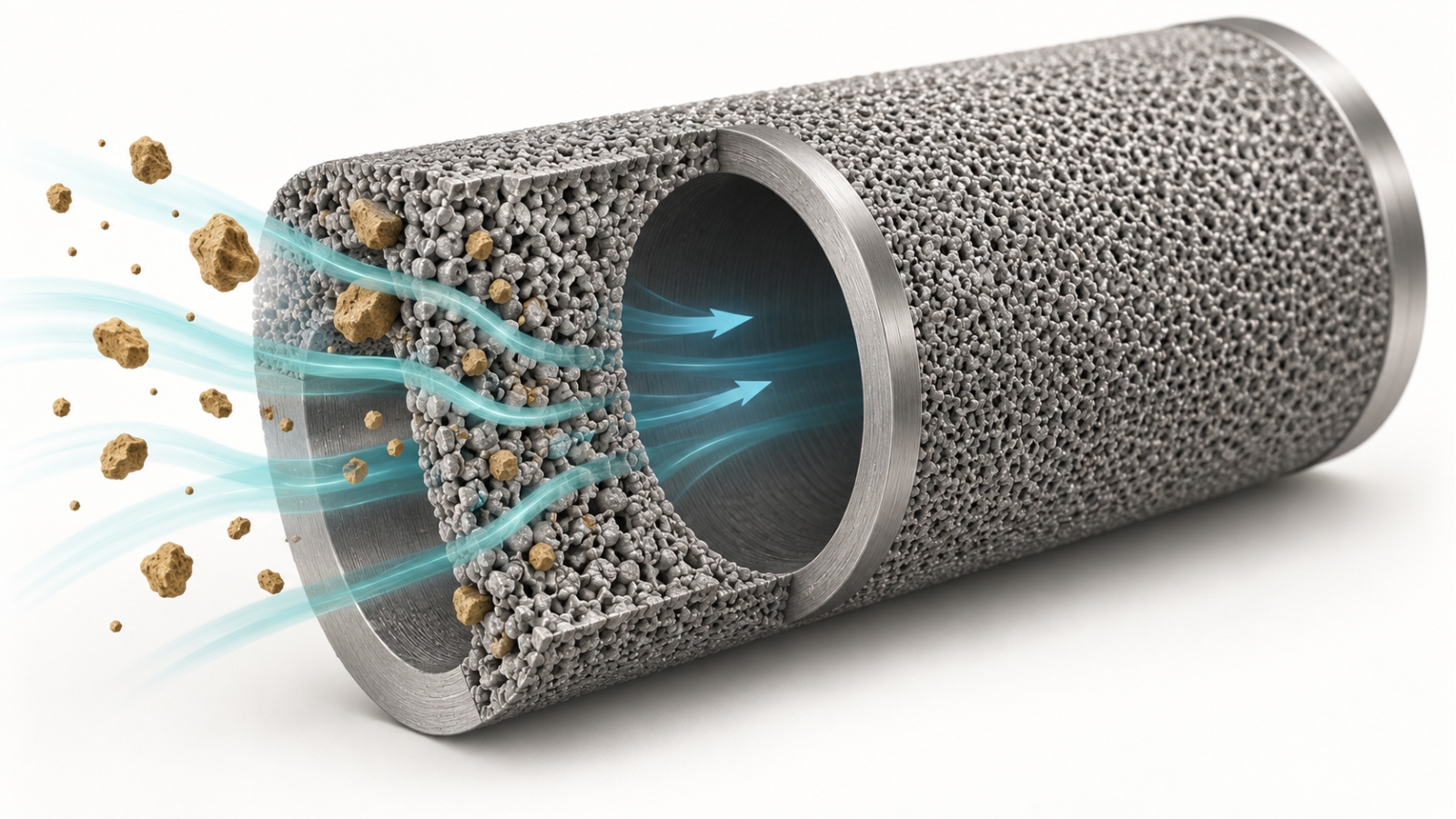
A sintered metal element uses interconnected porosity to provide a path for fluid flow. ISO 4022:2018 addresses permeability testing of these materials. For a compressed-air application, evaluate the proposed element's particle-retention result and flow behavior separately: a material description alone cannot complete the specification.
For plant-air selection, start by identifying the particle threat and the downstream component. Rust, pipeline debris, and process dust represent different application inputs from an oil-aerosol problem. The filter's job should be written in terms of the required result, rather than the broad promise of “clean air.”
HENGKO's sintered metal element range provides a starting point for reviewing available constructions and material options. Use the application requirements below to discuss a suitable configuration. Product-category information should lead to a configuration-specific proposal, supported by the relevant drawings, ratings, and test records.
That distinction is the starting point for a useful design discussion. Select a material or construction because it satisfies a documented requirement, then verify that the rest of the assembly supports it.
Different contaminants need different treatment functions
A particle filter, a coalescing stage, and a dryer may all contribute to an air-treatment system, but they solve different problems. CAGI's treatment tables distinguish equipment for particle, water, and oil control. Select each stage by the contaminant it must address, then check its inlet requirements.
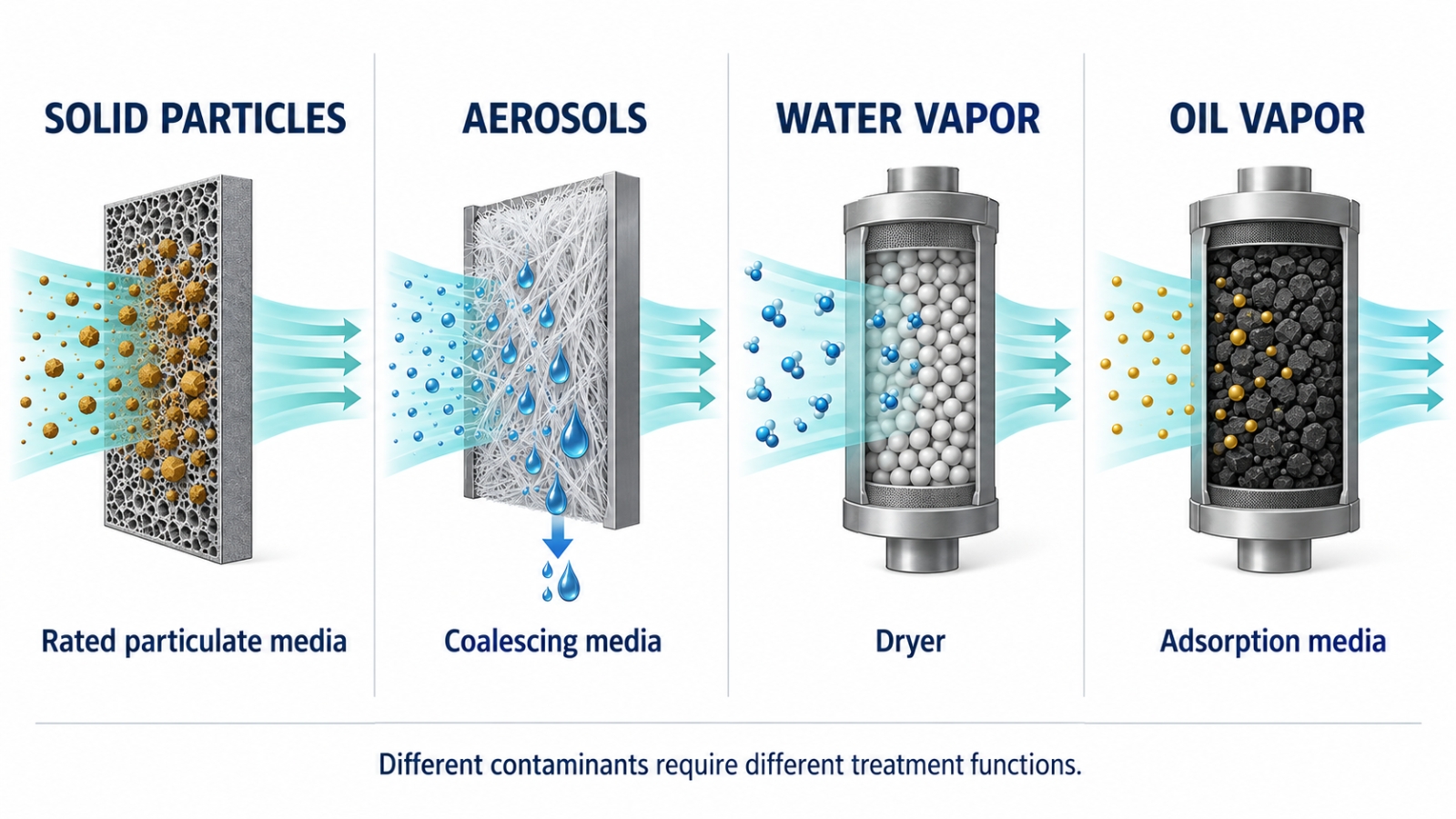
The following matrix translates those distinctions into selection questions. It is an original planning aid, not a recommended installation sequence.
| What needs to be controlled? | Treatment to evaluate | Evidence that matters |
|---|---|---|
| Solid particles | Rated particulate media, potentially including sintered metal | Particle size, retention result, test method, gas conditions |
| Bulk liquid carryover | Appropriate separation and drainage | Liquid load, orientation, drain operation |
| Fine liquid aerosols | A suitable coalescing stage | Aerosol-removal performance and upstream requirements |
| Water vapor | A compressed-air dryer | Required pressure dew point and inlet conditions |
| Oil vapor | Appropriate adsorption media | Capacity, inlet conditions, service requirements |
A useful supplier discussion starts with the contaminant's phase. Does a water-removal statement refer to droplets or vapor? Does an oil-removal claim include aerosol, vapor, or both? These are different acceptance questions, and a generic micron designation cannot answer them.
Five engineering decisions behind a suitable filter
Selecting the element becomes easier when the specification follows the application. Each decision below resolves a different source of uncertainty, from contamination control to integration and maintenance.
1. Define the retention result before the pore size
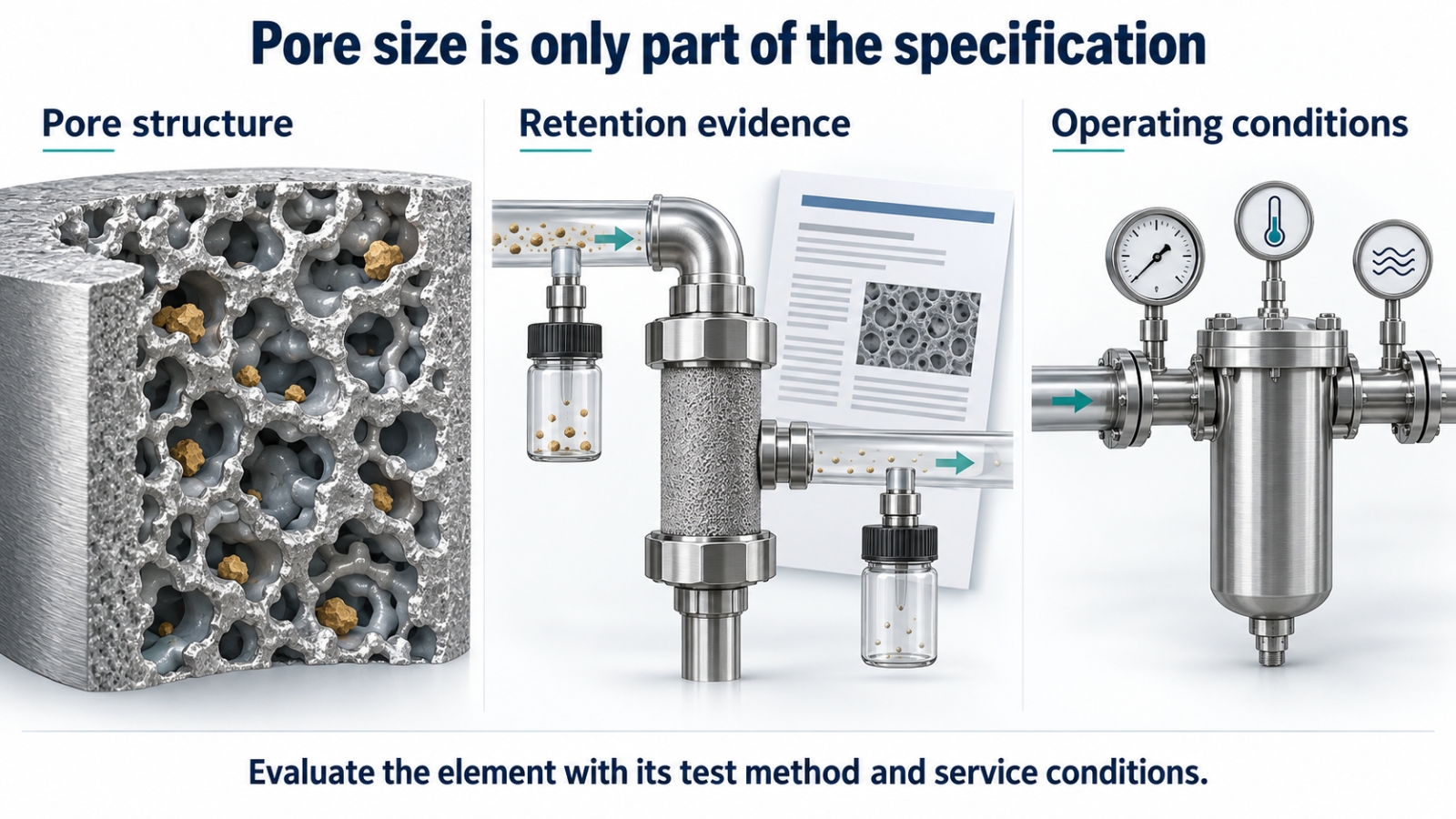
Write the required particle-retention result alongside the pore designation. CAGI's rating note following Table 5c warns that nominal media descriptions do not guarantee filtration efficiency. ISO 12500-3:2009 addresses evaluating compressed-air filter particulate-removal efficiency by particle size. These are different specification questions.
Define the challenge particle size, required removal result, test method, and relevant operating conditions. Then determine whether the supporting result applies to the bare element or the assembled product. This gives the buyer a consistent basis for comparing proposals that may use different rating terminology.
The smallest catalog number is not automatically the best selection. For a HENGKO inquiry, describe the protection required by the downstream equipment and request supporting evidence for the proposed configuration. Evaluate that evidence against the application rather than assuming another product's test result applies.
2. Match retention to the flow and pressure-loss budget
Retention addresses contamination control. Pressure loss addresses how the filter fits within the air supply. Both belong in the same specification.
A flow value needs a defined basis: operating conditions, temperature, inlet pressure, and whether the volume is standard, free-air delivery, or actual volume. Record the reference conditions in the inquiry so that the sizing response can be evaluated on the same basis.
For a candidate assembly, obtain a pressure-drop curve or documented sizing calculation at the branch's normal and peak demand. Distinguish the housing working-pressure limit, the element's allowable differential pressure, and the pressure-loss budget available to the process. One rating does not establish the other two.
Loading also belongs in the discussion. The U.S. Department of Energy's compressed-air sourcebook recommends evaluating pressure loss at maximum flow and obtaining component pressure-drop information for those conditions. For the proposed HENGKO configuration, request an appropriate monitoring and service basis.
A test range is not a product rating
The public abstract of ISO 12500-3:2009 identifies the following particle-diameter ranges for its filter-testing guidance. These values describe the test-method scope, not HENGKO retention performance or recommended pore sizes.
| Test category in ISO 12500-3:2009 | Particle-diameter range |
|---|---|
| Fine filter range | 0.01 µm to less than 5.0 µm |
| Coarse filter range | 5.0 µm to 40 µm |
Use the table to frame a test-method discussion. Ask which method is appropriate for the proposed configuration and what measured retention result is available. Do not turn a test range into a product efficiency claim.
3. Review materials as an assembly decision
316L is available in the product descriptions within HENGKO’s sintered element category. That confirms a material option. Suitability still depends on the selected element, housing, seals, fittings, and service conditions.
Provide HENGKO with the operating temperature, pressure envelope, expected contaminants, chemical exposure, and intended cleaning process. Include the materials of the housing, seals, and connections in that discussion. A material name is the start of a compatibility assessment, rather than the conclusion.
Compare alternative media on the same functional basis. A suitable pleated particulate filter should not be dismissed simply because it is not metal. Equally, the value of a reusable element depends on having an approved service method and an acceptance check after cleaning.
4. Place the filter where its function is needed
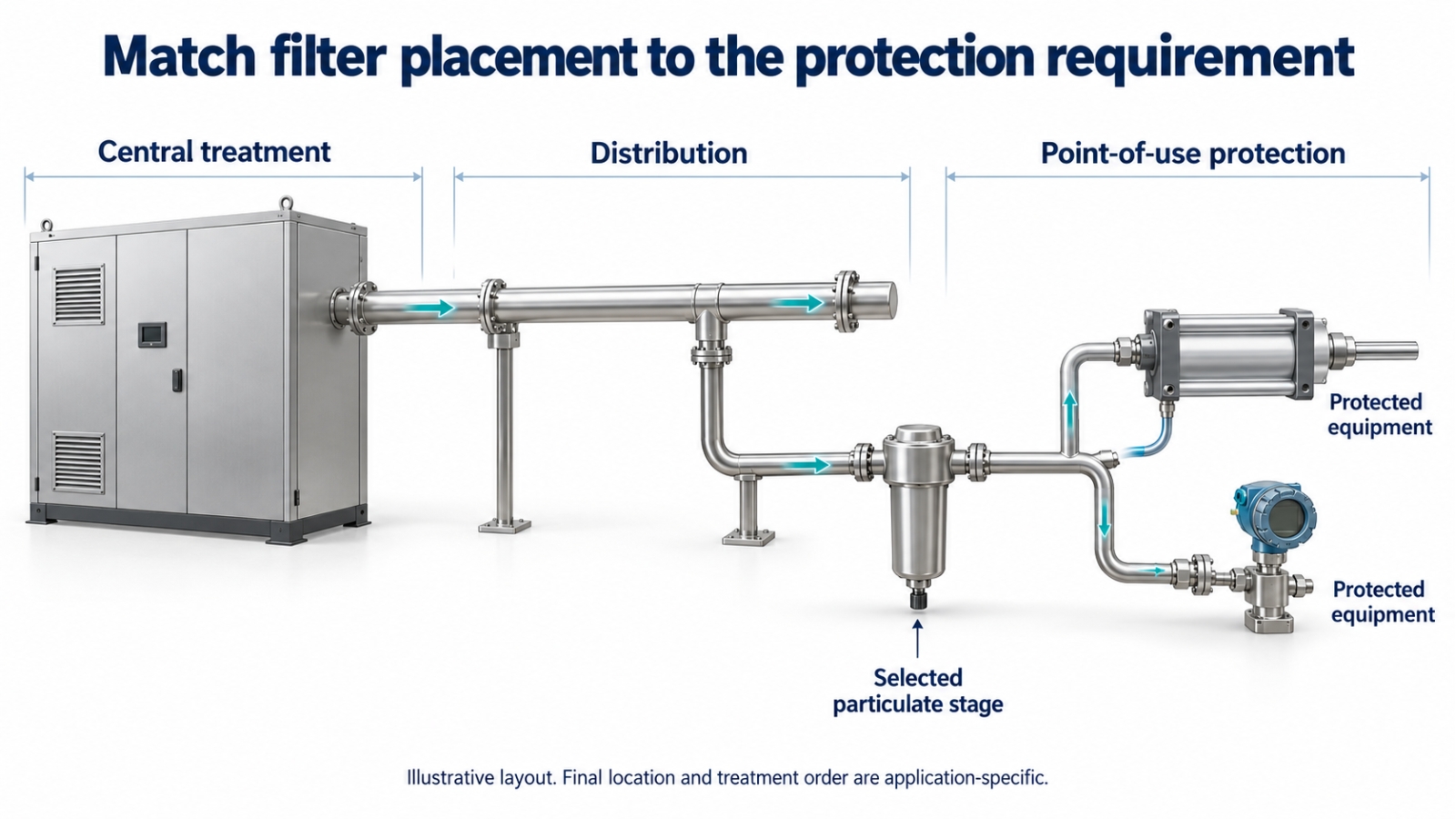
Location should follow the protection requirement and the treatment manufacturer's instructions. Review the central treatment, distribution piping, and point-of-use needs as separate parts of the layout. A local filter may address a branch's particle requirement without proving that moisture or oil has been controlled upstream.
CAGI's pretreatment guidance notes that treatment equipment may require specified inlet air quality. Verify those requirements for every proposed stage instead of copying one arrangement into all installations.
An assembly drawing should settle flow direction, sealing, connections, instrumentation, drainage where applicable, and service access. These interfaces turn an element into an installed component. Leave them unresolved and a technically promising medium can still be an incomplete purchasing specification.
5. Verify performance through service, not only at delivery
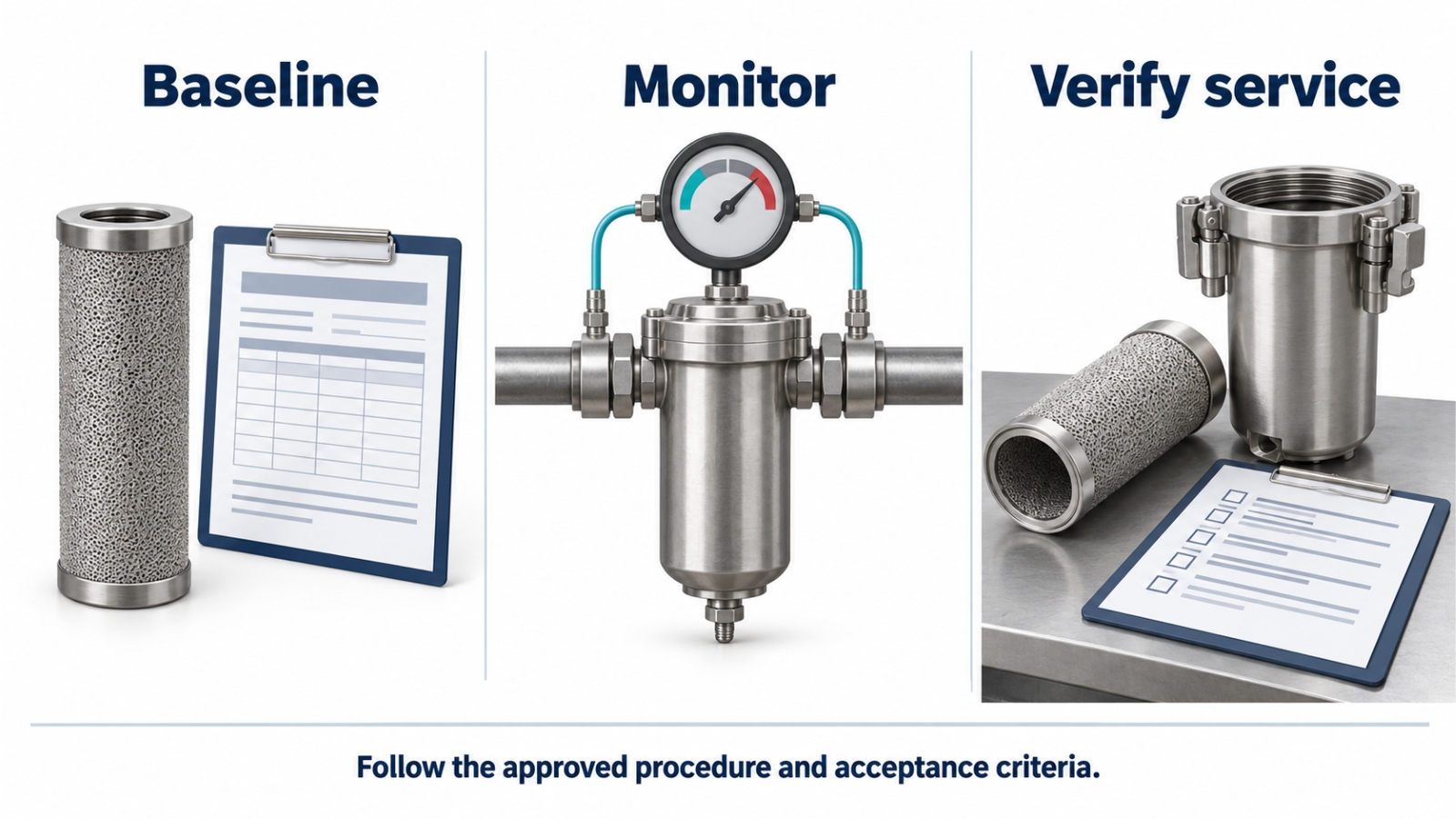
Decide whether cleaning is an approved option for the selected HENGKO element before treating reuse as a purchasing benefit. Request the applicable service procedure, inspection requirements, and acceptance criteria. If these documents are unavailable for the proposed part, keep reuse out of the approval assumptions.
For a reusable assembly, agree on the procedure and acceptance criteria before ordering. Record initial operating conditions, compare later observations on a consistent basis, and use the approved method for inspection or service. A general article should not assign a cleaning chemical, reverse-flow pressure, or replacement interval to an unspecified part.
| Observation | Engineering question | Useful evidence |
|---|---|---|
| Differential pressure rises | Has demand changed, or has the element loaded? | Comparable flow/pressure records and inspection guidance |
| Pressure loss remains after cleaning | Was the procedure followed, and is recovery acceptable? | Cleaning record and post-service acceptance results |
| Contamination remains downstream | Is the contaminant a particle, liquid, aerosol, or vapor? | Contaminant identification and treatment review |
| Differential pressure appears unusually low | Are the readings and operating conditions valid? | Instrument checks and an approved assembly inspection |
This troubleshooting aid organizes investigation. It does not diagnose a particular installation or replace the equipment procedure.
Translate ISO 8573-1 into an air-quality requirement
ISO's public description of ISO 8573-1:2010 identifies purity classes for particles, water, and oil. Specify the relevant application requirement and where it must be met. A pore designation does not establish all three contamination outcomes.
Keep the system requirement separate from evidence about an individual component. ISO 12500-3 concerns particulate-filter testing, while ISO 8573-1 classifies compressed-air contamination. Define the configuration, operating conditions, evaluation point, and measurement method for verifying the installed result.
The practical procurement question is who will verify the required result, and when. Include that responsibility in the HENGKO project inquiry. A proposed element should be approved on its documented operating limits and relevant evidence, while the installation must be assessed against the process air-quality requirement.
Turn the application into a useful engineering inquiry
A productive design discussion gives HENGKO enough information to evaluate the proposed element. Review the sintered metal filter element category, then prepare the following for the application inquiry:
- The application, downstream equipment, and identified contaminants.
- The required air quality and its evaluation point.
- Normal and peak flow, with units and reference conditions.
- The operating pressure and temperature envelope.
- The pressure-loss budget and required retention evidence.
- Connections, available space, and an assembly drawing when available.
- Material, seal, compatibility, and service requirements.
- The documents and acceptance checks needed to approve the proposal.
Ask for assumptions and exclusions to be visible. The returned proposal should connect important requirements to the proposed configuration, test evidence, and operating limits. Public portfolio information does not supply the missing retention curve, differential-pressure limit, or cleaning procedure for a specific project.
That is the value of application-led selection: the discussion moves from a material label to a documented component within a suitable treatment system. Confirm the evidence before approving the part, then verify the installed result against the application's requirements.
Discuss your compressed-air filter application with HENGKO. Share the operating conditions, required retention evidence, and assembly drawing so the inquiry starts with a clear specification.
References and Technical Sources
Sources reviewed October 21, 2026. Standards are cited for their publicly available scope only. The numerical table describes a test-method range, not a HENGKO product rating. All six illustrations are AI-generated conceptual artwork, not product photographs or measured performance.
- Compressed Air & Gas Institute — Compressed Air Purity Guide — PDF pages 14–15 (printed pages 12–13), Tables 5a–5c, rating note and pretreatment guidance. Supports treatment-function distinctions and the need to verify ratings. Accessed October 21, 2026.
- U.S. Department of Energy — Improving Compressed Air System Performance, Third Edition — PDF pages 36–37 (printed pages 31–32), Pressure Drop and Controlling System Pressure. Supports maximum-flow pressure-drop evaluation and component information requests. Accessed October 21, 2026.
- ISO 4022:2018 — Permeable sintered metal materials: Determination of fluid permeability — Public abstract; interconnected porosity and permeability-test scope. Accessed October 21, 2026.
- ISO 12500-3:2009 — Filters for compressed air: Test methods, Part 3: Particulates — Public abstract; particle-removal test scope and fine/coarse test ranges. Accessed October 21, 2026.
- ISO 8573-1:2010 — Compressed air: Contaminants and purity classes — Public abstract; classification scope for particles, water and oil. Accessed October 21, 2026.
- HENGKO — Sintered Metal Filter Elements — Product-category descriptions, including 316L material options. Portfolio information does not establish project-specific retention, differential-pressure or cleaning limits. Accessed October 21, 2026.
Post time: Oct-21-2026


