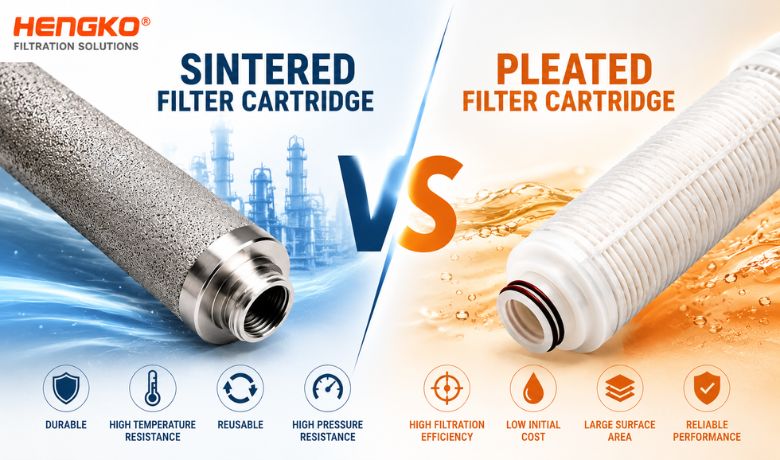
Sintered Filter Cartridge vs. Pleated Filter Cartridge: Which Is Better?
Filter cartridges play a critical role in industrial filtration systems by removing contaminants from liquids and gases.
Among the many filtration technologies available today, sintered filter cartridges and pleated filter cartridges are two of the most commonly used solutions.
Although both are designed to improve filtration performance, they differ significantly in structure, operating principles, durability, maintenance requirements, and application suitability.
Choosing the wrong filter cartridge can lead to increased operating costs, frequent replacements, reduced process efficiency, and even unexpected equipment downtime.
In this article, we compare sintered filter cartridges and pleated filter cartridges in detail, helping engineers, plant managers, and procurement professionals determine which option best fits their filtration requirements.
Quick Answer
Choose a sintered filter cartridge for high temperature, high pressure, corrosive media, repeated cleaning, and long service life. Choose a pleated filter cartridge for lower initial cost, high surface area, fine polishing, and disposable filtration in relatively clean processes.
What Is a Sintered Filter Cartridge?
A sintered filter cartridge is a porous filtration element manufactured by compacting and sintering metal powders at high temperatures. During the sintering process, metal particles bond together to create a rigid structure containing interconnected microscopic pores.
Common materials include:
- 316L Stainless Steel
- Bronze
- Titanium
- Nickel
- Inconel
- Hastelloy
Unlike disposable filter media, sintered filter cartridges are self-supporting and highly resistant to pressure, temperature, and mechanical stress.
The porous structure provides excellent filtration performance while allowing the filter to be cleaned and reused multiple times. This makes sintered filters particularly attractive in demanding industrial applications where durability and long service life are critical.
Key Characteristics
- Rigid porous metal construction
- Excellent mechanical strength
- High temperature resistance
- Corrosion resistance
- Reusable and cleanable
- Long service life
What Is a Pleated Filter Cartridge?
A pleated filter cartridge consists of folded filtration media wrapped around a support core.
The pleated design significantly increases the filtration surface area while maintaining a compact cartridge size.
Common filtration media include:
- Polypropylene (PP)
- Polyester (PES)
- PTFE
- Nylon
- Glass Fiber
The large surface area enables high flow rates and low initial pressure drops, making pleated filters popular in water treatment, food processing, pharmaceutical production, and final polishing filtration applications.
Unlike sintered metal filters, pleated cartridges are generally considered disposable or semi-disposable products.
Key Characteristics
- Large filtration area
- High filtration efficiency
- Lightweight construction
- Lower initial cost
- Disposable design
- Suitable for clean process streams
How Do These Filter Cartridges Work?
Although both technologies remove contaminants, their filtration mechanisms are fundamentally different.
1. Sintered Filter Cartridge: Depth Filtration
Sintered filters primarily operate through depth filtration.
As fluid or gas flows through the porous metal structure, particles are captured throughout the entire thickness of the filter.
Contaminants become trapped within the interconnected pore network rather than only on the surface.
This provides:
- Higher dirt-holding capacity
- Longer filtration cycles
- Better performance under heavy contamination loads
2. Pleated Filter Cartridge: Surface Filtration
Pleated filters primarily use surface filtration.
Particles are retained on or near the surface of the filtration media while the fluid passes through.
This approach offers:
- High filtration efficiency
- Precise particle retention
- Low initial pressure drop
However, surface loading can lead to faster clogging when processing dirty fluids or gases.
Sintered vs Pleated Filter Cartridge: Quick Comparison
| Feature | Sintered Filter Cartridge | Pleated Filter Cartridge |
|---|---|---|
| Structure | Porous Metal | Folded Membrane |
| Filtration Type | Depth Filtration | Surface Filtration |
| Temperature Resistance | Up to 600°C+ | Typically Below 100°C |
| Pressure Resistance | Excellent | Moderate |
| Mechanical Strength | Very High | Medium |
| Cleanability | Reusable | Usually Disposable |
| Service Life | Long | Shorter |
| Initial Cost | Higher | Lower |
| Maintenance Cost | Lower | Higher |
| Chemical Resistance | Excellent | Media Dependent |
Five Key Differences Between Sintered and Pleated Filter Cartridges
Key Difference #1: Temperature Resistance
One of the most significant differences between the two technologies is temperature capability.
Sintered Filter Cartridges
Because they are made from metal materials, sintered filters can withstand extremely high operating temperatures.
Typical operating ranges include:
- Stainless Steel : Up to 600°C
- Inconel : Above 800°C in some applications
- Titanium : Excellent high-temperature performance
This makes them ideal for:
- Steam filtration
- Hot gas filtration
- Catalyst recovery systems
- Petrochemical processes
Pleated Filter Cartridges
Pleated cartridges are limited by the thermal stability of their filter media.
Most operate within:
- 60°C to 90°C for standard materials
- Up to 120°C for specialized membranes
Excessive heat may cause:
- Media deformation
- Reduced filtration efficiency
- Structural failure
For high-temperature processes, sintered filters are usually the preferred solution.
Key Difference #2: Pressure Resistance and Mechanical Strength
Industrial filtration systems often operate under demanding pressure conditions.
Sintered Filter Cartridges
The rigid metal construction provides exceptional mechanical strength.
Advantages include:
- High differential pressure resistance
- Resistance to collapse
- Excellent performance under vacuum conditions
- Long-term structural stability
Common applications include:
- Compressed air systems
- Hydrogen filtration
- Semiconductor gas purification
- Process gas filtration
Pleated Filter Cartridges
Pleated cartridges typically rely on support cages and internal cores to maintain structural integrity.
Although adequate for many liquid filtration applications, they may be susceptible to:
- Media deformation
- Pleat collapse
- Reduced service life under pressure fluctuations
In harsh operating environments, sintered filters generally provide greater reliability.
Key Difference #3: Cleanability and Reusability
The ability to clean and reuse a filter significantly impacts lifecycle costs.
Sintered Filter Cartridges
One of the greatest advantages of sintered metal filters is their reusability.
Cleaning methods include:
- Backflushing
- Ultrasonic cleaning
- Solvent cleaning
- Chemical cleaning
- Steam sterilization
Many industrial users successfully regenerate sintered filters dozens or even hundreds of times.
This reduces:
- Replacement costs
- Maintenance downtime
- Waste generation
Pleated Filter Cartridges
Pleated filters are often treated as disposable products.
Although some cleaning is possible, complete restoration is difficult because contaminants become embedded within the media.
As a result:
- Replacement frequency is higher
- Maintenance costs increase
- Consumable costs accumulate over time
For facilities seeking sustainable filtration solutions, reusable sintered filters offer a clear advantage.
Key Difference #4: Service Life and Total Cost of Ownership
Many buyers focus only on the purchase price of a filter cartridge. However, total cost of ownership often tells a different story.
Pleated Filter Example
A pleated cartridge may require replacement every few weeks or months depending on contamination levels.
Costs include:
- Replacement cartridges
- Labor
- Production interruptions
- Inventory management
Sintered Filter Example
A sintered filter cartridge may remain in service for several years when properly maintained.
Although the initial investment is higher, long-term costs are often substantially lower.
When evaluating industrial filtration systems, lifecycle economics should always be considered alongside purchase price.
Key Difference #5: Chemical Compatibility
Chemical compatibility is another important selection factor.
Sintered Filter Cartridges
Metal filter cartridges are highly resistant to aggressive process media.
Depending on the alloy selected, they can handle:
- Solvents
- Acids
- Corrosive gases
- Oxidizing environments
Popular material choices include:
- 316L Stainless Steel
- Titanium
- Hastelloy
- Inconel
Pleated Filter Cartridges
Chemical compatibility depends entirely on membrane material.
Potential challenges include:
- Swelling
- Chemical degradation
- Reduced mechanical strength
- Shortened service life
Careful compatibility verification is essential before selecting a pleated filter.
Typical Applications
| Industry / Process | Sintered Filter Cartridge | Pleated Filter Cartridge |
|---|---|---|
| Compressed Air Systems | ✔ Excellent | △ Limited |
| Nitrogen Filtration | ✔ Excellent | △ Limited |
| Hydrogen Purification | ✔ Excellent | ✖ Not Recommended |
| Semiconductor Gas Filtration | ✔ Excellent | △ Limited |
| Chemical Processing | ✔ Excellent | △ Depends on Media Compatibility |
| Solvent Recovery | ✔ Excellent | ✖ Rarely Used |
| Petrochemical Industry | ✔ Excellent | ✖ Rarely Used |
| Catalyst Recovery | ✔ Excellent | ✖ Not Suitable |
| Powder Handling Systems | ✔ Excellent | ✖ Not Suitable |
| Water Treatment | △ Possible | ✔ Excellent |
| Reverse Osmosis Prefiltration | ✖ Rarely Used | ✔ Excellent |
| Beverage Filtration | △ Possible | ✔ Excellent |
| Pharmaceutical Final Filtration | △ Prefiltration | ✔ Excellent |
| Electronics Manufacturing | △ Process Filtration | ✔ Excellent |
| Laboratory Filtration | △ Special Applications | ✔ Excellent |
When to Choose a Sintered Filter Cartridge vs a Pleated Filter Cartridge
| Selection Criteria | Sintered Filter Cartridge | Pleated Filter Cartridge |
|---|---|---|
| Operating Temperature | ✔ High-temperature processes | △ Low to moderate temperatures |
| Operating Pressure | ✔ High-pressure systems | △ Moderate-pressure systems |
| Cleaning Requirement | ✔ Frequent cleaning required | ✖ Usually replaced rather than cleaned |
| Service Life Expectation | ✔ Long-term operation | △ Shorter service life |
| Chemical Resistance | ✔ Corrosive chemicals and solvents | △ Depends on filter media |
| Steam Sterilization | ✔ Suitable for repeated steam sterilization | ✖ Generally not recommended |
| CIP/SIP Compatibility | ✔ Fully compatible | △ Limited compatibility |
| Total Operating Cost | ✔ Lower long-term cost | △ Higher replacement costs over time |
| Initial Purchase Cost | △ Higher upfront investment | ✔ Lower upfront investment |
| Filtration Precision | △ Micron-level filtration | ✔ Excellent fine filtration |
| Disposable Filtration | ✖ Not typically required | ✔ Preferred option |
| Process Cleanliness | ✔ Suitable for dirty or harsh processes | ✔ Best for relatively clean processes |
| Sterile Final Filtration | △ Often used as prefiltration | ✔ Common choice |
| Replacement Frequency | ✔ Infrequent | △ More frequent replacements |
Quick Selection Guide
| If Your Process Requires... | Recommended Filter Type |
|---|---|
| High temperature gas filtration | Sintered Filter Cartridge |
| High-pressure compressed air filtration | Sintered Filter Cartridge |
| Corrosive chemical filtration | Sintered Filter Cartridge |
| Reusable filtration systems | Sintered Filter Cartridge |
| Long service life | Sintered Filter Cartridge |
| Low initial investment | Pleated Filter Cartridge |
| Sterile final filtration | Pleated Filter Cartridge |
| Ultra-fine particle removal | Pleated Filter Cartridge |
| Reverse osmosis prefiltration | Pleated Filter Cartridge |
| Disposable filtration applications | Pleated Filter Cartridge |
Bottom Line
| Application Scenario | Best Choice |
|---|---|
| Harsh industrial environments | Sintered Filter Cartridge |
| High-temperature processes | Sintered Filter Cartridge |
| High-pressure gas systems | Sintered Filter Cartridge |
| Clean water and beverage filtration | Pleated Filter Cartridge |
| Pharmaceutical final filtration | Pleated Filter Cartridge |
| Budget-sensitive applications | Pleated Filter Cartridge |
Which Filter Cartridge Is Better?
There is no single filter cartridge that is best for every application.
The optimal choice depends on:
- Operating temperature
- Pressure conditions
- Process media
- Filtration efficiency requirements
- Maintenance strategy
- Lifecycle costs
However, in demanding industrial environments involving high temperatures, aggressive chemicals, or continuous operation, sintered filter cartridges generally provide superior durability, reliability, and long-term value.
For applications requiring disposable filtration, low initial investment, and high-efficiency polishing, pleated filter cartridges remain an excellent solution.
Key Takeaways
- Sintered filter cartridges provide higher mechanical strength, temperature resistance, and reusability.
- Pleated filter cartridges provide a larger filtration area, lower initial pressure drop, and lower upfront cost.
- The correct choice depends on process temperature, pressure, chemical compatibility, filtration precision, maintenance strategy, and lifecycle cost.
- For harsh or continuous industrial service, sintered metal cartridges usually provide better long-term value.
- For disposable polishing or sterile final filtration, pleated cartridges are often the more practical choice.
Frequently Asked Questions
Are sintered filter cartridges reusable?
Yes. Most sintered metal filter cartridges can be cleaned and reused multiple times using backflushing, ultrasonic cleaning, chemical cleaning, or steam sterilization.
Can pleated filters handle high temperatures?
Most pleated filters are limited to temperatures below 100°C, although specialized materials may tolerate slightly higher temperatures.
Which filter cartridge lasts longer?
Sintered metal filter cartridges generally have a much longer service life due to their robust construction and cleanability.
Are sintered filters more expensive?
The initial purchase price is higher, but lifecycle costs are often lower because the filters can be reused for many years.
Can sintered filters achieve micron-level filtration?
Yes. Sintered metal filters are available in filtration ratings ranging from approximately 0.1 μm to over 100 μm.
Conclusion
Both sintered filter cartridges and pleated filter cartridges play important roles in modern industrial filtration systems.
Pleated filters offer high efficiency, low initial cost, and excellent performance in clean applications.
Sintered filter cartridges, on the other hand, provide exceptional durability, high-temperature capability, superior pressure resistance, and long-term cost savings through reusability.
For industries such as chemical processing, compressed air treatment, semiconductor manufacturing, pharmaceuticals, and petrochemicals, sintered metal filter cartridges are often the preferred solution for achieving reliable and sustainable filtration performance.
Need Help Selecting the Right Filter Cartridge?
Share your process medium, operating temperature, pressure, required filtration rating, flow conditions, cleaning method, dimensions, and connection requirements with HENGKO.
Our engineering team can help evaluate whether a standard or customized sintered metal filter cartridge is the better fit for your application.
Post time: Jun-06-2026


