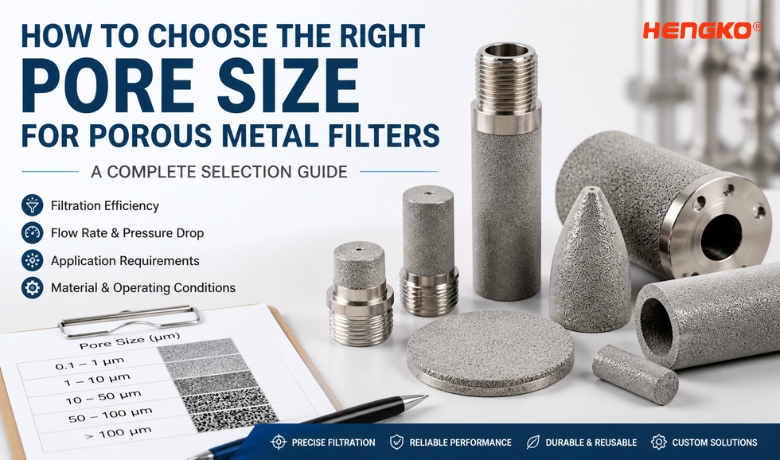
Selecting the right pore size for a porous metal filter is not about choosing the smallest micron rating
—it is about finding the optimal balance between filtration efficiency, flow performance, and system reliability.
In practical engineering applications, pore size selection typically follows three key principles:
1. Match the pore size to the target particle size distribution, not just a single micron value
2. Balance filtration precision with flow rate and pressure drop, to avoid system inefficiency
3. Consider operating conditions and maintenance requirements, such as clogging risk, cleanability, and service life
These factors must be evaluated together.
Overly fine pore sizes may improve particle retention, but often result in higher pressure drop, faster clogging, and increased operational costs.
Based on our experience supporting applications in semiconductor manufacturing, high-purity gas systems, and pharmaceutical processing, incorrect pore size selection is one of the most common causes of unstable filtration performance and frequent system maintenance.
In this guide, we will break down how to select pore size for porous metal filters step by step—covering technical principles, real-world considerations, and practical selection strategies to help you achieve both performance and reliability.
Why Pore Size Matters in Porous Metal Filters
Pore size is the defining parameter of a porous metal filter because it directly controls what particles can be retained and how the fluid flows through the structure. In sintered porous materials, the interconnected pore network acts as a three-dimensional filtration path, where both particle capture and flow resistance are determined by the size and distribution of these pores.
From a functional perspective, pore size influences three critical aspects of filtration performance:
1. Filtration Efficiency
Smaller pore sizes generally provide higher particle retention, enabling the removal of fine contaminants.
However, filtration is not simply a “pass or block” mechanism—real systems deal with particle size distributions, meaning that pore size must be selected to achieve the desired retention efficiency across a range of particle sizes.
2. Pressure Drop and Flow Rate
As pore size decreases, flow resistance increases. This leads to higher pressure drop across the filter, which can reduce system efficiency or require more energy to maintain the same flow rate. In gas systems, especially high-purity or low-pressure applications, this effect becomes even more significant.
3. Service Life and Clogging Behavior
Finer pores are more susceptible to blockage, particularly in applications with high particle loading or sticky contaminants.
This can shorten filter life and increase maintenance frequency. In contrast, slightly larger pore sizes often provide more stable long-term performance when combined with proper system design.
In our experience working with sintered metal filters in demanding environments such as semiconductor gas delivery and pharmaceutical processing, the most reliable systems are not those with the finest pore sizes, but those with well-balanced pore structures that align with process conditions and operational goals.
Understanding these relationships is the foundation of proper pore size selection. In the next section, we will clarify a commonly misunderstood concept—micron rating versus actual filtration performance—which is essential for making informed decisions.
Understanding Micron Rating vs. Absolute Filtration
One of the most common sources of confusion in filtration system design is the difference between micron rating and actual filtration performance.
While many filters are labeled with a specific micron value, this number alone does not fully describe how effectively the filter removes particles.
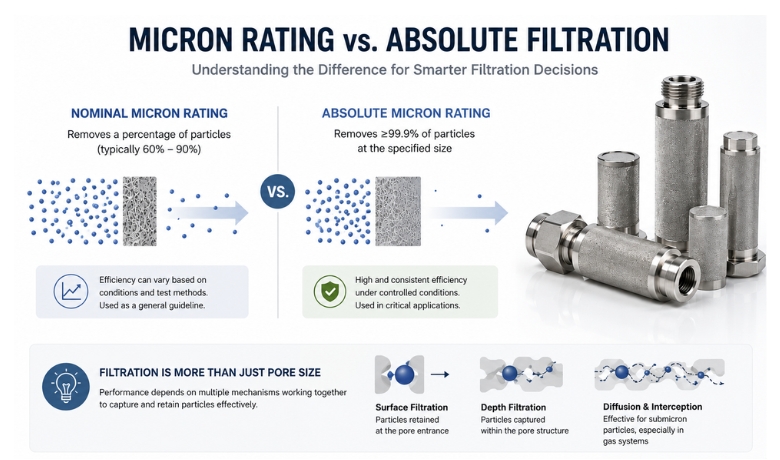
In general, micron ratings fall into two categories:
1. Nominal Micron Rating
A nominal rating indicates that the filter can remove a certain percentage of particles at a given size—typically around 60% to 90%.
However, this efficiency can vary depending on operating conditions, particle characteristics, and test methods. As a result, nominal ratings are often used as general guidelines rather than precise performance guarantees.
2. Absolute Micron Rating
An absolute rating refers to a much higher and more consistent level of particle retention—often defined as ≥99.9% removal efficiency for particles of a specified size under controlled conditions. Absolute-rated filters are typically required in critical applications such as semiconductor manufacturing, pharmaceutical processing, and high-purity gas systems, where even trace contamination can lead to system failure.
However, even “absolute” filtration is not purely determined by pore size alone. Filtration performance is influenced by multiple mechanisms, including:
- Surface filtration (particles retained at the pore entrance)
- Depth filtration (particles captured within the pore structure)
- Diffusion and interception effects, especially for submicron particles in gas systems
In sintered porous metal filters, the uniform and interconnected pore structure enables a combination of these mechanisms, providing more stable and predictable filtration performance compared to many fiber-based or irregular media.
From an engineering perspective, relying solely on a micron rating—without understanding the underlying retention efficiency and test conditions—can lead to incorrect filter selection.
This is particularly critical in applications where consistent performance, repeatability, and contamination control are required.
In the next section, we will break down the key factors that engineers should evaluate when selecting pore size, translating these concepts into practical decision-making steps.
6-Key Factors to Consider When Selecting Pore Size
Selecting the right pore size is not a single-variable decision—it requires evaluating how particle characteristics, process conditions, and system requirements interact. In real-world applications, engineers typically consider the following key factors:
1. Particle Size Distribution (Not Just a Single Value)
One of the most common mistakes is selecting pore size based on a single “target particle size.” In reality, most processes involve a range of particle sizes, not a uniform value.
As a general guideline:
*To achieve effective filtration, the pore size is often selected at 1/3 to 1/5 of the target particle size, depending on the required retention efficiency.
However, this rule must be adjusted based on particle shape, deformability, and aggregation behavior.
For example, soft or irregular particles may pass through pores smaller than their nominal size.
2. Fluid Type: Gas vs. Liquid Systems
The behavior of particles and flow characteristics differ significantly between gas and liquid filtration.
Lower viscosity and higher diffusivity mean that submicron particles can be influenced by diffusion and interception effects.
This often requires finer pore sizes, especially in high-purity gas systems.
*Liquid filtration:
Higher viscosity leads to more stable flow paths, but also higher resistance.
In these systems, overly fine pore sizes can quickly result in excessive pressure drop.
Selecting pore size without considering the fluid medium can lead to either underperformance or unnecessary system load.
3. Flow Rate and Pressure Drop Constraints
There is always a trade-off between filtration precision and flow performance.
*Smaller pore sizes → higher resistance → increased pressure drop
*Larger pore sizes → lower resistance → higher flow capacity
In many industrial systems, pressure drop limitations are just as critical as filtration efficiency, particularly in continuous processes or energy-sensitive operations.
From an engineering standpoint, it is often more effective to optimize pore size in combination with filter geometry
(surface area, thickness, structure) rather than relying solely on finer pores.
4. Operating Conditions (Temperature, Pressure, Corrosion)
Pore size selection should also account for the environment in which the filter operates.
- High temperatures may affect fluid properties and flow behavior
- High – pressure systems demand mechanically stable pore structures
- Corrosive media require material compatibility (e.g., 316L stainless steel, titanium)
In harsh environments, sintered metal filters offer a key advantage due to their structural integrity and resistance to thermal and chemical stress.
5. Clogging Risk, Cleanability, and Service Life
While finer pore sizes improve filtration precision, they also increase the risk of clogging—especially in systems with high particle loading.
Key considerations include:
- Expected contaminant concentration
- Whether the filter can be backflushed or ultrasonically cleaned
- Required maintenance intervals
In many cases, selecting a slightly larger pore size
—combined with proper system design
—can significantly extend service life and reduce total operating costs.
6. Application-Specific Requirements
Different industries impose different filtration priorities:
- Semiconductor / high – purity gas systems → ultra-fine filtration, contamination control
- Pharmaceutical / biotech → sterility, consistency, validation requirements
- Industrial processes → durability, cost – efficiency, ease of maintenance
This is why pore size selection cannot be standardized across applications—it must be aligned with the specific process goals.
| Key Factor | What to Consider | Key Impact on Pore Size Selection |
|---|---|---|
| 1. Particle Size Distribution | Actual particle size range, particle shape, aggregation, deformability | Pore size is often selected at 1/3–1/5 of the target particle size for effective retention |
| 2. Fluid Type (Gas vs. Liquid) | Gas diffusion effects, liquid viscosity, flow behavior | Gas systems often require finer pores; liquid systems must balance flow resistance |
| 3. Flow Rate & Pressure Drop | Required flow capacity and allowable pressure drop | Smaller pores improve filtration but increase resistance and energy consumption |
| 4. Operating Conditions | Temperature, pressure, corrosive media compatibility | Harsh conditions require stable pore structures and corrosion-resistant materials |
| 5. Clogging & Service Life | Contaminant loading, cleanability, maintenance intervals | Slightly larger pores may improve lifespan and reduce maintenance costs |
| 6. Application Requirements | Industry-specific filtration priorities | Semiconductor, pharma, and industrial systems all require different pore size strategies |
Typical Pore Size Ranges and Their Applications
While pore size selection should always be based on specific process conditions, there are general pore size ranges that correspond to common industrial applications. These ranges can serve as a practical starting point for engineers and buyers when evaluating filtration requirements.
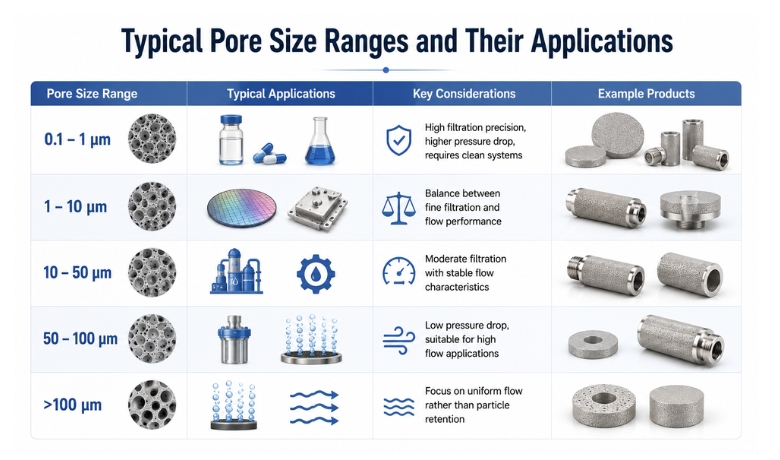
Below is a reference guide for typical pore size ranges used in porous metal filters:
Common Pore Size Ranges and Applications
| Pore Size Range | Typical Applications | Key Considerations |
|---|---|---|
| 0.1 – 1 μm | Sterile filtration, fine chemicals, pharmaceutical processes | High filtration precision, higher pressure drop, requires clean systems |
| 1 – 10 μm | High-purity gas filtration, semiconductor processes, catalyst protection | Balance between fine filtration and flow performance |
| 10 – 50 μm | General gas & liquid filtration, fuel systems, hydraulic systems | Moderate filtration with stable flow characteristics |
| 50 – 100 μm | Coarse filtration, pre-filtration stages, diffusers / spargers | Low pressure drop, suitable for high flow applications |
| >100 μm | Flow distribution, aeration, fluidization applications | Focus on uniform flow rather than particle retention |
How to Use This Table in Practice
It is important to note that these ranges are not strict rules, but engineering reference points.
The final pore size selection should always consider:
- Actual particle size distribution
- Required filtration efficiency (nominal vs. absolute)
- System pressure and flow constraints
- Maintenance and service life expectations
For example, in high-purity gas systems, even particles below 1 μm can be critical contaminants.
In such cases, engineers often select finer pore sizes within the 0.1–1 μm range, combined with strict system cleanliness and validation requirements.
In advanced applications, standard pore size categories are often insufficient. Systems such as semiconductor gas delivery, pharmaceutical processing, or precision analytical equipment may require:
- Ultra – fine filtration below 0.1 μm
- Highly uniform pore structures for consistent performance
- Customized geometries to fit system integration constraints
This is where sintered porous metal technology becomes particularly valuable.
With precise control over powder size, sintering conditions, and structural design, manufacturers can tailor pore size across a wide range
—from nanometer-level filtration to coarse micron-scale flow control.
Common Mistakes in Pore Size Selection
Even with a basic understanding of pore size ranges, many filtration systems underperform due to incorrect selection decisions.
In practice, these mistakes are not always obvious at the design stage
—but they often lead to higher costs, reduced efficiency, and frequent maintenance issues over time.
Below are some of the most common mistakes engineers and buyers make when selecting pore size:
1. Choosing the Smallest Pore Size “for Safety”
A widespread assumption is that smaller pore sizes always provide better filtration.
While this may improve particle retention, it often comes at the expense of:
*Increased pressure drop
*Reduced flow rate
*Faster clogging and shorter service life
In many cases, over-specifying pore size leads to system inefficiency rather than improved performance.
2. Ignoring Particle Size Distribution
Many selections are based on a single “target particle size,” without considering that real-world contaminants exist across a range of sizes.
This can result in:
- Incomplete filtration of smaller particles
- Or unnecessarily restrictive filtration if based on worst – case assumptions
A more effective approach is to evaluate the full particle size distribution and define acceptable retention efficiency levels.
3. Overlooking Pressure Drop Constraints
Filtration performance is often evaluated in isolation, without considering system pressure limits.
In reality:
- Excessive pressure drop can reduce system throughput
- It may also require higher energy input or redesign of upstream/downstream components
This is especially critical in gas systems and continuous industrial processes, where stability is essential.
4. Not Considering Clogging and Maintenance
Selecting a fine pore size without evaluating contamination load or cleanability can lead to frequent blockages.
Common issues include:
- Short maintenance cycles
- Increased downtime
- Higher operational costs
In many applications, a slightly larger pore size combined with proper system design delivers better long-term performance.
5. Relying Only on Micron Rating Without Understanding Performance
As discussed earlier, micron rating alone does not fully define filtration efficiency.
Two filters with the same nominal rating may perform very differently depending on:
- Pore structure uniformity
- Filtration mechanism (surface vs. depth)
- Manufacturing quality and consistency
Without understanding these factors, selection decisions may be based on incomplete or misleading information.
6. Using Standard Filters for Non-Standard Applications
Off-the-shelf filters are often designed for general-purpose use. However, in many advanced applications
—such as semiconductor processing, high-purity gas systems, or precision analytical equipment
—standard pore sizes and structures may not meet performance requirements.
This can lead to:
- Inconsistent filtration results
- Integration challenges
- Compromised system reliability
When Standard Pore Sizes Don’t Work (Why Customization Matters)
Standard pore size ranges provide a useful starting point, but in many real-world applications, they are not sufficient to achieve the required filtration performance. As systems become more complex and performance requirements more demanding, relying solely on off-the-shelf filters can introduce limitations that are difficult to resolve.
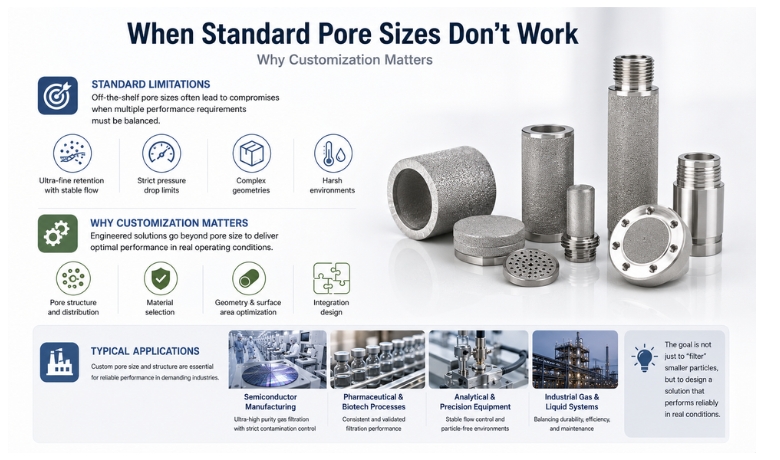
This is particularly true in applications where multiple constraints must be balanced simultaneously, such as:
- Ultra – fine particle retention combined with stable flow performance
- Strict pressure drop limits in continuous or energy – sensitive systems
- Complex geometries or space – constrained installations
- Harsh operating environments involving high temperature, high pressure, or corrosive media
In these scenarios, selecting a standard pore size often leads to compromises.
For example, choosing a finer pore size may improve filtration efficiency but create unacceptable pressure drop, while a larger pore size may improve flow but fail to meet contamination control requirements.
Why Customization Becomes Necessary
To overcome these trade-offs, filtration solutions must be engineered at multiple levels—not just pore size, but also:
- Pore structure and distribution → for consistent retention performance
- Material selection → to ensure compatibility with process conditions
- Filter geometry (shape, thickness, surface area) → to optimize flow and reduce pressure drop
- Integration design → to fit seamlessly into the system
This is where porous metal filters offer a significant advantage. Unlike many conventional filter media, sintered metal structures allow precise control over pore characteristics during the manufacturing process, enabling tailored solutions that align with specific application requirements.
Typical Scenarios Requiring Custom Pore Size Solutions
In practice, customized pore size and structure are often required in:
- Semiconductor manufacturing → ultra – high purity gas filtration with strict contamination control
- Pharmaceutical and biotech processes → consistent and validated filtration performance
- Analytical and precision equipment → stable flow control and particle – free environments
- Industrial gas and liquid systems → balancing durability, efficiency, and maintenance
In these applications, the goal is not simply to “filter smaller particles,” but to design a system that performs reliably under real operating conditions.
Custom Pore Size Solutions from HENGKO
When standard filtration solutions cannot meet performance requirements, working with a manufacturer that offers precise engineering capabilities becomes essential. Custom porous metal filters are not just aboutadjusting pore size
—they involve controlling the entire filtration structure to achieve consistent, reliable results under real operating conditions.
HENGKO specialize in the design and manufacturing of sintered porous metal filters and components, with a focus on precision, consistency, and application-driven engineering.
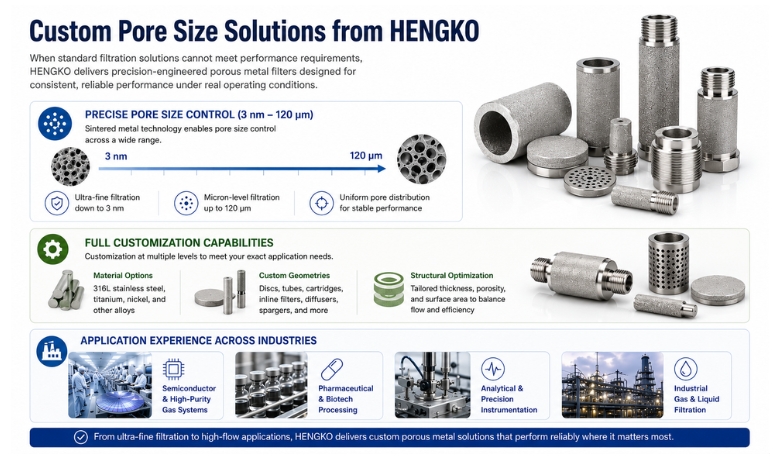
Precise Pore Size Control (3 nm – 120 μm)
One of the key advantages of sintered metal technology is the ability to control pore size across a wide range.
HENGKO offers:
- Ultra – fine filtration down to 3 nanometers for high-purity and contamination-sensitive applications
- Micron – level filtration up to 120 μm for flow control, diffusion, and coarse filtration
- Uniform pore distribution for stable and repeatable filtration performance
This wide range enables engineers to select or customize pore sizes that precisely match their process requirements.
Full Customization Capabilities
Beyond pore size, effective filtration solutions often require customization at multiple levels. HENGKO provides:
- Material options – 316L stainless steel, titanium, nickel, and other alloys for demanding environments
- Custom geometries – discs, tubes, cartridges, inline filters, diffusers, spargers, and more
- Structural optimization – tailored thickness, porosity, and surface area to balance flow and filtration efficiency
This flexibility allows seamless integration into both new system designs and existing equipment.
Application Experience Across Industries
HENGKO’s porous metal filters are widely used in:
- Semiconductor and high – purity gas systems
- Pharmaceutical and biotech processing
- Analytical and precision instrumentation
- Industrial gas and liquid filtration
By working closely with engineers across these sectors, we are able to translate application challenges into practical filtration solutions.
Frequently Asked Questions (FAQ)
1. What pore size should I choose for gas filtration?
The appropriate pore size for gas filtration depends on the target particle size, required cleanliness level, and system pressure constraints.
For high-purity gas systems, pore sizes in the 0.1–1 μm range are commonly used to remove fine particles and prevent contamination.
However, selecting a smaller pore size should always be balanced against pressure drop and flow requirements.
In critical applications, engineers often combine fine pore sizes with optimized filter geometry to maintain both filtration efficiency and system performance.
2. Is a smaller pore size always better?
No. While smaller pore sizes improve particle retention, they also increase flow resistance, leading to higher pressure drop and a greater risk of clogging.
In many cases, selecting an excessively fine pore size results in reduced system efficiency and higher maintenance costs.
The optimal choice is typically a balanced pore size that meets filtration requirements without compromising flow and service life.
3. What is the difference between nominal and absolute micron rating?
A nominal micron rating indicates partial filtration efficiency (typically 60–90% removal of particles at a given size), while an absolute micron rating represents a much higher retention efficiency (often ≥99.9%) under defined test conditions.
Understanding this distinction is critical, as two filters with the same micron rating may perform very differently depending on their efficiency and structure.
4. How do I prevent clogging in fine porous metal filters?
Clogging can be minimized by:
- Selecting an appropriate pore size based on particle load
- Using pre – filtration stages to remove larger particles
- Designing for backflushing or cleaning (e.g., ultrasonic cleaning)
- Optimizing flow conditions to reduce particle accumulation
In many systems, combining proper pore size selection with good system design significantly extends filter life.
5. Can porous metal filters be cleaned and reused?
Yes. One of the key advantages of sintered porous metal filters is their reusability.
Depending on the application, they can be cleaned using:
- Backflushing
- Ultrasonic cleaning
- Chemical cleaning
This makes them particularly suitable for industrial and high-performance applications where long service life and cost efficiency are important.
6. What pore size is used in semiconductor or high-purity applications?
In semiconductor and ultra-high purity gas systems, very fine pore sizes—typically below 1 μm—are used to ensure strict contamination control.
In some advanced applications, even finer filtration may be required, depending on the sensitivity of the process and cleanliness standards.
7. When should I consider a custom porous metal filter?
Custom solutions should be considered when:
*Standard pore sizes cannot meet both filtration and flow requirements
*The system has strict pressure drop or space constraints
*The application involves extreme conditions (temperature, pressure, corrosion)
*Consistent and repeatable performance is critical
In these cases, customizing pore size, structure, material, and geometry can significantly improve overall system performance.
8. What materials are best for porous metal filters?
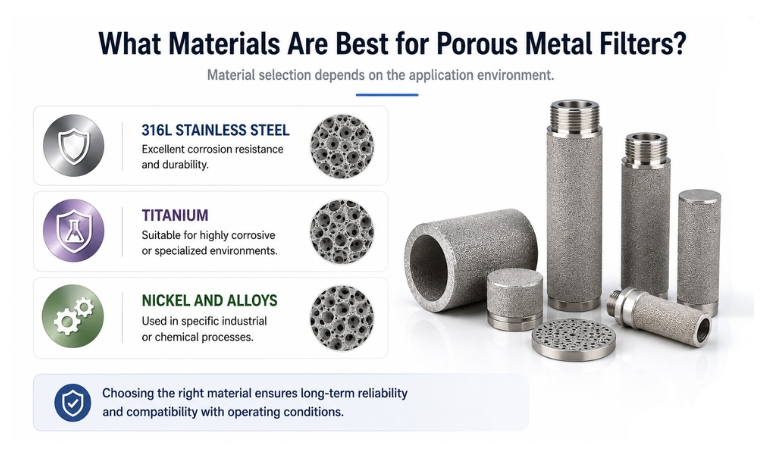
Material selection depends on the application environment. Common options include:
- 316L stainless steel → excellent corrosion resistance and durability
- Titanium → suitable for highly corrosive or specialized environments
- Nickel and alloys → used in specific industrial or chemical processes
Choosing the right material ensures long-term reliability and compatibility with operating conditions.
Choosing the right pore size for porous metal filters is ultimately about making informed engineering decisions
that align with real application needs. When filtration performance, system stability, and long-term cost all matter, a structured approach to pore size selection can make a significant difference.
For many projects, especially those involving high-purity requirements or complex operating conditions, working with a partner who understands both filtration theory and real-world system challenges can greatly reduce trial-and-error and accelerate implementation.
HENGKO support engineers and technical teams with application-driven filtration solutions
—from pore size selection to full customization of porous metal components.
By combining precise pore structure control with flexible design and material options,
we help ensure that each solution is tailored to the specific demands of the system.
Post time: May-05-2026


