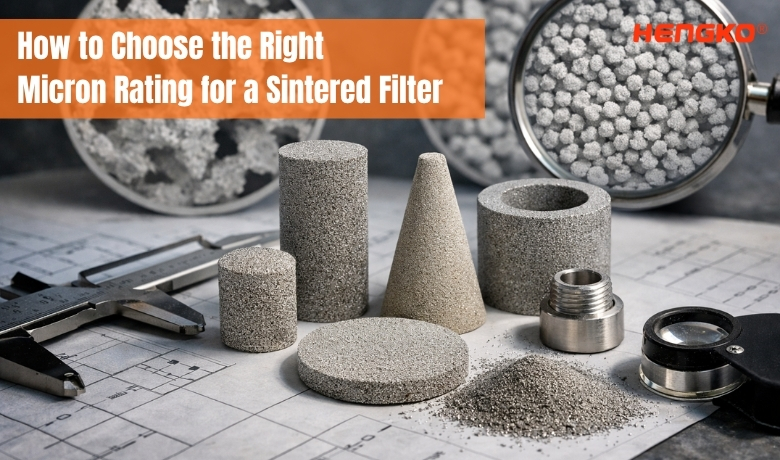
How to Choose the Right Micron Rating for a Sintered Filter
Based on our experience about over 20+ years, Choosing the right micron rating for a sintered filter comes down to three key factors:
1. Target particle size → Select a micron rating smaller than the particles you want to remove
2. Fluid type & viscosity → Thicker fluids require larger micron sizes
3. Flow & pressure limits → Smaller micron = higher pressure drop
Simple rule:
Choose the largest micron rating that still effectively removes your target contaminants.
This gives you the best balance between filtration efficiency, stable flow, and service life.
What Does Micron Rating Actually Mean?
A micron (µm) is one-millionth of a meter. In filtration, it refers to the size of particles a filter can capture.
*Smaller micron → finer filtration
*Larger micron → higher flow, less restriction
In sintered metal filters, the micron rating is related to the pore size of the porous structure,
which is created by sintering metal powders such as 316L stainless steel.
Think of it as a 3D porous metal network, not just a flat screen.
The Most Common 2-Mistakes: “Smaller / Larger Is Always Better”
Many buyers assume:
“The smaller the micron, the better the filtration.”
This is not always true.
1. Choosing too small can cause:
*High pressure drop
*Reduced flow rate
*Faster clogging
*Higher pump load
2. Choosing too large can cause:
*Particles passing through
*Equipment wear
*Product contamination
The goal is not the smallest micron.
The goal is the right micron for your process.
Step 1: Identify Your Target Contaminant Size
Before choosing a filter, ask:
What particles are you trying to remove?
Here is a practical reference:
| Contaminant | Size Range |
|---|---|
| Sand | 100–2000 µm |
| Pollen | 10–30 µm |
| Dust | 1–50 µm |
| Bacteria | 0.2–2 µm |
Practical rule:
Choose a micron rating smaller than the particles you need to capture
Example:
If your main contaminant is around 10 µm, a 5 µm sintered filter is often a practical choice.
Step 2: Consider Fluid Type and Viscosity
Fluid viscosity directly affects filtration performance.
Thin media:
*Air
*Gas
*Water
*Solvents
These can usually pass through smaller micron filters more easily.
Thick media:
*Oil
*Syrup
*Resin
*High-viscosity chemicals
These usually require larger micron sizes to avoid clogging and excessive pressure drop.
A micron size that works well for water may perform poorly in oil.
Step 3: Balance Flow Rate and Filtration Accuracy
Choosing micron size is always a trade-off between:
*Cleaner output
*Stable flow
*Acceptable pressure drop
| Micron Size | Filtration | Flow | Pressure Drop |
|---|---|---|---|
| 1–5 µm | High | Lower | Higher |
| 10–50 µm | Balanced | Moderate | Moderate |
| 50+ µm | Coarse | High | Low |
The smaller the pore size, the harder your system has to work.
Nominal vs Absolute Micron Rating
This is especially important in industrial filtration.
Nominal rating
*Captures a percentage of particles of a given size
*Often used in pre-filtration
*More economical
Absolute rating
*Captures 99.9%+ of particles at the rated size
*Used in critical filtration
*More precise and consistent
For high-purity gas, semiconductor, pharma, or analytical applications, absolute filtration performance is often preferred.
Why Sintered Filters Perform Better Than Surface Screens
Unlike wire mesh or flat screens, sintered filters provide depth filtration.
That means contaminants are captured:
*Not only on the surface
*But also throughout the porous structure
This offers:
*Higher dirt holding capacity
*Better particle retention
*Longer service life
*Better mechanical strength
That is why sintered metal filters are widely used in:
*Gas filtration
*Chemical processing
*High-pressure systems
*Semiconductor applications
Quick Micron Selection Guide for Common Applications
Here is a simple reference:
| Application | Typical Micron Range |
|---|---|
| Compressed air / gas | 0.5–5 µm |
| Water filtration | 1–50 µm |
| Oil filtration | 10–100 µm |
| Pre-filtration | 50–200 µm |
| High purity gas | 0.1–1 µm |
These are reference ranges only. Final selection should always consider:
*Pressure
*Flow rate
*Fluid type
*Contaminant load
If Your Filter Clogs Too Fast, Check These 3 Things
If your sintered filter clogs too quickly, the issue is often not the filter itself — but the sizing.
Check:
1.Is the fluid more viscous than expected?
2.Is the contaminant load too high?
3.Is the micron rating too fine?
Solutions:
*Increase micron size
*Add a pre-filter stage
*Increase filter surface area
Final Checklist Before Choosing a Sintered Filter
Before selecting a micron rating, confirm:
*What fluid are you filtering?
*What particle size must be removed?
*What flow rate do you need?
*What pressure drop is acceptable?
*Is this pre-filtration or critical filtration?
Choosing the correct micron rating will help you achieve:
*Better filtration performance
*Longer service life
*Lower maintenance cost
*Better system protection
Still Need Help Choosing the Right Micron Rating?
If you are not sure which pore size or micron rating is suitable for your application,
our engineering team can help you select the right sintered filter based on your:
1.Fluid type
2.Particle size
3.Pressure
4.Flow rate
4.Industry application
Contact us: ka@hengko.com
Or send us your filtration requirements for recommendation
Send your message to us:
-

Phone
-

E-mail
-

Whatsapp
-

Skype
-

Top