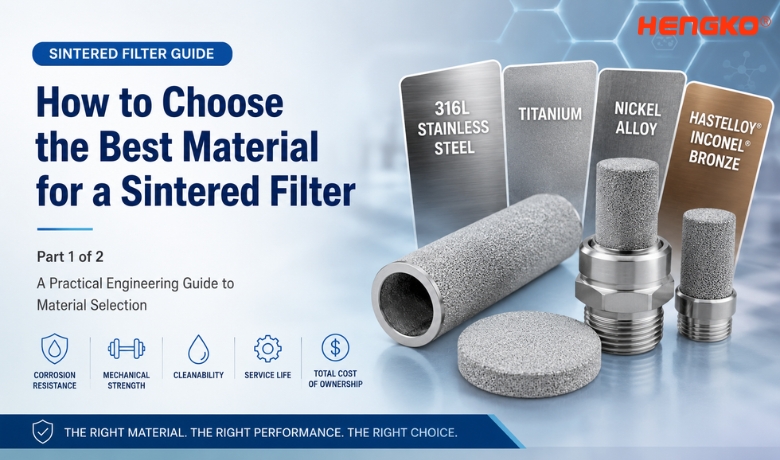
A Practical Guide to Selecting the Right Porous Metal for Industrial Filtration
Industrial filtration systems operate under a wide range of conditions—from ultra-clean semiconductor manufacturing to corrosive chemical processing and high-temperature gas filtration. While pore size, filtration efficiency, and structural design are often discussed during filter selection, one factor has an even greater impact on long-term performance: the material used to manufacture the sintered filter.
Choosing the wrong material can lead to premature corrosion, contamination, mechanical failure, increased maintenance costs, and unexpected downtime. On the other hand, selecting the right material improves filtration efficiency, extends service life, reduces replacement frequency, and lowers the total cost of ownership.
This guide explains the key factors engineers should consider when selecting a sintered filter material and introduces the most common porous metals used in industrial applications. Whether you are designing new equipment or replacing an existing filter element, understanding material properties is the first step toward making the right decision.
Quick Answer: Which Material Is Best?
There is no universal “best” material for every sintered filter application. For most general industrial applications, 316L stainless steel is the preferred starting point because it offers a practical balance of corrosion resistance, mechanical strength, cleanability, service life, and cost.
More demanding operating environments may require specialized materials such as titanium, nickel, Hastelloy, Inconel, or bronze.
The ideal material depends on your operating environment, including:
- Process fluid or gas
- Maximum and continuous working temperature
- Operating pressure and pressure cycling
- Corrosion level and chemical composition
- Cleaning and sterilization method
- Industry regulations and cleanliness requirements
- Required service life
- Initial budget and total lifecycle cost
The following table provides a quick starting point for material selection.
| Application | Recommended Material |
|---|---|
| General industrial filtration | 316L Stainless Steel |
| Food and beverage processing | 316L Stainless Steel |
| Pharmaceutical processing | 316L Stainless Steel |
| High-temperature gas filtration | Inconel |
| Strong acid environments | Hastelloy |
| Seawater filtration | Titanium |
| Hydrogen service | Nickel |
| Vacuum systems | 316L Stainless Steel |
| Semiconductor process gas systems | 316L Stainless Steel or Nickel |
| Compressed air filtration | 316L Stainless Steel |
Although this table provides a useful starting point, the final choice should be based on the exact chemical composition, temperature, pressure, cleanliness level, cleaning process, and expected service life of the filter.
Why Material Selection Matters
A sintered filter is more than a simple mechanical barrier. In many industrial systems, it becomes a critical component that protects equipment, controls particle contamination, stabilizes process performance, or supports reliable gas and liquid flow.
Unlike disposable filter media, sintered metal filters are often expected to operate continuously under demanding industrial conditions for thousands of hours while maintaining stable filtration performance.
The selected material determines many of the filter’s key characteristics, including:
- Corrosion resistance
- Temperature resistance
- Mechanical strength
- Pressure resistance
- Fatigue life
- Chemical compatibility
- Weldability
- Sterilizability
- Regeneration capability
- Long-term dimensional stability
Because porous metal filters are frequently exposed to chemicals, moisture, steam, thermal cycling, vibration, and pressure fluctuations, selecting an inappropriate material can significantly shorten service life and compromise system reliability.
What Happens If the Wrong Material Is Selected?
Many filtration failures are not caused by poor filter design. Instead, they result from selecting a material that is incompatible with the actual process conditions.
Corrosion Failure
A stainless steel filter used in an incompatible concentrated acid environment may corrode rapidly and release metal particles into the process stream.
Potential consequences include:
- Product or process contamination
- Increased pressure drop
- Loss of structural strength
- Filter rupture or leakage
- Unexpected equipment shutdown
Mechanical Failure
Some porous metals perform well under moderate and stable pressure but may not withstand repeated pressure cycling, sudden pressure shocks, or excessive differential pressure.
Cracks can gradually develop within the porous structure or around welded joints, eventually causing leakage, dimensional instability, or complete filter failure.
High-Temperature Deformation
Materials not designed for elevated temperatures may lose strength, oxidize, creep, or experience permanent deformation.
As a result:
- The pore structure may change
- Filtration accuracy may decrease
- Pressure-drop performance may become unstable
- Mechanical integrity may be compromised
Chemical Compatibility Problems
A material with excellent corrosion resistance in one environment may perform poorly in another. Compatibility depends not only on the name of the chemical but also on its concentration, temperature, moisture content, impurities, and exposure duration.
For example, a material compatible with certain alkaline solutions may not tolerate strong oxidizing acids or chloride-rich environments.
Chemical compatibility should therefore be verified using the complete process conditions rather than a general material description alone.
Increased Operating Cost
Choosing a lower-cost material may initially reduce purchasing expenses. However, if the filter requires frequent replacement, repeated cleaning, emergency maintenance, or unplanned system shutdowns, its total lifecycle cost can become significantly higher.
For industrial users, the total cost of ownership is often more important than the initial filter price.
Factors That Determine the Best Sintered Filter Material
Selecting the correct sintered filter material requires balancing several engineering and commercial requirements. The following factors should be evaluated before a material is finalized.
1. Operating Temperature
Temperature directly influences material strength, oxidation resistance, corrosion behavior, and long-term dimensional stability.
Questions to evaluate include:
- What is the normal continuous operating temperature?
- What is the maximum temporary or peak temperature?
- Are there rapid heating and cooling cycles?
- Is steam sterilization required?
- Will the filter operate in an oxidizing or reducing atmosphere?
Higher temperatures generally require materials with greater oxidation resistance and better retention of mechanical strength.
2. Corrosive Environment
Different chemicals attack metals through different corrosion mechanisms. The exact chemical composition and operating temperature should therefore be reviewed together.
Important factors include:
- Acid type and concentration
- Alkali type and concentration
- Chloride content
- Sulfur-containing compounds
- Organic solvents
- Oxidizing agents
- Dissolved gases and moisture
Corrosion is one of the most common reasons industrial sintered filters fail prematurely.
3. Working Pressure
Porous metal elements experience mechanical stress from internal pressure, external pressure, differential pressure, flow pulsation, and pressure cycling.
Engineers should evaluate:
- Normal operating pressure
- Maximum allowable pressure
- Maximum differential pressure
- Frequency of pressure cycling
- Vacuum or reverse-pressure conditions
- Potential pressure shock
A material with greater mechanical strength and fatigue resistance may significantly improve filter reliability in demanding systems.
4. Process Media
The type of gas or liquid being filtered has a direct influence on material selection.
Common process media include:
- Air and compressed air
- Nitrogen
- Hydrogen
- Oxygen
- Steam
- Industrial chemicals
- Organic solvents
- Food ingredients
- Pharmaceutical liquids
- Semiconductor process gases
Each medium may require different levels of corrosion resistance, cleanliness, mechanical strength, and contamination control.
5. Cleanability and Regeneration
Many industrial sintered metal filters are designed to be cleaned and reused rather than discarded after one operating cycle.
Common cleaning methods include:
- Backflushing
- Ultrasonic cleaning
- Chemical cleaning
- Steam sterilization
- High-pressure flushing
- Thermal cleaning
The selected material must tolerate the cleaning agent, temperature, pressure, and number of repeated cleaning cycles.
A reusable filter should retain its mechanical strength, pore stability, and filtration characteristics after regeneration.
6. Industry Standards and Process Requirements
Certain industries impose strict requirements for material traceability, cleanliness, corrosion resistance, sterilization, surface condition, and contamination control.
Food and Beverage Processing
- Hygienic construction
- Easy cleaning and sanitation
- Suitable material documentation
- Low contamination risk
Pharmaceutical Manufacturing
- Reliable cleanability
- Low particle and contamination risk
- Resistance to sterilization processes
- Material traceability where required
Semiconductor Manufacturing
- High-purity materials
- Low particle shedding
- Low contamination potential
- Compatibility with high-purity process gases
Chemical Processing
- Strong corrosion resistance
- Compatibility with the complete chemical mixture
- Resistance to operating temperature and pressure
- Long-term stability under continuous exposure
Selecting a material without considering the applicable process and documentation requirements may result in qualification problems or costly redesigns.
The Most Common Materials Used for Sintered Filters
Although many porous metals and alloys are technically available, a relatively small group of materials is used in most industrial sintered filter applications.
Common options include:
- 316L stainless steel
- Bronze
- Titanium
- Nickel
- Hastelloy
- Inconel
- Monel
- Duplex stainless steel
- Application-specific custom alloys
Each material has its own strengths, limitations, cost level, manufacturing characteristics, and suitable operating environments.
In the next part of this guide, these materials will be compared in greater detail based on corrosion resistance, temperature capability, mechanical strength, cleanability, cost, and typical applications.
Why 316L Stainless Steel Has Become the Industry Standard
Among the available porous metal materials, 316L stainless steel remains one of the most widely used choices for industrial sintered filters.
Its popularity comes from its practical balance of performance, manufacturability, availability, and cost.
Key advantages include:
- Good corrosion resistance in many industrial environments
- Good mechanical strength
- Broad usable temperature range
- Good weldability
- Easy cleaning and regeneration
- Long service life when correctly applied
- Compatibility with many common gases and liquids
- Competitive cost compared with specialty alloys
For these reasons, many OEM equipment manufacturers use 316L stainless steel as the default filter material unless the application requires a more specialized alloy.
However, 316L stainless steel is not the optimal solution for every operating environment. Concentrated acids, high-chloride media, seawater exposure, extreme temperatures, and certain specialty gas applications may require alternative materials.
Understanding the limitations of 316L stainless steel is just as important as understanding its advantages.
Looking Beyond the Initial Purchase Price
One of the most common material-selection mistakes is choosing a filter based only on its initial purchase price.
A lower-cost material may appear attractive, but hidden costs can include:
- More frequent filter replacement
- Increased equipment downtime
- Higher maintenance expenses
- Reduced process reliability
- Product or system contamination
- Shortened equipment service life
- Additional qualification and labor costs
When evaluating a filtration system, engineers should focus on the total cost of ownership (TCO) rather than the filter price alone.
A higher-performance material with a longer service life may provide better long-term value by reducing replacement frequency, cleaning costs, maintenance labor, and unplanned shutdowns.
Key Takeaways
- There is no single sintered filter material suitable for every application.
- Material selection should consider temperature, chemical compatibility, pressure, cleaning method, cleanliness requirements, and lifecycle cost.
- 316L stainless steel is a practical starting point for many general industrial applications.
- Titanium, nickel, Hastelloy, and Inconel may be required for more demanding operating environments.
- In Part 2, the most common sintered filter materials will be compared in detail by corrosion resistance, temperature capability, mechanical strength, cost level, and recommended applications.
Post time: Jul-22-2026


