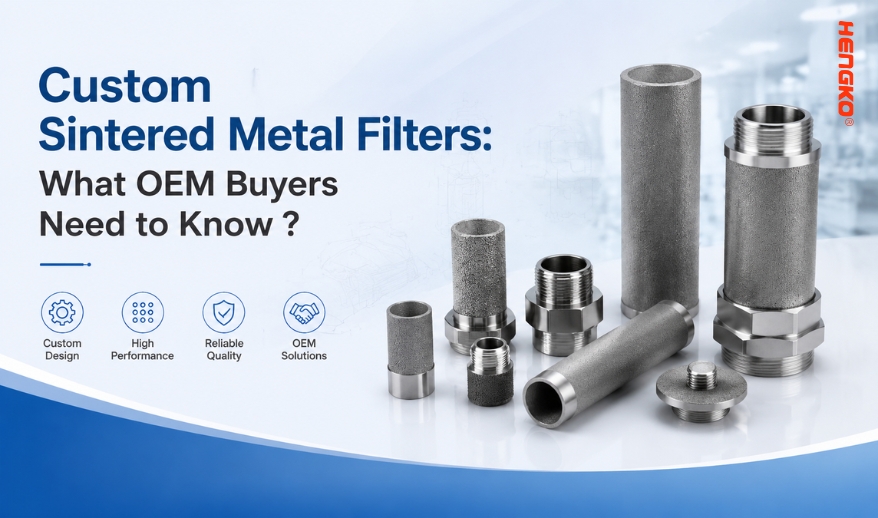
Standard filters are not always suitable for demanding industrial applications. OEM manufacturers may face high temperatures, corrosive media, limited installation space, unusual connection requirements, or specific flow and filtration targets. In these situations, a custom sintered metal filter can provide a more reliable and application-specific solution.
Manufactured from metal powders that are compacted and sintered at high temperature, porous metal filters combine mechanical strength, corrosion resistance, controlled pore structure, cleanability, and long service life. They can be engineered in different materials, pore sizes, geometries, dimensions, and connection types to match a specific OEM system.
This guide explains what OEM buyers should define before requesting a custom filter, how these components are manufactured, where they are commonly used, and how to evaluate a suitable manufacturing partner.
Quick Answer
OEM buyers should consider a custom sintered metal filter when standard products cannot meet the required material compatibility, pore size, pressure drop, flow rate, dimensions, installation space, or connection method. The best design is determined by the complete operating conditions—not by micron rating alone.
What Is a Custom Sintered Metal Filter?
A custom sintered metal filter is a porous component manufactured by compacting and sintering metal powder under controlled conditions. Unlike an off-the-shelf filter, it is designed around the dimensional, mechanical, filtration, flow, and installation requirements of a specific application.
Customization may include material, pore size, porosity, outside diameter, wall thickness, length, shape, surface treatment, support structure, welding method, and connection type. Common materials include 316L stainless steel, bronze, nickel, titanium, Inconel, Hastelloy, and other specialty alloys.
Typical geometries include discs, tubes, cups, cones, candle elements, sensor housings, diffusers, spargers, silencers, and integrated filter assemblies. These components are used for gas and liquid filtration, flow control, gas diffusion, venting, and sensor protection.
When Should OEM Buyers Consider a Custom Filter?
A custom design becomes valuable when a standard filter creates compromises in fit, performance, service life, or system integration.
Common reasons to request customization include:
- Limited installation space or an unusual mounting envelope
- Non-standard threads, flanges, welded fittings, KF, or sanitary connections
- High operating temperature or repeated thermal cycling
- Corrosive gases, liquids, solvents, acids, or chloride-rich media
- Specific pressure-drop, flow-rate, or permeability targets
- A required balance between filtration efficiency and service life
- Integration of the porous element into a valve, sensor, instrument, or OEM assembly
- A need to reduce maintenance, replacement frequency, or total lifecycle cost
A custom solution is especially useful when filtration, flow control, mechanical strength, and installation flexibility must be considered together.
Key Design Parameters OEM Buyers Must Define
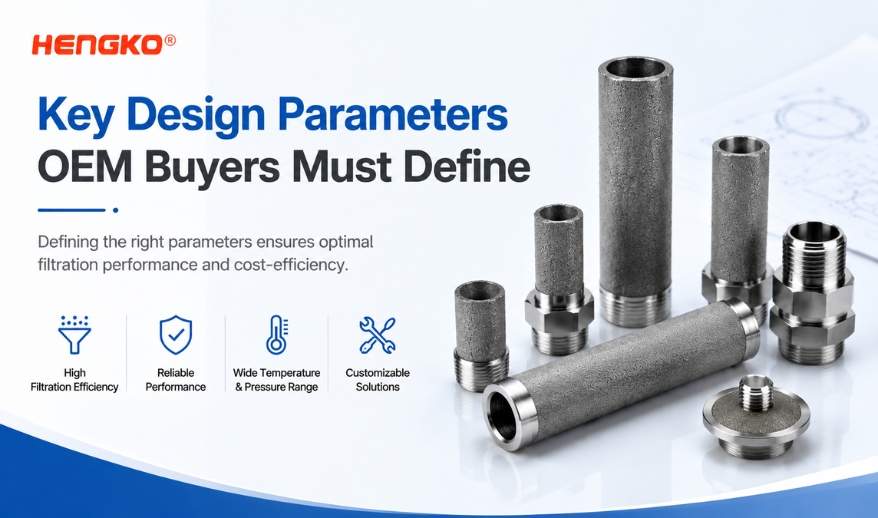
Before requesting a custom sintered metal filter, buyers should define the operating environment and performance targets as clearly as possible. These inputs directly affect filtration efficiency, pressure drop, mechanical strength, manufacturing feasibility, and cost.
| Parameter | What to Define | Why It Matters |
|---|---|---|
| Material | 316L, bronze, nickel, titanium, specialty alloy | Controls corrosion resistance, strength, temperature capability, and cost |
| Pore size | Target particle retention or bubble size | Influences filtration accuracy, permeability, and pressure drop |
| Porosity | Required open-pore volume and permeability | Affects flow capacity, pressure drop, and mechanical strength |
| Temperature | Normal, maximum, and cyclic temperature | Determines material stability, oxidation resistance, and joint design |
| Pressure | Operating pressure, differential pressure, vacuum, pressure shocks | Influences wall thickness, support requirements, and fatigue life |
| Flow rate | Gas or liquid flow under defined conditions | Helps size filtration area and predict pressure drop |
| Geometry | Disc, tube, cup, cone, candle, sparger, assembly | Determines installation fit, filtration area, and flow distribution |
| Connection | Threaded, welded, flanged, KF, Tri-Clamp, or custom | Ensures reliable sealing and compatibility with the OEM system |
1. Filter Material Selection
Material selection determines corrosion resistance, mechanical strength, temperature capability, weldability, cleanliness, and expected service life.
- 316L stainless steel: a practical choice for many gas and liquid filtration applications because of its balance of corrosion resistance, strength, cleanability, and cost.
- Bronze: commonly used for pneumatic silencers, air filtration, and moderate-pressure applications.
- Nickel: suitable for selected high-temperature or chemically demanding environments.
- Titanium: offers excellent corrosion resistance in seawater, pharmaceutical, and chemical-processing applications.
- Inconel and Hastelloy: considered for extreme temperature, high pressure, or highly corrosive media.
2. Pore Size Selection
Pore size affects particle retention, gas diffusion behavior, flow capacity, and pressure drop. Typical porous metal filters may be specified across a broad range, depending on the material and manufacturing process.
- 0.2–1 μm: fine filtration and protection of sensitive components
- 2–10 μm: general gas, liquid, and process-fluid filtration
- 20–50 μm: higher-flow applications with moderate particle retention
- 50–100 μm: coarse filtration, flow distribution, venting, or sparging
Smaller pore sizes generally improve particle retention but may increase pressure drop. The correct specification should be selected together with filtration area, thickness, porosity, and process conditions.
3. Porosity and Flow Performance
Pore size describes the filtering structure, while porosity indicates the proportion of interconnected open space through which the process medium can pass.
Higher porosity may provide:
- Higher flow capacity
- Lower pressure drop
- Improved gas or liquid permeability
A denser structure may provide:
- Greater mechanical strength
- Improved structural stability
- Better resistance to differential pressure
Pore size and porosity should always be evaluated together rather than treated as independent specifications.
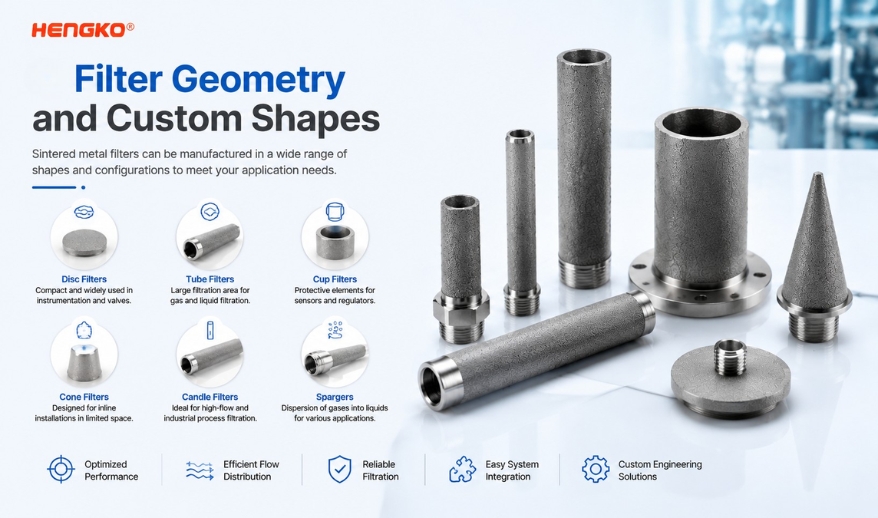
4. Filter Geometry and Custom Shapes
The ideal geometry depends on installation space, required filtration area, flow direction, mechanical loading, and connection method.
- Disc filters: compact components for valves, instruments, and flow-control assemblies
- Tube filters: larger filtration area for gas and liquid service
- Cup filters: protective components for sensors, regulators, and pneumatic systems
- Cone filters: compact inline installations and directional flow applications
- Candle filters: high-flow and industrial process filtration
- Spargers and diffusers: gas dispersion for aeration, fermentation, and chemical processing
Custom assemblies may also include machined threads, flanges, welded fittings, support structures, housings, or OEM-specific interfaces.
How Custom Sintered Metal Filters Are Manufactured
The reliability of a porous metal filter depends not only on the design but also on the control of powder characteristics, forming conditions, sintering parameters, machining, welding, cleaning, and inspection.
- Metal powder selection: choose the material, purity, particle-size distribution, and powder characteristics.
- Forming or mold pressing: create the required geometry and green density.
- High-temperature sintering: bond the particles while preserving an interconnected porous structure.
- Machining and finishing: achieve precise dimensions, threads, sealing surfaces, and special features.
- Welding and assembly: integrate fittings, supports, housings, or connection components.
- Inspection and testing: verify dimensions, permeability, pore characteristics, weld quality, and structural integrity.
Why Metal Powder Selection Matters
Powder material, purity, morphology, and particle-size distribution influence the final pore structure, permeability, mechanical strength, and filtration consistency. A well-controlled powder specification is therefore the foundation of a repeatable porous component.
The final production method should be selected according to the geometry, tolerance, order quantity, target pore characteristics, and downstream machining or welding requirements.
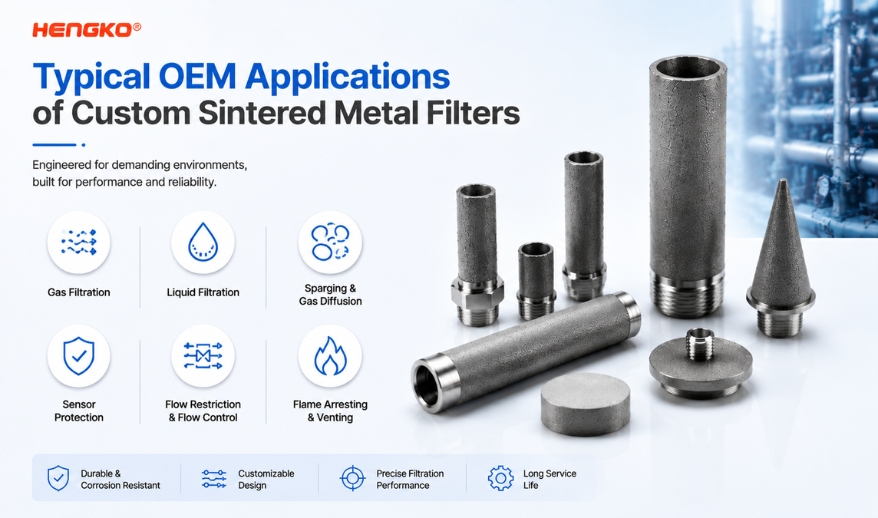
Typical OEM Applications of Custom Sintered Metal Filters
Custom porous metal components are used in equipment that requires a combination of controlled flow, particle retention, mechanical protection, temperature resistance, or chemical compatibility.
1. Gas Filtration
Sintered metal filters remove rust, dust, particles, and selected contaminants from compressed air and process gases while providing a strong, reusable structure.
- Compressed air
- Nitrogen, hydrogen, oxygen, and helium
- Natural gas and process gases
- Instrumentation and analytical gas systems
2. Liquid Filtration
Reusable porous metal elements are used where chemical compatibility, strength, backwashing, and consistent filtration performance are important.
- Chemical process fluids, solvents, and reagents
- Water-treatment and utility systems
- Pharmaceutical and food-processing liquids
- Lubrication and hydraulic circuits
3. Sparging and Gas Diffusion
Sintered spargers distribute gas through interconnected pores to create fine, relatively uniform bubbles and improve gas-to-liquid contact.
- Bioreactors and fermentation systems
- Wastewater aeration and aquaculture
- Chemical reactors and carbonation
- Nitrogen sparging, oxygenation, and degassing
4. Sensor Protection
Porous metal housings allow gas or air exchange while protecting sensing elements from dust, particles, oil mist, splashes, and mechanical contact.
- Temperature and humidity sensors
- Dew point and pressure sensors
- Gas sensors
- Environmental and industrial monitoring instruments
5. Flow Restriction, Venting, and Protection
Precisely engineered porous elements can also support gas or liquid flow restriction, pressure equalization, pneumatic silencing, venting, and protection of valves, pumps, regulators, and analytical instruments.
How to Evaluate a Custom Sintered Metal Filter Supplier
The supplier should be evaluated as both a manufacturer and an engineering partner. A capable supplier can help identify design risks, improve manufacturability, and reduce the probability of costly redesigns.
- Engineering expertise: ability to review pressure, temperature, flow, pore size, and material compatibility
- Material capability: access to suitable stainless steels, bronze, titanium, nickel, and specialty alloys
- Customization capability: forming, machining, welding, assembly, and special connection design
- Prototyping support: small-batch sampling before volume production
- Quality control: dimensional inspection, traceability, and process consistency
- Testing capability: permeability, flow, pressure, pore-related, leakage, or structural tests as applicable
- OEM experience: understanding of drawings, revisions, samples, approval processes, and repeat orders
- Supply capability: reliable delivery, documentation, packaging, and global shipment support
Information to Prepare Before Requesting a Quote
Providing complete application information helps the manufacturer assess feasibility, recommend a suitable structure, and issue a more accurate quotation.
- Application description and function of the filter
- Process gas, liquid, chemical composition, and contamination type
- Preferred material or corrosion-resistance requirements
- Required pore size, particle retention, or bubble-size objective
- Normal and maximum operating temperature
- Operating pressure, differential pressure, vacuum, and pressure cycling
- Required flow rate and acceptable pressure drop
- Dimensions, tolerances, geometry, and available installation space
- Thread, flange, weld, KF, sanitary, or custom connection details
- Prototype quantity, annual volume, drawings, photos, or existing samples
Common Mistakes OEM Buyers Should Avoid
| Common Mistake | Better Approach |
|---|---|
| Focusing only on pore size | Evaluate pore size together with porosity, thickness, filtration area, flow rate, and pressure drop. |
| Ignoring pressure drop | Specify the required flow under actual pressure and temperature conditions. |
| Choosing material by price alone | Compare corrosion resistance, cleaning cycles, replacement frequency, and total lifecycle cost. |
| Underestimating operating conditions | Provide normal, peak, cyclic, cleaning, and upset conditions. |
| Overlooking connection requirements | Define sealing surfaces, threads, weld locations, tolerances, and installation orientation. |
| Providing incomplete application data | Share drawings, photos, media composition, flow, pressure, temperature, and quantity as early as possible. |
Key Takeaways
- Custom sintered metal filters are most valuable when standard products cannot meet the complete application requirements.
- Material, pore size, porosity, geometry, pressure, temperature, flow rate, and connections must be evaluated together.
- Manufacturing control and testing are as important as the initial design.
- A qualified supplier should support engineering review, prototyping, quality control, and repeat production.
- Complete application information reduces development time and helps avoid redesigns.
Conclusion
Custom sintered metal filters give OEM manufacturers a flexible solution for filtration, gas diffusion, flow control, venting, and sensor protection. A well-engineered component can improve system integration, filtration stability, service life, and maintenance efficiency.
The best results come from defining the complete application conditions early and working with a manufacturer that can evaluate material compatibility, pore structure, geometry, flow performance, connections, and manufacturing feasibility as one system.
Need a Custom Sintered Metal Filter for Your OEM Project?
Send HENGKO your process medium, pore size, flow rate, operating temperature, pressure, dimensions, connection type, and estimated quantity.
Our engineering team can help review the application and recommend a suitable porous metal material, structure, and manufacturing approach.
Post time: Jun-13-2026


